Some verses don’t just sit on the page.
They find you in hospital rooms.
In depression.
In ministry burnout.
In the quiet places where you whisper, “Lord, I can’t do this anymore.”
2 Corinthians 12:9-10 is one of those verses.
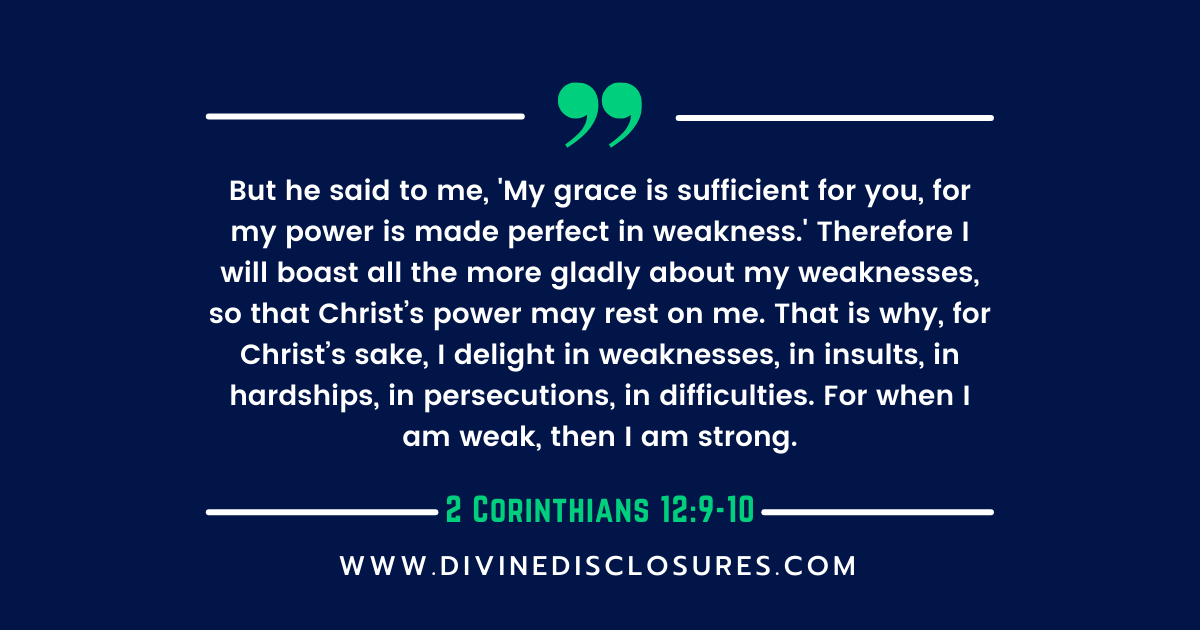
“But he said to me, ‘My grace is sufficient for you, for my power is made perfect in weakness.’
Therefore I will boast all the more gladly of my weaknesses, so that the power of Christ may rest upon me.
For the sake of Christ, then, I am content with weaknesses, insults, hardships, persecutions, and calamities.
For when I am weak, then I am strong.” (ESV)
If you’re searching “2 Corinthians 12:9-10 meaning” or “my grace is sufficient for you meaning,” you’re probably not just curious.
You’re tired.
You’ve got something that feels like a thorn that won’t go away.
So let’s walk this slowly:
- What’s actually going on with Paul here?
- What does it mean that God’s power is made perfect in weakness?
- And how on earth can you boast in weakness when you just want relief?
Table of Contents
2 Corinthians 12:9–10 in Several Translations
2 Corinthians 12:9
NIV
“But he said to me, ‘My grace is sufficient for you, for my power is made perfect in weakness.’ Therefore I will boast all the more gladly about my weaknesses, so that Christ’s power may rest on me.”
ESV
“But he said to me, ‘My grace is sufficient for you, for my power is made perfect in weakness.’ Therefore I will boast all the more gladly of my weaknesses, so that the power of Christ may rest upon me.”
KJV
“And he said unto me, My grace is sufficient for thee: for my strength is made perfect in weakness.
Most gladly therefore will I rather glory in my infirmities, that the power of Christ may rest upon me.”
NLT
“Each time he said, ‘My grace is all you need. My power works best in weakness.’
So now I am glad to boast about my weaknesses, so that the power of Christ can work through me.”
2 Corinthians 12:10
NIV
“That is why, for Christ’s sake, I delight in weaknesses, in insults, in hardships, in persecutions, in difficulties.
For when I am weak, then I am strong.”
ESV
“For the sake of Christ, then, I am content with weaknesses, insults, hardships, persecutions, and calamities.
For when I am weak, then I am strong.”
KJV
“Therefore I take pleasure in infirmities, in reproaches, in necessities, in persecutions, in distresses for Christ’s sake:
for when I am weak, then am I strong.”
NLT
“That’s why I take pleasure in my weaknesses, and in the insults, hardships, persecutions, and troubles that I suffer for Christ.
For when I am weak, then I am strong.”
Different wording.
Same shock: weakness is not where Christ abandons you; it’s where His power lands.
What Is the Main Meaning of 2 Corinthians 12:9–10? (Short Answer)
In 2 Corinthians 12:9–10, Paul describes how he begged God three times to remove a mysterious “thorn in the flesh.” God said no to removing the thorn, but yes to giving sustaining grace. The Lord’s answer is:
“My grace is sufficient for you, for my power is made perfect in weakness.”
The core meaning is:
- God often does not take away every weakness, limitation, or ongoing struggle.
- Instead, He pours out sufficient grace and manifest power in the very place where we feel most fragile.
- Because of this, Paul can “boast” in weakness—not because weakness is fun, but because it becomes the stage upon which Christ’s strength is showcased.
So when Paul says, “When I am weak, then I am strong,” he means:
“When I am most aware I have nothing in myself, I am most open to Christ’s strength working in me.”
Love the Word? Unlock Its Meaning
Join Daniel Niranjan’s inner circle who receive in-depth verse meaning insights, biblical word studies, and Spirit-filled explanations that help you understand and live God’s Word with clarity, confidence, and passion.
Join 12,000+ Believers Growing in Prayer and Power
2 Corinthians 12:9–10 in Context
The Literary Context – Visions, Thorn, and a Shocking Answer
2 Corinthians 12 doesn’t drop out of nowhere. Paul has been defending his ministry against so-called “super-apostles” who boasted in their spiritual experiences, eloquence, and strength (2 Corinthians 11:5; 12:1).
He reluctantly talks about:
- Being “caught up to the third heaven” and hearing inexpressible things (12:1–4).
- Then he flips things: instead of using visions to boost his spiritual résumé, he talks about a thorn in the flesh given to keep him from becoming conceited (12:7).
He pleads with the Lord three times to take it away (12:8). The answer is not deliverance, but a declaration:
“My grace is sufficient for you, for my power is made perfect in weakness.” (12:9)
So verses 9–10 are Paul’s response to that word from the Lord. They’re not theory. They are the theology that grows when prayer meets God’s wise “no.”
Historical and Cultural Context – Honor, Rhetoric, and the “Super-Apostles”
To really feel the weight of “My grace is sufficient for you… for my power is made perfect in weakness”, you have to feel Corinth.
Corinth was obsessed with status, strength, and show. It was a commercial hub, a prestige city, packed with people who loved:
- Powerful public speakers
- Impressive presence
- Visible success and patronage connections
In that world, you didn’t lead by looking weak. You led by looking impressive.
Into this culture came traveling teachers and philosophers—polished communicators who knew how to capture a room and then secure wealthy patrons. They boasted in:
- Eloquence
- Spiritual experiences
- Letters of recommendation
- Outward marks of authority
Paul calls some of these voices “super-apostles” (2 Corinthians 11:5; 12:11). They seem strong. Slick. Persuasive. They fit Corinth’s cultural dream of what a spiritual leader should look like.
Paul, in contrast, looks like the opposite of a winner:
- He’s often sick, beaten, shipwrecked, and poor.
- His speech is “unimpressive.”
- His life is marked by weakness, hardship, and humiliation (2 Corinthians 11:23–30).
The Corinthians are torn:
Can someone this weak really be an apostle of the risen Christ?
That’s the cultural pressure behind 2 Corinthians 10–13. Paul is defending not just his ministry, but the very shape of Christlike authority.
So when Jesus says to Paul,
“My grace is sufficient for you, for my power is made perfect in weakness” (2 Corinthians 12:9),
He is not giving a generic inspirational slogan. He is directly confronting Corinth’s value system.
And when Paul responds,
“Therefore I will boast all the more gladly of my weaknesses… For when I am weak, then I am strong” (2 Corinthians 12:9–10),
he is doing something culturally shocking:
- In a city where you boast in strength, Paul boasts in weakness.
- In a culture where suffering discredits you, Paul says his sufferings authenticate him—because they put Christ’s power, not Paul’s polish, at the center.
- In a world where leaders hide their scars, Paul lays his open and says, “Here is where Jesus rests His power.”
Culturally, these verses are not gentle sentiment.
They are a revolution: God’s true power does not ride on human impressiveness. It rides on cruciform weakness—on leaders and believers who say:
“I will not build my identity around looking strong.
I will build it around a Savior who was crucified in weakness and raised in power.”
That’s the backdrop that makes “My grace is sufficient for you” burn. It’s not just personal comfort for Paul; it’s God rewriting what “strength” means for an entire church, and for every culture that still worships image, success, and performance.
What Was Paul’s Thorn in the Flesh?
Everyone wants to know: What exactly was the thorn?
Scholars have suggested:
- A physical ailment (weak eyesight, recurring illness, chronic pain).
- Spiritual harassment (a demonized opponent, intense persecution).
- Psychological distress or inner anguish.
Paul calls it:
- “A thorn in the flesh”
- “A messenger of Satan to harass me”
- Given “to keep me from becoming conceited.” (12:7)
The Spirit does not specify exactly what it was, and that’s probably deliberate. The ambiguity allows the principle to be widely applied:
- Any ongoing, God-allowed limitation
- Any persistent weakness that doesn’t go away, even after earnest prayer
- Any place where you feel “thorned” and God says, “My grace is sufficient.”
Phrase-by-Phrase Meaning of 2 Corinthians 12:9–10
“My Grace Is Sufficient for You”
“But he said to me, ‘My grace is sufficient for you…’”
This is Jesus speaking in the present tense: “He keeps saying to me.” Grace here is not just forgiveness; it is ongoing help, sustaining favor, divine enabling.
- “Sufficient” means: enough, adequate, not lacking what is needed.
- Not “barely enough to survive,” but enough to carry you through the pressure with God’s presence and help.
It’s as if the Lord says:
“Paul, I will not remove this thorn.
But I will give you Myself.
And I am enough.”
“For My Power Is Made Perfect in Weakness”
“…for my power is made perfect in weakness.”
“Made perfect” doesn’t mean God’s power was flawed before. It means:
- Brought to full expression
- Fully displayed
- Shown for what it really is
Weakness, then, isn’t a glitch in the system of God’s power. It’s the theater where His power is clearly seen.
When you are strong, gifted, resourced, and in control, people might assume you are the source.
When you are visibly weak and yet sustained, fruitful, steady—that’s when everyone knows it must be God.
“Therefore I Will Boast All the More Gladly of My Weaknesses…”
“Therefore I will boast all the more gladly of my weaknesses…”
That “therefore” is wild.
Because God’s power shows up in weakness, Paul’s attitude flips:
- He does not hide his weakness.
- He does not resent his weakness as something that disqualifies him.
- He boasts in it—not as self-pity, but as a way of pointing to Christ.
In Corinth, boasting was a big deal. People boasted in status, spiritual experiences, rhetorical skill. Paul says:
“Fine. I’ll boast—
but I’ll boast in my scars, not my sparkle,
so that you see Christ, not me.”
“…So That the Power of Christ May Rest Upon Me”
“…so that the power of Christ may rest upon me.”
The phrase “rest upon” echoes the language of tabernacling—God’s glory dwelling among His people. Think of:
- God’s presence filling the tabernacle in the wilderness.
- The Spirit “resting” upon Jesus.
Paul is saying:
“When I stop posturing and embrace my weakness before God,
Christ’s power pitches its tent over my life in a special way.”
Weakness becomes a place of manifest presence, not divine absence.
“For the Sake of Christ, Then, I Am Content with Weaknesses…”
“For the sake of Christ, then, I am content with weaknesses, insults, hardships, persecutions, and calamities.”
Content doesn’t mean he enjoys pain.
It means he accepts it when it cannot be righteously avoided, because it is tied to following Jesus.
He lists:
- Weaknesses – general frailty, limitation.
- Insults – attacks on his reputation.
- Hardships – pressures, distresses.
- Persecutions – opposition for Christ’s sake.
- Calamities – crises, tight corners, “no way out” moments.
He is not chasing suffering.
He is not glorifying pain.
He is saying:
“If these come to me because I belong to Christ and serve Him,
then I will receive them as the place His power rests.”
“For When I Am Weak, Then I Am Strong”
“For when I am weak, then I am strong.”
This is the paradox at the heart of the Christian life.
“When I am weak” =
- When I know I can’t fix myself.
- When my limitations are obvious.
- When I am beyond my own capacity.
“Then I am strong” =
- Because Christ’s strength is now my only boast.
- Because grace is carrying me, not my ego.
- Because the Spirit sustains what my flesh cannot.
Many commentators see this as the summary of Paul’s entire theology of the cross: God saves and works not through human impressiveness, but through the way of the crucified and risen Christ.
Key Word Insights (Without Getting Too Technical)
A few quick notes you can easily unpack in teaching:
- Grace (charis) – not just unmerited favor, but active, empowering presence.
- Sufficient (arkeo) – to be enough, to be content with; God’s grace is not lacking for this exact load.
- Power (dynamis) – God’s active might, the same power that raised Christ.
- Weaknesses (astheneiai) – frailty, limitation, suffering; not celebrating sin, but acknowledging creaturely and situational limitation.
- Rest upon (episkenoo) – literally “to pitch a tent over”; a beautiful echo of God’s dwelling presence.
Every one of these whispers:
You don’t have to be enough.
His grace is.
His power is.
He is.
Theological Themes in 2 Corinthians 12:9–10
1. The Upside-Down Power of the Cross
God’s power does not follow the world’s logic.
- The cross looked like defeat, yet it was victory.
- Paul’s life looks weak, yet carries resurrection fruit.
- Your “thorn” may look like disqualification, yet become your deepest place of anointing.
2 Corinthians as a whole insists that the shape of Christian life and ministry is cruciform—marked by weakness, suffering, and resurrection power.
2. Grace as Sustaining, Not Just Saving
We love to say we’re “saved by grace.”
2 Corinthians 12 reminds us we are also sustained by grace.
God’s word to Paul is not:
- “Pull yourself together.”
- “Have more willpower.”
- “Pretend you’re strong.”
It’s:
“My grace is sufficient…
My power is made perfect in your weakness.”
Grace is the oxygen of Christian endurance.
3. Boasting in the Lord, Not Ourselves
Paul’s boasting language is deliberate.
In a church obsessed with shining leaders, Paul says:
- I’ll boast in my weakness.
- I’ll showcase my scars, not my strengths.
- I want you to see Christ’s power, not Paul’s brilliance.
This is a call to a radically different ministry culture:
- Not celebrity.
- Not image management.
- But transparent weakness + visible grace.
4. The Mystery of Unremoved Thorns
Perhaps the hardest part: God says no to Paul’s repeated request.
This tells us:
- Not every godly prayer for healing, relief, or change is answered with removal.
- Sometimes the answer is deeper grace, not different circumstances.
- That “no” is not rejection. It is wise, loving, purposeful.
Paul never says the thorn is good.
He says God is good in the middle of the thorn.
How to Apply 2 Corinthians 12:9–10 in Your Weakness
Let’s bring this into your actual life—not just commentary pages.
1. Name Your Thorn Honestly
Don’t spiritualize it away.
- Is it chronic illness?
- Persistent anxiety or depression?
- A painful limitation?
- A family situation that never seems to resolve?
- Ministry pressure that feels beyond you?
Write it down. Call it what it is. Paul didn’t pretend his thorn wasn’t sharp.
2. Pray Boldly – and Then Listen for God’s Answer
Paul “pleaded with the Lord three times” for the thorn to be removed (12:8). That’s intense language.
It’s right to:
- Ask for healing.
- Ask for breakthrough.
- Ask for change.
Then be open to the Lord’s reply.
Sometimes:
- He removes the thorn.
- Sometimes He relieves the thorn partially.
- Sometimes He says, “My grace is sufficient for you right here.”
None of those answers means He loves you less. They simply mean He knows:
Which kind of grace will most deeply conform you to Christ and bear fruit through you.
3. Shift from Image Management to Weakness-Boasting
Most of us spend enormous energy trying to appear “together.”
Paul invites a different way:
- Appropriate vulnerability.
- Telling the truth about limitation.
- Sharing testimonies of how Christ sustains you in what hasn’t changed.
“Boasting in weakness” doesn’t mean broadcasting every detail or centering yourself. It means:
“I won’t hide the places I can’t fix,
so that you can see the places Christ carries me.”
4. Look for Christ’s Power in the Middle, Not Just at the End
We often say, “One day I’ll share a testimony when this is over.”
2 Corinthians 12 says: Start now.
- Where has God given you strength to get through days you thought you couldn’t?
- Where have you experienced peace that didn’t match circumstances?
- Where has the Spirit used your weakness to comfort others?
Those are “power resting upon you” moments. Pay attention to them.
Common Misunderstandings of 2 Corinthians 12:9–10
“If His Grace Is Sufficient, I Shouldn’t Feel Pain or Struggle.”
Not true.
These words are spoken right into Paul’s ongoing struggle. He still has a thorn. He still feels its sting. Sufficient grace doesn’t erase human feelings; it meets us in them and holds us when we would otherwise collapse.
Using the Verse to Shame People in Deep Suffering
Sometimes people weaponize this text:
- “Just remember, His grace is sufficient!”
- “You shouldn’t be struggling like this if you really believed that.”
That’s not how Paul uses it, and it’s not how we should either.
This verse is meant to comfort the suffering, not scold them. It invites patient presence, not quick fixes.
Glorifying Suffering for Its Own Sake
Paul does not have a martyr complex.
- He doesn’t chase pain.
- He doesn’t refuse relief when God gives it.
- He simply refuses to deny Christ when pain shows up.
He is content with weakness, “for the sake of Christ”—when weakness is the price of faithful discipleship.
Equating Weakness with Sin
We must distinguish:
- Sin – rebellion against God; must be confessed and forsaken.
- Weakness – creaturely limitation, suffering, finiteness; can be the very place grace shines.
2 Corinthians 12 is about weakness, not an excuse to tolerate sin.
A Prayer Based on 2 Corinthians 2:9-10 to Experience God’s Power in Your Weakness
Lord Jesus,
You see the places where I feel utterly weak and worn down. You see the thorn I carry—the thing I’ve asked You to remove, the burden that has not lifted yet. You know the tears, the questions, the days when I have quietly wondered if Your grace is really enough for this.
Today I hear Your words again: “My grace is sufficient for you, for my power is made perfect in weakness.” I confess that I have often wanted power without weakness, strength without dependence, testimony without tears. Forgive me for resenting my limitations and for trying to hide them from You and from others.
I bring my thorn before You. [Name it honestly.] I ask, once again, for Your healing, Your intervention, Your deliverance—because I know You are able. But if Your wise and loving answer is to sustain me rather than remove this, then I choose to trust that Your grace will truly be enough.
Let the power of Christ rest upon me in this exact place of weakness. Pitch the tent of Your presence over my fragile heart. Teach me to boast not in what I can do, but in what You can do through someone as limited as I am. Turn my weakness into a window where Your strength is seen.
When I am weak, be my strength. When I feel empty, be my fullness. When I can’t carry myself, carry me. And let my life quietly declare to those around me: “Christ’s grace really is sufficient. His power really is made perfect in weakness.”
In Your precious name, Jesus,
Amen.
Reflection Questions for 2 Corinthians 12:9–10
Use these for journaling, small groups, or spiritual direction:
- If you had to name your “thorn in the flesh” in this season, what would it be? How has it affected your view of yourself, of God, and of ministry?
- When you read “My grace is sufficient for you,” what emotions rise up—comfort, doubt, anger, hope? Why do you think that is?
- Where have you seen God’s grace sustain you in ways you didn’t expect, even though the situation didn’t change?
- In what areas of your life are you tempted to project strength instead of admitting weakness? What might “boasting in weakness” look like there in a healthy, Christ-honoring way?
- How might your testimony become richer if you began to share not only your victories, but the places where Christ meets you in ongoing struggle?
Related Bible Verses About God’s Power in Our Weakness
These passages echo and deepen the 2 Corinthians 12:9–10 meaning:
- Philippians 4:13 – “I can do all things through him who strengthens me.” – Strength to endure every season through Christ.
- Isaiah 40:29–31 – God gives power to the faint; those who wait on the Lord renew their strength like eagles.
- 1 Corinthians 1:27–29 – God chooses the weak things of the world to shame the strong, so that no one may boast before Him.
- Hebrews 4:15–16 – We have a High Priest who sympathizes with our weaknesses; we can approach the throne of grace for help in time of need.
- Romans 8:26 – The Spirit helps us in our weakness and intercedes for us when we don’t know how to pray.
Each of these is a natural bridge to:
- Prayers for strength
- Prayers in suffering
- Further verse-meaning articles on weakness and grace
2 Corinthians 12:9–10 Meaning – FAQs
What exactly was Paul’s “thorn in the flesh”?
Scripture doesn’t say. Suggestions include physical illness, spiritual harassment, or persecution. The Spirit leaves it intentionally vague so the principle applies broadly: any ongoing, God-allowed weakness or affliction that He chooses to meet with sustaining grace rather than immediate removal.
Does “My grace is sufficient for you” mean God will never remove my suffering?
No. Sometimes God does heal, deliver, and dramatically change circumstances. The New Testament is full of miracles. But 2 Corinthians 12 shows that sometimes God’s loving answer is to sustain us in the suffering with deeper grace and power, rather than to remove it. Both are expressions of His grace; they just take different forms.
How can I tell if my weakness is something to accept or something to fight?
A helpful distinction:
- If it’s sin, you never “accept” it; you repent and seek transformation.
- If it’s creaturely limitation or suffering—illness, persecution, constraints—you rightly pray for relief, seek help, use wisdom. When, after earnest prayer and wise effort, the situation doesn’t change, you can begin to receive it as a place where God is inviting you to deeper dependence and testimony. Spiritual counsel, community, and Scripture can help you discern which is which.
What does it practically look like to “boast in weakness”?
It looks like:
- Refusing to pretend you’re self-sufficient.
- Sharing honestly about your limitations and struggles when it serves others.
- Framing your story so that Christ’s strength, not your resilience, is the hero.
- Giving glory to God for sustaining you where you know you couldn’t sustain yourself.
Isn’t focusing on weakness depressing?
If you stop at weakness, yes.
But Paul doesn’t stop there.
He names weakness so that he can point to Christ’s power resting on him. The focus is actually Jesus, not pain. Weakness is simply the dark backdrop against which the diamond of Christ’s grace and power shines more brightly.
Keep Walking in the Strength of Weakness
2 Corinthians 12:9–10 is not a call to love pain.
It is a call to meet Christ in your pain.
“My grace is sufficient for you,
for my power is made perfect in weakness.”
- You do not have to clean yourself up to be usable.
- You do not have to be “strong” to be fruitful.
- You do not need to hide your thorns from the One who carries scars.
Let your weaknesses become altars where the power of Christ rests.
Let your limitations become the doorway where His sufficiency walks in.
And as you teach, preach, and write for others on Divine Disclosures, you’ll be able to say not just, “Here is what the verse means,” but:
“Here is where I’ve lived it.
Here is where His grace really was sufficient.
And here is how His power shone through my weakness.”
Has this Article been a a Blessing?
Your Next Step to Spiritual Growth
Consider Partnering with Divine Disclosures
Access Resources & Personal Guidance
Access 150+ Prayers exclusive Prayer Handbooks and support the ministry
Submit A Prayer Request
Access the primary portal or use one of the specific submission links below for immediate, targeted prayer
Spiritual Growth & Content Articles
Deepen your knowledge of the Word with study, scriptures, and more prayers
Share This Article
Help others discover God’s word. Share your thoughts below and spread the message!
Show more on Divine Disclosures →