
In years of counseling people affected by war — sitting with men and women whose anger had been declared spiritually inadmissible for so long that it had gone underground — I learned something about anger that most Christian resources do not say plainly enough.
Forbidding anger does not make it go away. It makes it invisible. And invisible anger does more damage than anger that has been named, brought before God, and dealt with in the open. The people I sat with in the aftermath of Sri Lanka’s civil war had been carrying grief and rage for years — sometimes decades — that the church had told them, explicitly or implicitly, was not acceptable. They had learned to present as peaceful while the thing they were actually carrying ate at them from the inside, emerging eventually as bitterness, depression, or sudden explosions that seemed to come from nowhere.
The reality is that the Bible does not tell people their anger is always sinful. It tells them two things simultaneously — and the church tends to preach only one.
Look: the same letter that says “be angry and do not sin” also says “put away all bitterness and wrath and anger.” That is not a contradiction. It is a distinction — between anger that is appropriate, proportionate, and brought to God, and anger that has become a permanent internal resident that is damaging the person who is carrying it and everyone around them. Most anger content in the church collapses this distinction and produces one of two failures: the suppression that calls all anger sinful, or the licence that spiritualises any anger the person is feeling as righteous. Both failures cause real damage. Neither is what Scripture teaches.
I curated these Bible verses about anger because the distinction between righteous anger and sinful anger is not a minor theological footnote — it is the framework that determines how every other verse on this topic should be read. Without it, the same passage can be used to justify what needs to be put away or to condemn what is entirely appropriate. These verses are arranged by what kind of anger they address, what they say about it, and what they require of the person carrying it. Some will be for the person who needs permission to feel what they feel. Others are for the person who needs to release what they have been nursing for too long.
Table of Contents
10 Key Bible Verses About Anger
These are the strongest verses across the full arc — a first reference for anyone who needs a quick orientation before going deeper. The full commentary on each appears in the sections below.
- Ephesians 4:26–27 — Permission and constraint in one sentence: be angry, do not sin in it, and do not let it become an overnight resident. The New Testament’s clearest single statement on what anger is and what it requires.
- Psalm 4:4 — The contemplative response to anger — not expression, not suppression, but taking anger into God’s presence in the quiet and examining it there before it goes anywhere else.
- Nehemiah 5:6–7 — The model of anger that identifies a genuine injustice, takes counsel with God internally, and then takes structured public action. Anger that produced justice, not damage.
- Mark 3:5 — Jesus angry and grieved simultaneously. The anger directed at hardness of heart, accompanied by sorrow rather than contempt, and immediately followed by an act of compassion. The New Testament’s clearest picture of what righteous anger actually looks like.
- James 1:19–20 — The diagnostic verse for reactive anger: quick to hear, slow to speak, slow to anger — because the anger of man does not produce what God’s righteousness looks like.
- Proverbs 14:29 — Slowness to anger framed as the mark of great understanding, not weakness. The person who is slow to anger has enough understanding to know the situation is more complex than the first reaction.
- Romans 12:19 — The release of vengeance into God’s hands. Not because the wrong was nothing, but because God’s justice is more complete and more reliable than anything human retaliation produces.
- Psalm 37:8 — The honest assessment of sustained anger: refrain and forsake, because brooding anger tends only to evil. Two active verbs — deliberate choice, not passive feeling.
- Ephesians 4:31–32 — The comprehensive putting-away passage. What must go, named in full. What must replace it, grounded not in the person’s own generosity but in the forgiveness already received.
- Psalm 13:1–2 — Four how longs directed at God by a man who is asking questions he does not know the answers to. The model of anger brought to God in prayer, unguarded and unresolved — and received.
Divine Disclosures Prayer Handbooks:
Targeted Prayers for Real Battles
You don’t need more information—you need a prayer handbook.
These prayer handbooks give you Scripture-rooted, specific prayers for the pressure you’re actually facing—so you stop circling and start breaking through.
What the Bible Actually Says About Anger
Four things Scripture establishes that most anger content either skips or collapses.
God himself is described as angry throughout Scripture. The Hebrew word ‘aph — literally nostrils, the flaring expression of intense feeling — appears hundreds of times to describe God’s anger at sin, at injustice, at the exploitation of the vulnerable, at idolatry. Divine anger is not an embarrassing Old Testament artefact. It is the appropriate response of a holy God to what breaks his creation and damages his people. Human anger at genuine injustice, in Scripture’s framework, is a reflection of the image of God responding to what God himself responds to. Anger is not inherently un-Christlike. There are things worth being angry about.
The New Testament uses at least two distinct Greek words for anger that most English translations both render as “anger.” Orgē describes settled, principled indignation — the kind of anger that can be held without immediately becoming sin. Thumos describes explosive, passionate outburst — the kind that flares, damages, and destroys. Ephesians 4:26 says “be angry” using orgizesthe, a form of orgē — and does not call it sin. Ephesians 4:31 says put away thumon — and lists it with bitterness, wrath, malice. The New Testament simultaneously permits one and prohibits the other. Collapsing them both into “anger” and applying the prohibition to both is how the church produces the suppression failure. Applying the permission to both is how it produces the licence failure.
Scholar’s Corner — Orgē and Thumos: Two Greek Words That Change Everything
Orgē (ὀργή) comes from a root meaning to swell, to teem — like a river rising. It describes anger that has built from a settled conviction, that is proportionate to its object, that can be held over time without immediately becoming destructive. It is the word used in Ephesians 4:26 (be angry), in Mark 3:5 for Jesus’ anger in the synagogue, and throughout the New Testament for God’s righteous anger. Thumos (θυμός) comes from a root meaning to rush, to breathe violently — the short, explosive outburst. It appears in Galatians 5:20 as a work of the flesh, in Ephesians 4:31 as something to put away. The Stoic philosophers used both words and observed the same distinction: thumos was the passion that overwhelmed reason; orgē could coexist with reason. Paul’s use is more precise still — he permits orgē with conditions and prohibits thumos outright. Most English translations render both as anger or wrath interchangeably, losing the distinction entirely. Takeaway: when Scripture says be angry, it is addressing orgē — the anger that can be held. When it says put it away, it is often addressing thumos — the anger that damages. They are not the same thing.
Righteous anger has specific characteristics that distinguish it from sinful anger. It is directed at sin and injustice rather than at personal offence. It produces action toward the correction of the wrong rather than retaliation against the person who caused it. It does not nurse and does not linger. It is accompanied by grief — sorrow at what the wrong has cost — rather than contempt for the person who did it. These are not abstract criteria. They are the consistent pattern across every instance of righteous anger in Scripture, including God’s anger and Jesus’ anger.
The suppression of legitimate anger is itself a problem. Psalm 4:4, the lament psalms, Habakkuk’s direct confrontation of God, Job’s sustained outcry — Scripture gives consistent permission and consistent language for anger that is brought to God rather than buried. The person who has been told their anger is always spiritually inadmissible has been told something that Scripture does not say. Anger buried does not disappear. It transforms — most commonly into bitterness, which is what anger becomes when it has nowhere to go.
Righteous Anger vs Sinful Anger — The Distinction That Changes Everything
Before the main verse sections, this framework determines which verses are for which reader. Getting it wrong means applying the wrong passage to the wrong situation — which is how Scripture gets used as pressure rather than provision.
Righteous anger — anger at what God is angry at. Directed at sin, injustice, the exploitation of the vulnerable, the desecration of what is holy. It looks outward at the wrong rather than inward at how the wrong affected me personally. It wants to correct what is broken rather than punish who caused the hurt. It does not linger or build. Jesus’ anger at the money changers in the temple is the primary example. Nehemiah’s anger at the wealthy Jews exploiting the poor is another. God’s anger throughout the prophets is the theological model.
Sinful anger — anger rooted in wounded pride, unmet expectations, personal offence, or the desire to make someone pay. Primarily about what happened to me rather than what was objectively wrong. It nurses and builds over time. It expresses itself toward people rather than toward the wrong. It does not produce justice — it produces damage to relationships, to the person carrying it, and to everyone in range of it. Ephesians 4:31, Colossians 3:8, and James 1:20 address this kind directly.
The diagnostic questions to bring to your own anger:
- Is my anger directed at a genuine wrong, or at a personal offence that wounded my pride?
- Does my anger want to correct the wrong, or punish the person?
- Is my anger accompanied by grief for what was lost, or contempt for who caused it?
- Has this anger been present for weeks, months, years?
The last question is the most revealing. Sustained anger — regardless of how legitimate its origin — has almost always shifted from righteous anger into something Scripture calls bitterness. The trigger may have been righteous. What it has become is another matter.
The honest pastoral note on mixed anger: Most human anger is not purely one or the other. The person who has been wronged can feel both legitimate outrage at the injustice and wounded pride at being its target. The work of anger before God is not to sort it perfectly before bringing it — it is to bring the whole thing and let God examine both dimensions with you. Psalm 4:4 models exactly this: take the anger to God in the quiet, before expressing it anywhere else.
Love the Word? Live the Word
Join Daniel Niranjan’s inner circle who receive powerful Bible insights, exclusive offers on transformative Christian resources, and Spirit-filled reflections to fuel your faith and deepen your walk with God.
Join 12,000+ believers receiving encouragement
Bible Verses About Righteous Anger — When Being Angry Is Not a Sin
These verses address anger that is legitimate, proportionate, and directed at what actually warrants it. They are for the person who has been told their anger is always spiritually wrong — who needs the biblical framework that says some anger is not only permitted but is the appropriate response to what they have witnessed or experienced.
Ephesians 4:26 “Be angry and do not sin; do not let the sun go down on your anger.”
Dynamic addressed: The person who believes all anger is sinful, or who has buried anger that was legitimate because the church told them to.
What this restores: Permission within constraint. The imperative be angry (orgizesthe) is not a concession — it is an acknowledgement that anger is a real and sometimes appropriate response. The constraint follows immediately: do not sin in it. And then the time limit: do not let it become an overnight resident.
What this corrects: The assumption that feeling angry means you have already sinned. The verse assumes anger exists and addresses what to do with it — not whether it is permissible to feel it.
Faith response: Bring the anger to God before the sun goes down. Not necessarily resolve the conflict by then — but bring the anger to God so it does not calcify overnight into something harder to move.
Best use: For anyone who has been told that feeling angry is a sign of weak faith, or who is carrying guilt about anger that may have been entirely appropriate.
Psalm 4:4 “Be angry, and do not sin; ponder in your own hearts on your beds, and be silent. Selah.”
Dynamic addressed: The anger that needs to be brought to God before it is expressed or buried.
What this restores: The contemplative response to anger — not suppression, not explosion, but the act of taking anger into God’s presence and examining it there. Ponder in your own hearts — the Hebrew ‘amarta (say, speak) used reflexively, meaning to process internally. On your beds — in the quiet, before sleep, when the defences are down. Be silent — the silence after the internal examination, the Selah pause.
What this corrects: The idea that the only options with anger are to express it or suppress it. This verse gives a third option: bring it to God, examine it in his presence, and hold it in the silence before him.
Faith response: When anger comes, take it to God before taking it to the person who caused it. Not as a delay tactic — as a genuine act of examination. Ask God in the quiet what this anger is about and what it is for.
Best use: For anyone learning to process anger Godward rather than immediately outward or inward.

Nehemiah 5:6–7 “I was very angry when I heard their outcry and these words. I took counsel with myself, and I brought charges against the nobles and the officials.”
Dynamic addressed: Anger at injustice that needs a path toward structured, effective action rather than explosion or burial.
What this restores: The model of anger that sees a wrong, feels it deeply, takes it to God internally (took counsel with myself), and then takes structured action. Nehemiah does not explode. He does not retaliate personally. He convenes a public assembly and confronts the injustice directly. The anger produced something just.
What this corrects: The assumption that the only outcomes of anger are damage or suppression. Nehemiah’s anger produced neither — it produced a public confrontation and systemic correction that ended the exploitation of the poor.
Faith response: When anger at injustice comes, ask what action this anger would produce if it were brought to God first. What does it want to correct — and what is the most effective way to pursue that correction?
Best use: For anyone whose anger is directed at a genuine injustice and who needs the biblical framework for turning it into structured, constructive action.
Mark 3:5 “And he looked around at them with anger, grieved at their hardness of heart, and said to the man, ‘Stretch out your hand.’ And he stretched it out, and his hand was restored.”
Dynamic addressed: The anger that is accompanied by grief rather than contempt.
What this restores: The dual emotional reality of righteous anger. Jesus is meta orgēs — with anger — and simultaneously syllypumenos — co-grieving, grieved with and for them. The anger is directed at the hardness of heart, not at the Pharisees as persons. And it does not linger — the very next thing Jesus does is heal the man. The anger produced compassion, not retaliation.
What this corrects: The assumption that righteous anger is cold, clinical, or contemptuous of its object. The anger that grieves is closer to what Scripture models than the anger that despises.
Faith response: When anger comes, notice whether it is accompanied by grief. Contempt for the person tends toward sinful anger. Grief for what their wrong has cost — them or others — is one of the markers of anger that has not yet crossed into sin.
Best use: For anyone examining the character of their own anger — whether it comes closer to grief or contempt, and what that reveals.
John 2:15–17 “And making a whip of cords, he drove them all out of the temple, with the sheep and oxen. And he poured out the coins of the money-changers and overturned their tables. And he told those who sold the pigeons, ‘Take these things away; do not make my Father’s house a house of trade.’ His disciples remembered that it was written, ‘Zeal for your house will consume me.'”
Dynamic addressed: Anger at the desecration of what is holy — and the question of whether it was considered or impulsive.
What this restores: The model of anger that is deliberate, not reactive. The making of the whip of cords was not instantaneous — it was a deliberate act of construction. This was not a sudden explosion of temper. It was a measured, purposeful response to a genuine desecration. And the disciples did not describe it as anger — they described it as zeal. Purposeful, directed, burning for something specific.
What this corrects: The misuse that treats the temple cleansing as justification for any angry outburst. The anger here was entirely other-directed — not about what had happened to Jesus personally, but about what was being done to his Father’s house. The test of righteous anger is not how strongly it is felt but what it is directed at and what it produces.
Faith response: Before acting in anger, ask: is this anger about what was done to me, or about what was done to God and others? The answer changes what the right response looks like.
Best use: For serious theological reflection on righteous anger — not for casual use as licence, but for the person who wants to understand what anger in the image of God actually looks like.
Slow to Anger Bible Verses — Scriptures on Controlling Anger Before It Controls You
These are the passages for the person whose anger is real and often legitimate in its origin — but whose expression of it has been doing damage. Not suppression passages — control passages. The distinction matters. Control is not burial. It is the deliberate, disciplined stewardship of an emotion that, expressed recklessly, consistently produces outcomes no one wanted.
Psalm 103:8 “The Lord is compassionate and gracious, slow to anger, abounding in love.”
Dynamic addressed: The slowness to anger that needs a model — and the recognition that the model is God himself.
What this restores: The slow-to-anger character is not a human personality trait that some people have and others do not. It is a description of God’s own character, placed alongside compassion, grace, and steadfast love. The person working toward slowness to anger is not trying to achieve a psychological technique. They are trying to reflect the character of the God in whose image they are made.
What this corrects: The assumption that anger control is a temperament issue rather than a theological one. Scripture frames it as an attribute of God — which means it is available to those who are being formed into his likeness.
Faith response: When anger comes quickly, remember whose character slowness to anger reflects. The aspiration is not psychological self-improvement — it is the image of God, expressed in how you hold what you feel.
Best use: Opens any reflection on slowness to anger well — because it grounds the whole discussion in who God is rather than in human effort.
Proverbs 19:11 “Good sense makes one slow to anger, and it is his glory to overlook an offence.”
Dynamic addressed: The person who believes that overlooking an offence is weakness — who feels that not responding to every slight is a failure of self-respect.
What this restores: Two things in one verse: good sense produces slowness to anger, and overlooking an offence is described as glory — not weakness, not doormat behaviour, but something honourable. The word translated glory (tip’eret) is used elsewhere for beauty, adornment, splendour. The person who can overlook an offence with genuine peace, not suppressed resentment, is wearing something worth wearing.
What this corrects: The notion that responding to every offence is the dignified or strong response. The verse frames the capacity to overlook as the higher achievement.
Faith response: When an offence comes, ask first: is this worth responding to? Not every offence requires a response. The good sense that asks the question is the beginning of the slow to anger life.
Best use: For anyone who finds themselves consistently reacting to offences that, on reflection, were not worth the energy spent. The overlook is not denial — it is discernment.
James 1:19–20 “Know this, my beloved brothers: let every person be quick to hear, slow to speak, slow to anger; for the anger of man does not produce the righteousness of God.”
Dynamic addressed: The reactive, unexamined anger that responds before it has fully heard — that speaks before it has listened.
What this restores: The sequence of wisdom: hear first, speak second, anger last. The slowness is not passivity. It is the deliberate insertion of understanding between trigger and response. Slow to anger is not never angry — it is the anger that arrives after understanding rather than instead of it.
What this corrects: The reading that being slow to anger means never expressing it. Slow is a pace, not a prohibition. The verse does not say never be angry. It says slow. The person who reads this as a complete ban on anger has added a word the text does not contain.
Faith response: Before responding in anger, ask: have I fully heard? Have I understood what was actually meant, or am I responding to what I assumed was meant? Slowness to anger begins with slowness to assume.
Best use: The slow to anger verse the church quotes most — directly applicable to anyone whose anger consistently arrives before the understanding does, who responds before they have fully heard and then regrets what they said.
Proverbs 14:29 “Whoever is slow to anger has great understanding, but he who has a hasty temper exalts folly.”
Dynamic addressed: The hasty temper — the anger that moves faster than understanding.
What this restores: Slowness to anger as a sign of understanding, not weakness. The person who is slow to anger has enough understanding to know that the situation is more complex than the first reaction, that the person is more than their offence, that the response will have consequences that last beyond the moment.
What this corrects: The idea that emotional restraint belongs only to the naturally calm. Scripture frames it as understanding — something that can be grown.
Faith response: In the moment of anger, pause long enough to ask: what understanding do I not yet have about this situation? That question is often enough to create the space between trigger and response.
Best use: For anyone who wants a foundational slow-to-anger passage that frames emotional control as wisdom rather than weakness.
Proverbs 15:1 “A soft answer turns away wrath, but a harsh word stirs up anger.”
Dynamic addressed: The escalation cycle — anger feeding anger in relationship.
What this restores: The power of the soft answer to break the cycle. Harsh words accelerate what soft words de-escalate. The soft answer is not agreeing with everything the angry person says. It is choosing the tone and pace that does not add fuel to what is already burning.
What this corrects: The instinct that matching the intensity of someone else’s anger is the honest or strong response. The verse frames the soft answer not as weakness but as effectiveness — it turns away the wrath. It works.
Faith response: In a heated exchange, identify the moment where the choice between soft and harsh appears. The choice made at that moment determines the rest of the conversation.
Best use: For anyone in repeated conflict with someone whose anger escalates easily, or whose own harsh responses have consistently made things worse.
Proverbs 29:11 “A fool gives full vent to his spirit, but a wise man quietly holds it back.”
Dynamic addressed: The anger that demands full expression — that believes the most honest response is always the most direct one.
What this restores: The wisdom of the held-back response. Quietly holds it back does not mean buries it permanently — it means does not vent fully and immediately at the person or situation that triggered it. The holding creates space for examination, for prayer, for asking whether full venting would serve anyone.
What this corrects: The notion that restraining anger is dishonest or emotionally repressed. The verse does not frame holding back as cowardice. It frames it as wisdom.
Faith response: When the impulse to vent fully arrives, hold. Not forever — long enough to ask what the full venting would produce and whether that is what you actually want.
Best use: For the person whose first instinct is to express anger fully and immediately — who has a track record of saying things in anger they later regret.
Proverbs 29:22 “A man of wrath stirs up strife, and one given to anger causes much transgression.”
Dynamic addressed: The chronically angry person and the pattern of damage they create around them.
What this restores: The honest assessment of what chronic anger produces. Not one conflict, not one difficult conversation — much transgression. The person given to anger does not only harm themselves. They create an environment in which strife and transgression multiply.
What this corrects: The idea that anger is primarily a private spiritual issue with no communal consequences. This verse makes the communal consequences explicit.
Faith response: Honest self-examination: am I a person given to anger? What is the pattern of strife around me — and what is my contribution to it?
Best use: For the person willing to do honest self-assessment about whether their anger has become a pattern that is damaging their relationships, their community, or their family.
Proverbs 22:24–25 “Make no friendship with a man given to anger, nor go with a wrathful man, lest you learn his ways and entangle yourself in a snare.”
Dynamic addressed: The formative power of the company kept in relation to anger.
What this restores: The recognition that anger is learned. The person who maintains close friendship with chronically angry people will, over time, absorb patterns of anger that were not originally theirs. The warning is not about occasional angry people — it is about the person given to anger, whose anger is the persistent pattern of their character.
What this corrects: The assumption that sustained time in the company of angry people leaves a person unchanged. The snare is gradual and largely invisible until it is set.
Faith response: Honest assessment of the sustained relationships in your life — and whether any of them are forming anger in you rather than wisdom.
Best use: For anyone whose anger has been significantly shaped by a relationship or environment they have been embedded in — and who is trying to understand where the pattern came from.

Anger Scriptures for When It Has Gone Too Far — Putting Away Wrath and Bitterness
These are the passages for the person whose anger has become a sustained condition — a permanent internal resident that is damaging their relationships, their health, and their walk with God. Not the anger that comes and goes, but the anger that has moved in. These verses do not address whether the anger was legitimate in its origin. They address what it has become and what it requires.
Ecclesiastes 7:9 “Be not quick in your spirit to become angry, for anger lodges in the heart of fools.”
Dynamic addressed: The anger that has stopped being a passing response and has taken up residence.
What this restores: The Preacher’s precise image: anger that lodges — the Hebrew nûach, to rest, to settle, to make a permanent home. Anger was never meant to be a resident. It was meant to pass through. The person in whose heart anger has settled is not described as wounded or justified — the Preacher calls them a fool. Not because the original anger was wrong, but because allowing it to lodge has made them one.
What this corrects: The idea that carrying long-term anger is a sign of strength or of taking seriously what was done. The Preacher’s assessment is the opposite: it is the mark of foolishness.
Faith response: Ask plainly: has this anger moved in? Is it a passing feeling or a settled resident? If it has moved in, the work is not to process the original wrong more thoroughly — it is to begin the eviction.
Best use: For the person willing to acknowledge that their anger has been resident for a long time and who needs the blunt biblical assessment of what that means.
Ephesians 4:31–32 “Let all bitterness and wrath and anger and clamour and slander be put away from you, along with all malice. Be kind to one another, tenderhearted, forgiving one another, as God in Christ forgave you.”
Dynamic addressed: The anger that has calcified — bitterness, wrath, and malice all feeding each other.
What this restores: The replacement pattern. Paul does not say put away anger and leave the space empty — he says put away and be kind, tenderhearted, forgiving. The forgiveness that replaces the anger is grounded in the forgiveness you have received: as God in Christ forgave you. The standard is not what the other person deserves. It is what was given to you.
What this corrects: The fear that putting away anger means pretending the wrong did not happen. Forgiveness is not amnesia. It is the release of the debt — held in the light of a greater forgiveness already received.
Faith response: Identify what specific anger needs to be put away. Name it. Then identify the forgiveness that grounds the release: as God in Christ forgave you. The release is drawn from that well, not from the person’s own capacity for generosity.
Best use: For the person in sustained anger who is ready to examine what needs to go and what should replace it.
Colossians 3:8 “But now you must put them all away: anger, wrath, malice, slander, and obscene talk from your mouth.”
Dynamic addressed: The full range of what sustained anger produces — anger, wrath, malice, slander, and destructive speech.
What this restores: The comprehensiveness of what must go. Paul names orgēn (settled anger) and thumon (explosive anger) together — not one or the other. Both need to go. And the verse names what they produce: malice (the desire to harm), slander (speech designed to damage), and destructive talk. Sustained anger does not stay internal. It emerges in specific and damaging forms.
What this corrects: The assumption that anger is a private internal issue that does not affect others. The verse shows anger’s external fruit — the speech patterns it produces when it has been resident long enough.
Faith response: Trace the speech patterns back to the anger underneath. The slander, the sharp tongue, the destructive talk — ask what sustained anger is generating them.
Best use: For the person who has noticed that their anger is expressing itself in how they speak about or to specific people — and who wants the biblical framework for addressing the root.
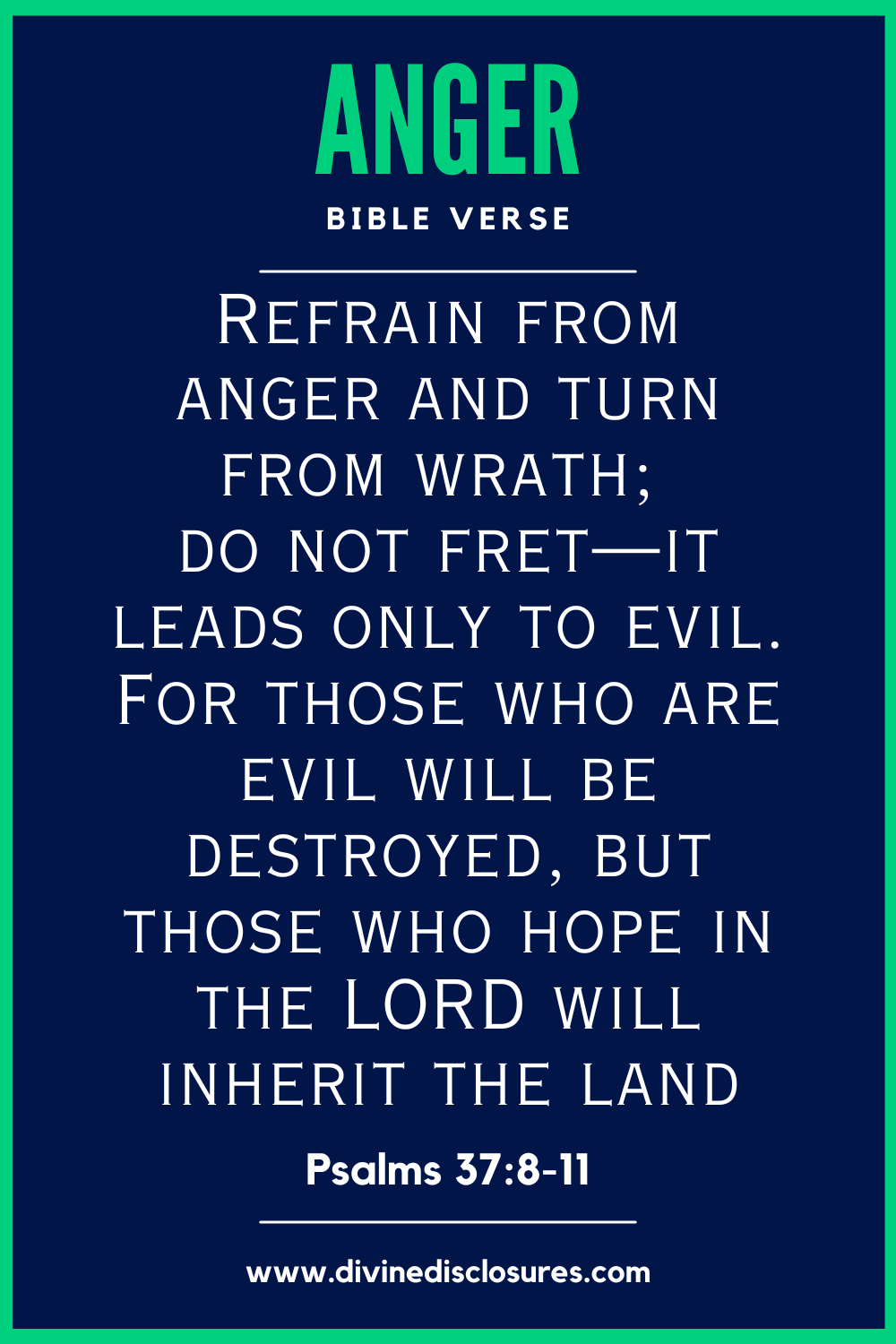
Psalm 37:8 “Refrain from anger, and forsake wrath! Fret not yourself; it tends only to evil.”
Dynamic addressed: The sustained internal burn of anger — fretful, brooding anger that has become a constant state.
What this restores: The honest assessment of where sustained anger ends. David does not say it tends only to exhaustion or unhappiness. He says it tends only to evil. Not usually, not often — only. The person who sustains anger long enough will eventually do something they cannot undo.
What this corrects: The idea that sustaining anger is a neutral act — that carrying it without acting on it does no harm. The verse states otherwise. The sustained carrying is itself a trajectory toward evil.
Faith response: Refrain and forsake — two active verbs. Not passive release but deliberate choice. The person who wants to stop the trajectory of sustained anger has to actively choose to refrain and actively choose to forsake. This is not a feeling that arrives on its own.
Best use: For anyone who has been carrying anger for a long time and is beginning to notice what it is doing to them and to their choices.
Romans 12:17–19 “Repay no one evil for evil, but give thought to do what is honourable in the sight of all. If possible, so far as it depends on you, live peaceably with all. Beloved, never avenge yourselves, but leave it to the wrath of God, for it is written, ‘Vengeance is mine, I will repay, says the Lord.'”
Dynamic addressed: The anger that wants to make someone pay — the retaliatory impulse.
What this restores: The release of vengeance into God’s hands. This is not passivity or pretending nothing happened. It is the deliberate act of trusting a more reliable judge with the outcome. As far as it depends on you is pastoral precision — Paul is not promising that peace is always achievable from one side. He is saying: do your part. Release the rest.
What this corrects: The confusion between releasing vengeance and accepting that the wrong was acceptable. Vengeance is given to God because God’s justice is more complete and more reliable than anything the angry person can produce through retaliation.
Faith response: Identify the specific wrong you want to repay. Name it to God. Then actively place it in his hands. This is not a once-for-all act — it may need to be repeated every time the impulse to retaliate returns.
Best use: For anyone carrying anger toward a person who has wronged them and has not yet faced any consequence — and who is tempted toward retaliation.
James 4:1–2 “What causes quarrels and what causes fights among you? Is it not this, that your passions are at war within you? You desire and do not have, so you murder. You covet and cannot obtain, so you fight and quarrel.”
Dynamic addressed: The anger that comes from unmet desire — from wanting something and not getting it.
What this restores: The honest root diagnosis. James goes behind the anger to the unmet desire that generated it. Most interpersonal anger, in James’s analysis, begins not with a genuine injustice but with a frustrated want — you desire and do not have. The anger is real. The trigger is real. But the root is a desire that has not been surrendered to God. The fights and quarrels are the surface. The war within is the issue.
What this corrects: The assumption that all anger is a response to genuine wrong done by others. James is pointing at the anger that is primarily a response to not getting what we wanted — and it is a category of anger most people do not want to examine.
Faith response: Behind the anger, identify the desire. Name the want. Then bring the want to God — which is the move James recommends in verse 3: you do not have because you do not ask. The unmet desire behind the anger can become a prayer rather than a fight.
Best use: For anyone in a pattern of repeated interpersonal conflict who is willing to ask what desire is underneath it.
Matthew 5:21–22 “You have heard that it was said to those of old, ‘You shall not murder; and whoever murders will be liable to judgment.’ But I say to you that everyone who is angry with his brother will be liable to judgment; whoever insults his brother will be liable to say, ‘You fool!’ will be liable to the hell of fire.”
Dynamic addressed: The internal anger that has not yet acted — that exists only in the heart.
What this restores: The seriousness of nursed anger before it acts. Jesus is not saying that feeling angry is equivalent to murder. He is saying that the anger that is nursed, that escalates to insult, that escalates to contempt (“you fool” — mōre, a term of utter dismissal), is on a trajectory that the law cannot contain because the law only addresses the final act. Jesus addresses the beginning of the trajectory.
What this corrects: The rationalisation that anger is only a problem when it produces external consequences. The internal condition is addressed here, not just its fruit.
Faith response: Track the trajectory. Anger → insult → contempt. Where on this line are you? The earlier the intervention, the shorter the distance back.
Best use: For anyone who has been rationalising internal anger as harmless because it has not yet produced visible damage. The trajectory is the problem, not just the destination.
Proverbs 16:32 “Whoever is slow to anger is better than the mighty, and he who rules his spirit than he who takes a city.”
Dynamic addressed: The misunderstanding that anger management is weakness and that emotional restraint is less impressive than strength.
What this restores: The reframing of emotional self-control as a greater achievement than military conquest. Ruling your own spirit is harder than taking a city. The person who can hold their anger, examine it, and respond with wisdom rather than reaction has done something more difficult than external displays of power.
What this corrects: The assumption that the person who controls their anger is less strong than the one who expresses it freely. Scripture has the opposite view.
Faith response: Treat the moments of anger as the opportunities for the most significant kind of strength — the strength of ruling your own spirit.
Best use: For anyone who has framed anger control as passivity or weakness and needs the biblical reframe that positions it as the greater power.
Bible Verses for Anger — When the Only Place Left to Take It Is God
These verses are for the person whose anger has nowhere legitimate to go — whose anger at what was done to them, or at what they have witnessed, needs to be brought to God before it can be released or redirected. They are the lament passages, the prayers that stayed honest. They are here to say that bringing raw anger to God is not spiritual immaturity. It is the prayer of people Scripture holds up as faithful.
Psalm 6:1–3 “O Lord, rebuke me not in your anger, nor discipline me in your wrath. Be gracious to me, O Lord, for I am languishing; heal me, O Lord, for my bones are troubled. My soul also is greatly troubled. But you, O Lord — how long?”
David is afraid. He is exhausted. And his prayer is entirely unguarded — he speaks directly to God about his condition without dressing it in appropriate spiritual language first. How long? is not a polite question. It is the cry of someone who has been waiting and is starting to wonder whether waiting will ever end. God received this prayer. He receives yours.
Psalm 13:1–2 “How long, O Lord? Will you forget me forever? How long will you hide your face from me? How long must I take counsel in my soul and have sorrow in my heart all the day? How long shall my enemy be exalted over me?”
Four how longs in two verses. Not rhetorical. Not performed. David is asking questions he does not know the answers to, directing them at God because there is nowhere else that makes sense to take them. The prayer ends in verses 5–6 with an act of will — I have trusted in your steadfast love — but it begins here, in the unresolved place. Both are the prayer. You do not have to arrive at verse 5 before the prayer is valid.
Habakkuk 1:2–3 “O Lord, how long shall I cry for help, and you will not hear? Or cry to you ‘Violence!’ and you will not save? Why do you make me see iniquity, and why do you idly look at wrong? Destruction and violence are before me; strife and contention arise.”
Habakkuk is a prophet — not a person of weak faith, not someone who failed to pray correctly — and he is accusing God of not listening. Of not saving when saving was needed. Of looking idly at wrong while violence continues. God’s response is not a rebuke. It is an answer — one Habakkuk wrestles with and eventually holds. But the process begins with an accusation God neither deflected nor punished. He received it.
Lamentations 3:1–3 “I am the man who has seen affliction under the rod of his wrath; he has driven and brought me into darkness without any light; surely against me he turns his hand again and again the whole day long.”
Jeremiah writing from the ruins of Jerusalem after its total destruction. The language does not soften — again and again, the whole day long. The grief is unqualified. The anger at God is in the text. And this is in the canon, inspired, Scripture. The same book that contains his mercies are new every morning opens with this. Both are true. The journey from the first verse to the later ones takes time, and the earlier verses are not less spiritual for being where they are.
Jonah 4:1–2 “But it displeased Jonah exceedingly, and he was angry. And he prayed to the Lord and said, ‘O Lord, is not this what I said when I was yet in my country? That is why I made haste to flee to Tarshish; for I knew that you are a gracious God and merciful, slow to anger and abounding in steadfast love, and relenting from disaster.'”
Jonah is angry that God did not destroy Nineveh — angry at God’s grace, at God’s slow to anger character, at the fact that the thing Jonah knew about God from the start turned out to be true. He prays his anger directly to God. He does not pretend he is fine. He names it: I was angry. And what he names as the source of his anger is the very character of God — compassion, mercy, slowness to anger, steadfast love. This is one of the most spiritually honest anger passages in Scripture. The person who is angry at God for being more gracious than they wanted him to be is in good company. The prayer is still the right response.
Jesus and Anger: Two Episodes That Define What Righteous Anger Looks Like
There is no section this article needs more than this one — and no section that most anger articles skip more completely.
Jesus expressed anger twice in the Gospel narratives: in the synagogue before healing the man with the withered hand (Mark 3:1–5), and in the temple when he drove out the money changers (John 2:13–17). Both episodes are either ignored — because they are inconvenient for the all-anger-is-sin position — or misused — deployed to justify human anger that looks nothing like what Jesus expressed. They need to be read together, because each one corrects a misreading of the other.
Mark 3:1–5 — Anger and Grief Held Together
Jesus enters the synagogue on the Sabbath. A man with a withered hand is present. The Pharisees are watching — not because they care about the man, but because they want a charge to bring. Jesus asks them: “Is it lawful on the Sabbath to do good or to do harm, to save life or to kill?” Silence. And then the text gives us two Greek words simultaneously: met’ orgēs — with anger — and syllypumenos — co-grieved, grieved with them, sharing the grief of what their hardness was costing them.
Two emotions at once. Anger at the hardness of heart, and grief for what that hardness had done to the people holding it. The anger is not contemptuous. It is grieving. And the very next action is an act of compassion — he heals the man. The anger does not produce a lecture, a rebuke, a vindicated withdrawal. It produces a healing.
This is the pattern of righteous anger in its clearest New Testament expression: it grieves what it is angry at. It is directed at the wrong, not the people. And it issues immediately in something good.
John 2:13–17 — Deliberate, Purposeful, Other-Directed
Jesus enters the temple courts and finds the money changers and animal sellers. He makes a whip of cords — a deliberate act of construction, not an impulsive grab of whatever was nearby. He drives out the animals, scatters the coins, overturns the tables, tells the dove-sellers to leave. “Do not make my Father’s house a house of trade.”
The disciples’ response is recorded in verse 17: “Zeal for your house will consume me.” They did not describe what they witnessed as a temper. They described it as zeal — purposeful, directed, burning for something specific. And the specific thing was not what had happened to Jesus personally. His personal interests were not at stake. This was about what was being done to his Father’s house.
What both episodes reveal about righteous anger:
First — it grieves rather than despises. The anger in Mark 3 is accompanied by sorrow for the people who were wrong, not contempt for them.
Second — it is entirely other-directed. In neither episode is Jesus angry about what happened to himself. The temple cleansing was not triggered by a personal offence. The synagogue anger was not triggered by how the Pharisees had treated Jesus. Both were triggered by what was being done to others — to God’s house, to a man with a withered hand, to the people being exploited.
Third — it is deliberate, not impulsive. The making of the whip of cords is the detail that changes everything about how the temple cleansing is read. This was considered. It was measured. It was proportionate to what was at stake.
Fourth — it produces something good immediately. It does not linger, nurse, or build. It acts — toward justice, toward healing, toward the correction of what was wrong — and then it is done.
The next time someone cites the temple cleansing as permission for their anger, these four criteria are the test: Is my anger grieving what it is angry at, or despising the person? Is it about what was done to others, or what was done to me? Was my response deliberate and measured, or impulsive? And did it produce something good — or just relief?
Two Bible Verses About Anger That Are Regularly Misread
“Be angry and do not sin” (Ephesians 4:26) — used as blanket permission for any anger
The verse gives permission to be angry and immediately constrains it with two qualifications: do not sin and do not let the sun go down on your anger. The permission is not unconditional. It is wrapped in boundaries. The person who uses this verse to justify sustained, personal, retaliatory anger has read the first clause and stopped. The verse does not end at “be angry.” It continues. The permission and the constraint are one sentence.
“Be slow to anger” (James 1:19) — used as a prohibition on all anger
Slow is not never. The verse instructs a deliberate pace — the insertion of understanding between trigger and response — not the elimination of the capacity for anger. The person who reads slow to anger as never angry has added a word the text does not contain. The verse is about the pace of anger, not the existence of it. Healthy anger can be slow and still be real.

Frequently Asked Questions About Anger, Wrath, and What the Bible Says
What is the key Bible verse about anger?
The verse most directly addressing the full range of anger in one sentence is Ephesians 4:26 — “Be angry and do not sin; do not let the sun go down on your anger.” It acknowledges that anger exists and is sometimes appropriate (be angry), sets the boundary (do not sin), and gives the time limit (do not let the sun go down). Three things in one verse: permission, constraint, and a time limit. No other single verse covers all three simultaneously. It is the anchor verse for understanding the biblical position on anger.
What does the Bible say about being slow to anger?
The slow to anger verse most people know is James 1:19 — “let every person be quick to hear, slow to speak, slow to anger.” But Proverbs 14:29 gives it its deepest frame: “whoever is slow to anger has great understanding.” And Proverbs 16:32 gives it its highest honour: “he who is slow to anger is better than the mighty.” Scripture consistently frames slowness to anger not as passivity or weakness but as the mark of understanding and the greater strength. The slow to anger person has enough understanding to know the situation is more complex than the first reaction.
Is it a sin to feel angry?
No. The emotion of anger — the internal experience of it — is not sin. Ephesians 4:26 assumes anger exists and addresses what to do with it, not whether it is permissible to feel it. Jesus felt anger (Mark 3:5). God is described as angry throughout Scripture. What Scripture addresses is the stewardship of anger: whether it is brought to God or buried, expressed constructively or destructively, released before it calcifies or nursed until it does damage. The feeling is not the issue. What is done with it is.
What is the difference between anger and wrath in the Bible?
In the New Testament, two primary Greek words are translated as anger or wrath. Orgē describes settled, principled indignation — anger that can be present without immediately becoming sin, the kind Ephesians 4:26 permits. Thumos describes explosive, passionate outburst — the hot flare that strikes and damages. Ephesians 4:31 lists thumon as something to put away. In the Old Testament, the Hebrew ‘aph (nostrils — the physical sign of intense emotion) describes both human and divine anger. Chemah (heat, fury) describes the burning intensity of wrath. The biblical vocabulary of anger is richer and more specific than the single English word conveys — which is why the same letter can say both “be angry” and “put away anger” without contradicting itself.
How do I deal with anger according to the Bible?
Scripture gives a specific sequence, not a single instruction. First, bring it to God before expressing it anywhere else — Psalm 4:4 (ponder in your own hearts, be silent). Second, be slow before speaking — James 1:19 (quick to hear, slow to speak, slow to anger). Third, do not let it become an overnight resident — Ephesians 4:26 (do not let the sun go down on your anger). Fourth, release vengeance into God’s hands — Romans 12:19 (leave it to the wrath of God). Fifth, put away what has calcified — Ephesians 4:31 (let all bitterness and wrath and anger be put away). The process is not a formula — it is a set of pastoral orientations that work together to move anger from an unexamined internal state toward something that has been named, brought to God, and either acted on rightly or released.
What Bible verse talks about anger leading to sin?
Ephesians 4:26–27 addresses the transition directly: “Be angry and do not sin; do not let the sun go down on your anger, and give no opportunity to the devil.” The sun going down is the transition point — when anger moves from an acute response to a settled internal state, it becomes the foothold the enemy uses. James 1:20 gives the diagnostic: “the anger of man does not produce the righteousness of God.” And Matthew 5:21–22 traces the trajectory from anger through insult to contempt — the internal escalation that the law cannot address because it has not yet produced an external act.
Related Pages to Bible Verses About Anger
Anger rarely exists in isolation. It is usually downstream of a wound and upstream of something worse if it is not addressed.
For what anger becomes when it is not brought to God and released — the long, slow hardening into something more dangerous — the Bible Verses About Bitterness page addresses that specific condition and what Scripture says about it. For the turning that anger sometimes requires before it can be released — the acknowledgment of what the person’s own contribution to the conflict was — the Bible Verses About Repentance page goes there directly. For the person whose anger has crossed into something affecting their mental and emotional health at a clinical level, the Bible Verses About Mental Health page holds additional resources. And for the work of discerning what kind of anger you are actually carrying — righteous, sinful, or mixed — the Scriptures on Discernment page offers the biblical framework for that examination.
Anger is one of the most human emotions Scripture records. It is present in God. It is present in Jesus. It is present in the psalms, the prophets, the letters. The work of anger before God is not to eliminate it but to bring it — all of it, the righteous and the sinful together — and let him examine what is in it, direct what belongs to action, and release what belongs in his hands.
That is a better outcome than burying it. And it is available to anyone willing to bring what they are actually carrying.
Has this Article been a a Blessing?
Your Next Step to Spiritual Growth
Consider Partnering with Divine Disclosures
Access Resources & Personal Guidance
Access 150+ Prayers exclusive Prayer Handbooks and support the ministry
Submit A Prayer Request
Access the primary portal or use one of the specific submission links below for immediate, targeted prayer
Spiritual Growth & Content Articles
Deepen your knowledge of the Word with study, scriptures, and more prayers
Share This Article
Help others discover God’s word. Share your thoughts below and spread the message!
Show more on Divine Disclosures →