Few verses are printed on more mugs, gym shirts, and Instagram bios than Philippians 4:13.
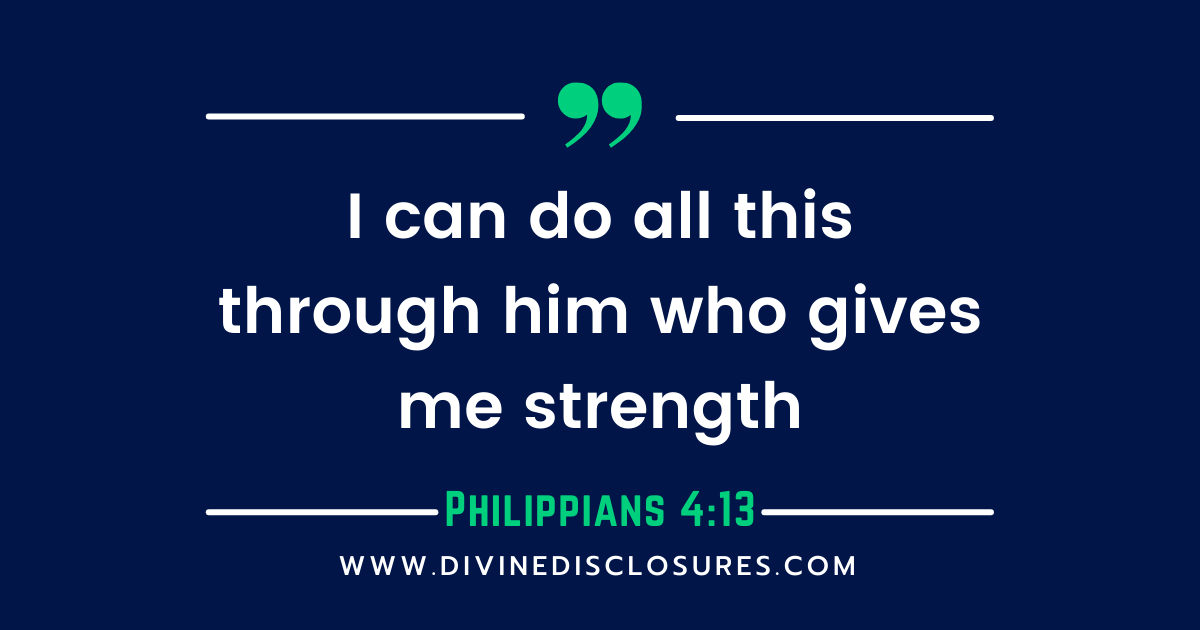
“I can do all things through Christ who strengthens me.” (often quoted from KJV/ESV)
For many, it has become a Christian power slogan:
- “I can crush my goals.”
- “I can win this match.”
- “I can land that job.”
But Paul is not standing in a locker room before a big game.
He’s sitting in chains.
If you’re searching “Philippians 4:13 meaning” or “I can do all things through Christ meaning”, what you actually need is this:
- What is Paul talking about in context?
- What does “all things” refer to?
- How does Christ strengthen us in real, messy, unglamorous life?
Let’s walk through the verse slowly and let Scripture reshape the slogan into something deeper and stronger.rd so that we might live boldly and faithfully in the trenches of a suffering world.
Table of Contents
Philippians 4:13 in Several Translations
Philippians 4:13 (NIV)
“I can do all this through him who gives me strength.”
Philippians 4:13 (ESV)
“I can do all things through him who strengthens me.”
Philippians 4:13 (KJV)
“I can do all things through Christ which strengtheneth me.”
Philippians 4:13 (NLT)
“For I can do everything through Christ, who gives me strength.”
Notice the NIV’s “I can do all this.” That’s actually very helpful. It points us back to what Paul has just been talking about in verses 11–12.
Let’s go there.
What Is the Main Meaning of Philippians 4:13? (Short Answer)
Before we go deep, here’s the headline.
In Philippians 4:13, Paul is not saying, “I can achieve any dream or win any battle I choose.” He is saying:
“I can endure and remain content in every circumstance—poverty or plenty, hunger or abundance, hardship or ease—through the strength of Christ.”
The “all things” are the “all circumstances” of verses 11–12:
- Being brought low
- Abounding
- Facing plenty
- Facing hunger
- Living in abundance
- Living in want
The Philippians 4:13 meaning is not a blank cheque for success.
It is a declaration of Christ-sourced contentment and endurance in whatever God allows.
Love the Word? Unlock Its Meaning
Join Daniel Niranjan’s inner circle who receive in-depth verse meaning insights, biblical word studies, and Spirit-filled explanations that help you understand and live God’s Word with clarity, confidence, and passion.
Join 12,000+ Believers Growing in Prayer and Power
Philippians 4:13 in Context
Literary Context – The Secret of Contentment (Philippians 4:10–12)
Read the three verses just before Philippians 4:13:
“I have learned to be content whatever the circumstances. I know what it is to be in need, and I know what it is to have plenty… I have learned the secret of being content in any and every situation… I can do all this through him who gives me strength.” (Philippians 4:11–13, NIV)
Paul is talking about learning contentment. Twice he stresses:
- “I have learned…” (4:11, 12)
- “In any and every circumstance…” (4:12)
Then comes verse 13 as the summary:
“I can do all this through him who gives me strength.”
Most responsible commentators—from classic evangelical voices to modern scholarship—agree that “all things” here means all the circumstances of contentment in 4:10–12, not everything imaginable.
In other words:
Philippians 4:13 is Paul’s contentment confession, not his conquest slogan.
Historical and Cultural Context – Imprisonment, Poverty, and Provision
Paul is writing Philippians from some form of imprisonment—almost certainly under Roman custody.
He thanks the Philippians for their renewed concern and financial support (4:10, 14–18). Their gift has helped relieve his need, yet he’s careful to say:
“Not that I am speaking of being in need, for I have learned in whatever situation I am to be content.” (4:11)
This is crucial:
- In a Roman honor–shame culture, financial lack was often seen as disgrace.
- Paul boldly reframes his lack as a classroom where he learns Christ-shaped contentment.
So when he says “I can do all things through Christ who strengthens me,” he isn’t visualizing trophies.
He’s visualizing chains, cramped quarters, financial pressure—and surprising, Spirit-given contentment.
Phrase-by-Phrase Meaning of Philippians 4:13
Now let’s unpack the verse line by line.
“I Can Do All Things”
“I can do all things…” (ESV / KJV)
“I can do all this…” (NIV)
The Greek phrase panta ischuo means “I am strong for all things” or “I am able for all things.”
Key point:
“All things” is defined by the context. Here, it clearly refers back to:
- being brought low and abounding
- facing plenty and hunger
- living in abundance and in need (4:12)
So in Philippians 4:13 meaning, “all things” =
“All the varied situations I encounter as I follow Christ.”
Not:
“Any project or ambition I decide to pursue.”
“Through Him / Through Christ”
“…through him…” (ESV)
“…through Christ…” (KJV)
Paul never treats himself as a stoic hero who has found self-sufficiency. In fact, he plays with that Stoic word autarkes (self-sufficient) and flips it: his “sufficiency” is in Christ, not in himself.
Ancient moral philosophers spoke of cultivating a calm spirit untouched by circumstances. Paul says, in effect:
“I have learned the secret of contentment—but my secret isn’t me.
My secret is Him.”
So the Philippians 4:13 meaning is radically Christ-centered:
- Christ is the source of strength.
- Christ is the sphere in which Paul lives and acts.
- Christ is the secret of enduring joy in both plenty and poverty.
“Who Strengthens Me”
“…who strengthens me.”
The verb is present tense: “who keeps strengthening me”—ongoing, repeated empowering.
Jesus does not give Paul a one-time jolt. He sustains him in:
- Hunger
- Hardship
- Waiting
- Preaching
- Manual labor
- Imprisonment
As one commentary summarizes it, the key thought in Philippians 4 is “the enabling power of Christ” as the believer’s strength.
So the heart of Philippians 4:13 meaning is this:
“Christ continually supplies the strength I need to be faithful and content in every circumstance God places me in.”
Key Word Insights (Without Going Too Technical)
Let’s highlight a few key terms.
- “Learned to be content” (4:11) – language of apprenticeship; this was not automatic for Paul. Contentment is learned over time in the school of Christ.
- “Secret” (4:12) – the verb has the sense of being “initiated” into something; Paul has been initiated into the mystery of Christ-supplied contentment in every circumstance.
- “All things / all this” – limited by context to the varied situations of scarcity and abundance, not universal omnipotence.
- “Strengthens” – an ongoing empowering; Christ’s strength is not a motivational quote but a living stream of grace.
Moisés Silva notes that Philippians as a whole constantly directs us back to Christ as life, model, and power—Philippians 4:13 gathers that thread up: Christ Himself is the believer’s strength, not circumstances, not personality, not grit.
Theological Themes in Philippians 4:13
1. Christ-Sourced Contentment
Contentment is not:
- Stoic indifference
- Natural temperament
- Positive thinking
It is Christ-sufficiency.
Paul can sit in chains, unsure of his future, and say, “I have learned the secret.” That secret is the living Christ, present and active with him.
2. Strength in Weakness and Lack
Philippians 4:13 lines up with 2 Corinthians 12:9–10:
“When I am weak, then I am strong.”
Christ’s strength does not always remove weakness; often it fills weakness. The strength of Philippians 4:13 is not the removal of hard circumstances but the stability of soul within them.
3. Partnership and Provision in the Body of Christ
Don’t forget: this verse sits in a thank-you section. The Philippians have sent a gift; Paul is grateful, but his joy is anchored deeper than fluctuating support.
- Christ strengthens him to be content when gifts don’t come.
- Christ strengthens him to remain humble and grateful when they do.
How to Apply Philippians 4:13 in Real Life
Let’s bring this down to street level. How does the true Philippians 4:13 meaning reshape real situations?
When You Feel Weak and Overwhelmed
Instead of:
“I’m done. I can’t do this.”
Learn to say:
“In this exact situation, I can endure and obey through Christ who strengthens me.”
This doesn’t mean you never rest, never say no, or never change direction. It means that wherever Christ has truly called you, He will truly strengthen you.
When You Have Little
Philippians 4:13 speaks into:
- Financial pressure
- Tight seasons
- Ministry with limited resources
Christ strengthens you to:
- Resist envy and bitterness.
- Trust God’s provision instead of panicking.
- Stay generous even when it feels small.
When You Have Much
Paul also learned contentment in abundance.
Christ’s strength is needed to:
- Resist pride and the illusion of self-sufficiency.
- Hold resources with open hands.
- Give liberally without clinging to safety nets.
In both lack and plenty, the confession is the same:
“I can live faithfully, humbly, and contentedly in this situation through Christ who strengthens me.”
When God’s Call Is Costly
Sometimes “all things” looks like:
- Forgiving someone you’d rather resent.
- Staying faithful in a hard marriage.
- Continuing in ministry when there’s no applause.
- Bearing witness to Christ in a hostile environment.
Philippians 4:13 does not promise easy outcomes.
It promises sufficient strength to obey.
Common Misunderstandings of Philippians 4:13
1. “God Will Help Me Win Any Game or Achieve Any Goal.”
Could Christ strengthen you in your work, studies, or sport? Absolutely.
But Philippians 4:13 in context is not about guaranteed outward success.
As one pastoral resource notes, the promise is that we “will have strength from the Lord to faithfully endure the difficulties that arise in life,” not that we’ll triumph in every chosen goal.
2. Prosperity Twist: “I Can Do Big, Extraordinary Things if I Just Claim This Verse.”
Some use this text as a triumphalist badge—“through Christ I become superhuman.” In reality, the “extraordinary thing” Paul is doing is being content in prison. That is supernatural. But it is not glamorous.
3. Ignoring the “All Things” of 4:11–12
When “all things” is ripped out of its paragraph, we miss Paul’s entire point. The verse becomes spiritualized self-help instead of Christ-centered endurance.
4. Using It to Pressure People into Overwork or Burnout
“I can do all things through Christ” is sometimes wielded to shame believers who are exhausted:
- “Take on more.”
- “Don’t admit limits.”
- “Real faith never feels overwhelmed.”
That’s not Paul’s message. He is not denying human limitation; he is confessing Christ’s sufficiency in the specific assignments and seasons God gives.
A Prayer to Live Philippians 4:13
Lord Jesus, my Strength and my Sufficiency,
I confess that I have often treated Philippians 4:13 as a slogan instead of a secret. I have used it to decorate my ambitions more than to anchor my contentment. Forgive me for chasing strength without seeking You.
Today, I bring You my real circumstances—the ones I like and the ones I hate. [Name them before Him.] Whether I am in a season of lack or abundance, joy or heaviness, I choose to say: “My strength is not in my situation; my strength is in Christ.”
Teach me, as You taught Paul, the secret of being content in any and every circumstance. When I feel weak, be my strength. When I feel proud, humble me. When I fear losing what I have, remind me that You are my true treasure. When I feel I cannot go on, whisper again, “My grace is sufficient for you.”
Strengthen me—not to chase every dream, but to do Your will in the place You have assigned me. Let Philippians 4:13 become my quiet confession of dependence: “I can do all things through Christ who strengthens me.”
In Your strong name I pray, Amen.
Reflection Questions for Philippians 4:13
- When you’ve quoted “I can do all things through Christ,” what did you usually mean? How does seeing the context of contentment change that?
- In which area of life do you most feel, “I just can’t do this”—and how might Christ want to strengthen you there?
- Are you currently in a season of lack or abundance? What would “Christ-sourced contentment” look like in that season?
- Where are you most tempted to use Philippians 4:13 as a triumph slogan rather than a contentment confession?
- Looking back, can you identify a time when Christ strengthened you to endure something you never imagined you could walk through?
Related Bible Verses About Strength, Weakness, and Contentment
These passages harmonize with Philippians 4:13 meaning:
- 2 Corinthians 12:9–10 – Christ’s power made perfect in weakness; “When I am weak, then I am strong.”
- 2 Corinthians 9:8 – God makes all grace abound so that you have all you need for every good work.
- 1 Timothy 6:6–8 – “Godliness with contentment is great gain.”
- Hebrews 13:5–6 – Be content with what you have, for God has said, “I will never leave you nor forsake you.”
- John 15:5 – “Apart from Me you can do nothing”—and in Him you bear much fruit.
Each of these gives you a natural internal link to prayers for strength, Bible verses about contentment, or other verse-meaning articles you’re building.
Philippians 4:13 Meaning – FAQs
Is Philippians 4:13 a promise that I can achieve any goal?
No. It is a promise that Christ will strengthen you to be faithful and content in whatever circumstances God places you, especially in seasons of need or hardship. He may bless particular goals, but the verse is not a universal guarantee of success.
How does Philippians 4:13 relate to suffering and hardship?
Philippians 4:13 is birthed in hardship: prison, financial pressure, uncertainty. Its primary arena is suffering, not triumph. The verse assures you that Christ’s strength is enough to sustain you when the road is long and rough.
Can I still apply Philippians 4:13 to my work, studies, or dreams?
Yes—with the right posture. You can pray, “Lord, strengthen me to work diligently, humbly, and faithfully in this calling.” But you hold outcomes loosely. The verse guarantees strength for obedience, not automatic achievement.
What does it practically mean to be “strengthened” by Christ?
It means that as you depend on Him in prayer, Word, and obedience, the Holy Spirit supplies:
- Fresh courage when you want to quit
- Deep peace when circumstances are shaky
- Steadfastness when others wobble
- Grace to be content when nothing feels ideal
You may still feel your weakness—but you discover that weakness carried by Christ does not collapse.
How do Philippians 4:11–12 shape our understanding of verse 13?
They are the control panel for “all things.” Paul explicitly defines the “all” as the full range of circumstances—from poverty to plenty, hunger to abundance. Any interpretation of Philippians 4:13 that ignores 4:11–12 is incomplete at best and distorted at worst.
Keep Growing in Christ’s Strength and Contentment
Philippians 4:13 is not meant to be a motivational sticker slapped on our ambitions.
It is meant to be a settled confession whispered in prison cells, hospital rooms, quiet kitchens, and ordinary workplaces:
“Whatever this season holds—need or abundance, joy or hardship—
I can walk through it, faithfully and content,
through Christ who strengthens me.”
From here, you can lead your readers to:
- Your Philippians 4:6–7 meaning article (peace in anxiety).
- Your Philippians 4:9 meaning article (practicing what we’ve learned).
- Topical guides on prayers for strength, contentment, and trust in hard times.
That way, Philippians 4:13 becomes not a cheap slogan, but an open door into a whole way of life:
Christ our strength, in every circumstance.
Has this Article been a a Blessing?
Your Next Step to Spiritual Growth
Consider Partnering with Divine Disclosures
Access Resources & Personal Guidance
Access 150+ Prayers exclusive Prayer Handbooks and support the ministry
Submit A Prayer Request
Access the primary portal or use one of the specific submission links below for immediate, targeted prayer
Spiritual Growth & Content Articles
Deepen your knowledge of the Word with study, scriptures, and more prayers
Share This Article
Help others discover God’s word. Share your thoughts below and spread the message!
Show more on Divine Disclosures →