Contentment is probably the most misunderstood virtue in the Christian life.
It is not passivity. It is not the spiritual rebranding of low expectations. It is not the posture of someone who has stopped wanting things or stopped working toward them. And it is emphatically not the performance of peace — the person who says “I’m fine, God has blessed me” while quietly seething over what others have and they do not.
Biblical contentment is something harder and something richer than all of that. Paul says in Philippians 4 that he has learned it — and the word he uses implies acquisition through difficulty, through a process that cost him something. He is writing from prison. He has been hungry and well-fed, in need and in abundance. The contentment he describes is not the product of comfortable circumstances. It is the Spirit-formed capacity to rest in God’s sufficiency regardless of circumstances — to trust God with what you have, what you lack, and what has not yet changed.
That distinction matters because these bible verses about contentment are not asking you to stop feeling the weight of unmet needs, unanswered prayers, or the gap between where you are and where you hoped to be. They are asking something more interior than that: whether God’s sufficiency can become more real to you than the sum of what you are lacking. That is a long obedience, not a quick resolution. But it is what the Bible is pointing toward.
In This Article
Core Bible Verses About Contentment
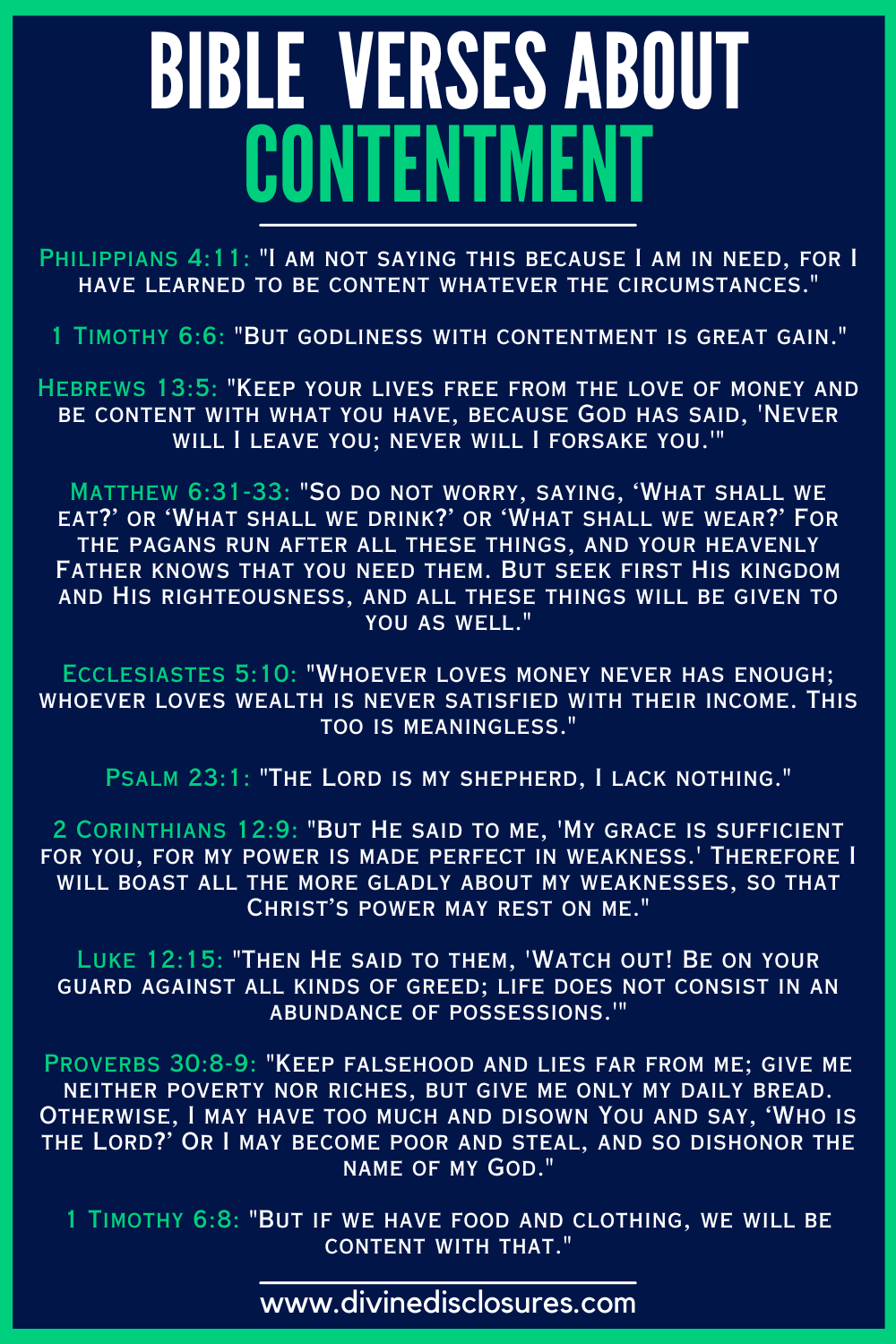
These seven passages form the theological foundation for everything Scripture says about contentment. They establish where it comes from, what it requires, what it protects you from, and why it is not a natural human capacity but a Spirit-formed one.
Philippians 4:11–13
Not that I speak in respect to lack, for I have learned, in whatever state I am, to be content. I know how to be humbled, and I know also how to abound. In everything and in all things I have learned the secret both to be filled and to be hungry, both to abound and to be in need. I can do all things through Christ, who strengthens me.
The Greek word Paul uses for “content” is autarkes — self-sufficient, needing nothing external to complete oneself. In the Stoic philosophy of Paul’s day, this was the highest human ideal: a person so internally fortified that circumstances could not touch them. Paul takes that word and places it inside a completely different framework. His autarkeia is not Stoic self-sufficiency. It is Christ-sufficiency. He can do all things — including endure poverty, including hold abundance without grasping — through Christ who is the actual source of the strength. Contentment in Paul’s framing is not internal fortitude. It is an ongoing dependence on Christ that produces stability regardless of external conditions.
1 Timothy 6:6–8
But godliness with contentment is great gain. For we brought nothing into the world, and we certainly can’t carry anything out. But having food and clothing, we will be content with that.
Paul places godliness and contentment together as a compound — not two separate virtues but a single orientation. The argument that follows is one of the most economically leveling in the New Testament: you arrived with nothing, you will leave with nothing, therefore the difference between everything you have accumulated and nothing is less significant than it appears. Food and clothing are named not as the minimum decent standard but as genuine sufficiency. The person who has these things and is not content does not have a provision problem. They have a desire problem.
Hebrews 13:5
Be free from the love of money, and be content with such things as you have, for he has said, “I will in no way leave you, neither will I in any way forsake you.”
The reason given for contentment here is not philosophical. It is covenantal. The writer grounds the command to be content not in the sufficiency of what you currently have, but in the sufficiency of who is with you. The Greek is emphatic — a double negative that carries the force of: under absolutely no circumstance will I abandon you. That promise is meant to function as the actual foundation of economic contentment. You can hold your possessions loosely when you know that the one who cannot be taken from you is the one who actually sustains you.
Psalm 23:1
The Lord is my shepherd. I shall not want.
Four words in Hebrew that may be the most economically radical statement in the entire Old Testament: lo echsar — I will not lack, I will not be in want. The psalmist is not describing a life without hardship. He is about to walk through a dark valley. But the presence of the shepherd changes the meaning of the lack — not by eliminating it, but by accompanying it. Contentment in Psalm 23 is not the absence of need. It is the confidence that the shepherd knows the need and has already begun to tend to it.
Proverbs 30:8–9
Give me neither poverty nor riches. Feed me with the food that is needful for me, lest I be full, deny you, and say, “Who is the Lord?” or lest I be poor, and steal, and so dishonor the name of my God.
This prayer is one of the most honest requests in Scripture, and it is worth sitting with its logic. The writer does not want wealth because wealth carries a specific spiritual risk: the risk of forgetting God. He does not want poverty because poverty carries a different risk: the risk of compromising integrity to survive. What he wants is enough — the portion that sits between the two dangers. Biblical contentment is not the endorsement of a particular income bracket. It is the discernment to recognize that both extremes have their own temptations, and that sufficiency is itself a form of grace.
Luke 12:15
He said to them, “Beware! Keep yourselves from covetousness, for a man’s life doesn’t consist of the abundance of the things which he possesses.”
Jesus speaks this warning in response to a man who wants him to arbitrate an inheritance dispute — someone who is, on the surface, asking for justice, but who is underneath the request asking Jesus to confirm that more things will make his life better. Jesus refuses the role and instead diagnoses the assumption. The word he uses for “beware” is phulasso — guard yourself, watch carefully, post sentinels. Covetousness is treated here as a danger that requires active vigilance, not a minor tendency to be mildly discouraged. The reason: a life measured by possessions has misidentified what a life actually consists of.
2 Corinthians 12:9–10
He has said to me, “My grace is sufficient for you, for my power is made perfect in weakness.” Most gladly therefore I will rather glory in my weaknesses, that the power of Christ may rest on me. Therefore I take pleasure in weaknesses, infirmities, insults, hardships, persecutions, and distresses, for Christ’s sake. For when I am weak, then am I strong.
This verse is included in the foundation because it addresses the form of discontentment that is hardest to name: discontentment with limitation itself, with what God has not changed despite sustained prayer, with the specific thorn that remains. Paul had asked three times for its removal. The answer was not removal but sufficiency — and Paul’s response is not gritted teeth but genuine declaration: I will glory in the weakness because it is the occasion for Christ’s power. Contentment with one’s weakness is perhaps the deepest form of the virtue, and it is available only through the same Christ-sufficiency that undergirds all the rest.
More Bible Verses About Contentment
Contentment in Scripture is not a single experience. There is the deep satisfaction of finding in God what no accumulation of things can provide. There is the specific grace required to live well with little, without resentment and without greed. There is the freedom from the comparison loop — the eye that is always measuring one’s portion against another’s. There is the daily sufficiency of trusting God for today without demanding the security of knowing about tomorrow. And there is the form of contentment that is hardest of all: the quiet of a soul that has learned to wait without demanding that the waiting end on its schedule.
These clusters trace contentment through each of those different biblical registers.
Finding Satisfaction in God
Contentment that rests on circumstances will fail the moment circumstances shift — which is why the psalms in this cluster locate satisfaction not in what the psalmist has received but in who he has. Psalm 73:25–26 makes the logic explicit: there is nothing on earth I desire besides you. My flesh and my heart fail, but God is the strength of my heart and my portion forever. The cheleq — the portion — that Asaph names as his is not a material allocation. It is God Himself. Isaiah 55 extends the invitation to the hungry: come, buy wine and milk without money, without price. The satisfaction Scripture offers is available to people who cannot afford the things that are supposed to bring it.
- Psalm 16:5–6 — The Lord is my chosen portion and my cup. You maintain my lot. The lines have fallen to me in pleasant places. Yes, I have a good inheritance.
- Psalm 63:5 — My soul shall be satisfied as with the richest food. My mouth shall praise you with joyful lips.
- Psalm 73:25–26 — “Whom do I have in heaven? There is no one on earth that I desire besides you. My flesh and my heart fails, but God is the strength of my heart and my portion forever.”
- Psalm 107:9 — For he satisfies the longing soul. He fills the hungry soul with good.
- Isaiah 55:1–2 — “Come, everyone who thirsts, to the waters! Come, he who has no money, buy, and eat! Yes, come, buy wine and milk without money and without price. Why do you spend money for that which is not bread, and your labor for that which doesn’t satisfy? Listen diligently to me, and eat that which is good, and let your soul delight itself in richness.”
Being Content With Little
The manna narrative in Exodus 16 is one of the most underread passages in the Bible on the subject of contentment. God gave exactly enough — and when the Israelites gathered more than they needed, it rotted. The economy of manna was an object lesson in sufficiency: your portion is today’s portion, it is enough, and grasping beyond it will not improve it. Proverbs adds the moral and spiritual dimension: better a little with the fear of the Lord than great treasure with trouble. The little is not spiritualized poverty. It is the clarity that comes with an undivided life — the recognition that more is not always better, and that peace of conscience has its own return.
- Exodus 16:18 — When they measured it with an omer, he who gathered much had nothing over, and he who gathered little had no lack. They each gathered as much as they could eat.
- Proverbs 15:16 — Better is a little with the fear of the Lord, than great treasure with trouble.
- Proverbs 16:8 — Better is a little with righteousness than great revenues with injustice.
- Ecclesiastes 4:6 — Better is a handful with quietness, than two handfuls with labor and chasing after wind.
- Luke 3:14 — …be content with your wages.
- 1 Timothy 6:9–10 — “But those who are determined to be rich fall into a temptation, a snare, and many foolish and harmful lusts, such as drown men in ruin and destruction. For the love of money is a root of all kinds of evil. Some have been led astray from the faith in their greed, and have pierced themselves through with many sorrows.”
Freedom From Greed and Comparison
Covetousness in Scripture is not treated as a minor character flaw. It is the root system from which a great deal of human misery and relational destruction grows. James 4 gives us the anatomy of it: desires at war within, killing and coveting and fighting and quarreling, asking and not receiving because the asking is purely self-serving. The comparison loop — measuring your life against someone else’s visible abundance — is the daily form of the covetousness that Luke 12:15 warned about. These verses do not counsel indifference to the world. They counsel a specific kind of freedom from it: the person who is no longer measuring their life by what others have has been released from a particular form of bondage.
- Ecclesiastes 5:10 — He who loves silver shall not be satisfied with silver; nor he who loves abundance, with increase. This is also vanity.
- Mark 8:36 — For what does it profit a man to gain the whole world, and forfeit his soul?
- Colossians 3:5 — Put to death therefore your members which are on the earth: sexual immorality, uncleanness, depraved passion, evil desire, and covetousness, which is idolatry.
- James 4:1–3 — “Where do wars and fightings among you come from? Don’t they come from your pleasures that war in your members? You lust, and don’t have. You murder and covet, and can’t obtain. You fight and make war. You don’t have, because you don’t ask. You ask, and don’t receive, because you ask with wrong motives, so that you may spend it on your pleasures.”
- 1 John 2:15–17 — “Don’t love the world or the things that are in the world… For all that is in the world — the lust of the flesh, the lust of the eyes, and the pride of life — is not the Father’s, but is of the world. The world is passing away with its lusts, but he who does the will of God remains forever.”
Enough for Today
Matthew 6 is the clearest teaching in the Gospels on the theology of daily sufficiency, and it carries a specific pastoral edge that Philippians 4 elaborates on. Do not be anxious for tomorrow — tomorrow will have its own anxiety. The provision available to you is today’s provision. The Israelites learned this with manna. The disciples were taught it in the Lord’s Prayer: give us this day our daily bread. Not this year’s bread, not security for the next decade, but today’s portion. These verses do not prohibit planning or saving. They prohibit the anxious, grasping posture that requires certainty about tomorrow before it can be at peace today.
- Matthew 6:11 — Give us today our daily bread.
- Matthew 6:31–33 — “Therefore don’t be anxious, saying, ‘What will we eat?’, ‘What will we drink?’ or, ‘With what will we be clothed?’ For the Gentiles seek after all these things; for your heavenly Father knows that you need all these things. But seek first God’s Kingdom and his righteousness; and all these things will be given to you as well.”
- Psalm 34:10 — The young lions do lack, and suffer hunger, but those who seek the Lord won’t lack any good thing.
- Psalm 37:16 — Better is a little that the righteous has, than the abundance of many wicked.
- Deuteronomy 8:3 — He humbled you, and allowed you to be hungry, and fed you with manna, which you didn’t know, neither did your fathers know; that he might make you know that man does not live by bread only, but man lives by everything that proceeds out of the Lord’s mouth.

Contentment in Waiting and Weakness
Psalm 131 is one of the quietest psalms in the entire Psalter — and also one of the most hard-won. The image of the weaned child is chosen deliberately: a child who has moved through the demand and the restlessness of hunger to a place of quiet resting against the mother, no longer reaching. The weaning was real. The quiet on the other side of it is also real. Habakkuk 3:17–19 is perhaps the most extreme test case for contentment in all of Scripture — fig tree failed, vines failed, flock gone, fields bare, no food in the stalls — and yet the prophet declares he will rejoice in the God of his salvation. That is not denial. It is a faith that has found its footing somewhere below circumstance.
- Psalm 131:1–2 — “Lord, my heart isn’t haughty, nor my eyes lofty, nor do I concern myself with great matters, or things too wonderful for me. Surely I have stilled and quieted my soul, like a weaned child with his mother; like a weaned child is my soul within me.”
- Habakkuk 3:17–19 — “For though the fig tree doesn’t flourish, nor fruit be in the vines; the labor of the olive fails, the fields yield no food; the flocks are cut off from the fold, and there is no herd in the stalls: yet I will rejoice in the Lord. I will be joyful in the God of my salvation! The Lord, the Lord, is my strength. He makes my feet like deer’s feet, and enables me to go in high places.”
- 2 Corinthians 6:10 — as sorrowful, yet always rejoicing; as poor, yet making many rich; as having nothing, yet possessing all things.
- 1 Thessalonians 5:18 — In everything give thanks, for this is the will of God in Christ Jesus toward you.
- James 1:4 — Let endurance have its perfect work, that you may be perfect and complete, lacking in nothing.
Divine Disclosures Prayer Handbooks:
Targeted Prayers for Real Battles
You don’t need more information—you need a prayer handbook.
These prayer handbooks give you Scripture-rooted, specific prayers for the pressure you’re actually facing—so you stop circling and start breaking through.
What the Bible Says About Contentment
There is a phrase in Philippians 4:11 that the English translation tends to flatten, and I want to return to it because it changes the entire texture of what Paul is saying about contentment.
He says he has learned it. The Greek is emathon — the aorist form of manthanō, which carries the connotation of learning through experience, through a process that has left marks. Paul is not describing a posture he arrived at through insight. He is describing something acquired through seasons of actual poverty and actual abundance, through prison and through freedom, through the thorn that was not removed and the grace that was given in its place. Contentment, in Paul’s rendering, is not a theological conclusion. It is a practical formation — the kind that can only come from having been through enough to discover that God’s sufficiency is real in places where nothing else is.
That matters because it protects against two misreadings of these thirty-three verses.
The first misreading is that contentment means the suppression of need and desire — that the content person is the one who has successfully convinced themselves that they do not actually want what they want. That is not what these passages describe. The psalmists in this collection are hungry. Habakkuk is surveying literal desolation. The person in Proverbs 30 is naming the real danger of poverty, not pretending it does not exist. Contentment in Scripture is not the absence of desire. It is the presence of something — or someone — whose reality is more substantial than the desire’s loudness.
The second misreading is that contentment is passive — the spiritual rationale for never striving, never asking, never working toward change. But Paul takes pleasure in weakness precisely because in the weakness the power of Christ rests on him. Habakkuk rejoices and says the Lord makes his feet like deer’s feet — able to go in high places. The person who is genuinely content in God is not someone who has stopped moving. They are someone whose movement is no longer driven by the anxious compulsion of never enough.
What the Bible is consistently pointing toward is the difference between two postures: the life oriented around acquisition — more, better, different, other — and the life oriented around the one who is already sufficient. The acquisition-oriented life is not evil by definition. But it is structurally incapable of contentment, because acquisition has no natural terminus. Ecclesiastes names it precisely: the person who loves silver is not satisfied with silver. The category of enough does not exist inside the logic of more.
The God-oriented life has a different logic. Psalm 23 says lo echsar — I will not lack — not because the shepherd has promised to eliminate all hardship, but because the shepherd is present. Hebrews 13:5 grounds the freedom from the love of money in the double-negative promise of God’s presence: I will absolutely not abandon you. The sufficiency is not circumstantial. It is covenantal. And because it is covenantal, it holds in the famine years as well as the abundant ones — which is exactly what Habakkuk demonstrates when the famine arrives and he still finds his footing.
The practical invitation of all of this is not to manufacture feelings of satisfaction you do not have. It is simpler and more demanding than that. It is to practice, daily, the act of acknowledging that God is your portion — before the provision arrives, before the waiting ends, before the thorn is removed. Not as a formula for getting what you want, but as a truthful confession about where your sufficiency actually lies. That practice, repeated through enough seasons, is what Paul means by having learned it.
You may be in the middle of the learning right now. The learning is not comfortable. But it leads somewhere — toward the quiet of Psalm 131, toward the footing of Habakkuk, toward the settled autarkeia that is not your own self-sufficiency but Christ’s, resting in you.
If this page opened something you want to continue tracing through Scripture, a few others carry it in different directions.
If what sits underneath the discontentment is anxiety about provision — the fear that there will not be enough — Bible Verses for Anxiety speaks directly into that current, and Prayers for Abundance gives language for bringing those specific needs to God.
If the discontentment is relational rather than material — if what you are waiting for is a person, a restored relationship, or a season that has not arrived — Bible Verses for Breakups and Bible Verses About Loneliness hold that specific form of longing.
If you want to go deeper into the character formation these verses are pointing toward — what it looks like to build a life in which trust in God is the actual governing posture rather than an aspirational one — Bible Verses About Trusting God is where I would point you next.