There is a particular kind of disorientation that does not come from ignorance. You have prayed. You have sought counsel. You have read Scripture. And still you are standing in the middle of your own life wondering which way is forward. That is not a faith problem. That is a human problem — and the Bible knows it well.
Confusion, in the way most of us experience it, is not the same as unbelief. It is the fog that settles when two roads look equally possible, when the voice you are straining to hear feels distant, when the decision in front of you carries weight and the answer has not come. I have sat with people in that place. I have been in it myself. And what I want you to know before we open Scripture together is this: God is not annoyed by your confusion. He is not withholding clarity as punishment. He is a God who guides, who speaks, who leads — and these verses are evidence of that.
Let’s look at what these bible verses about confusion say about uncertainty, and finding your footing again.
In This Article
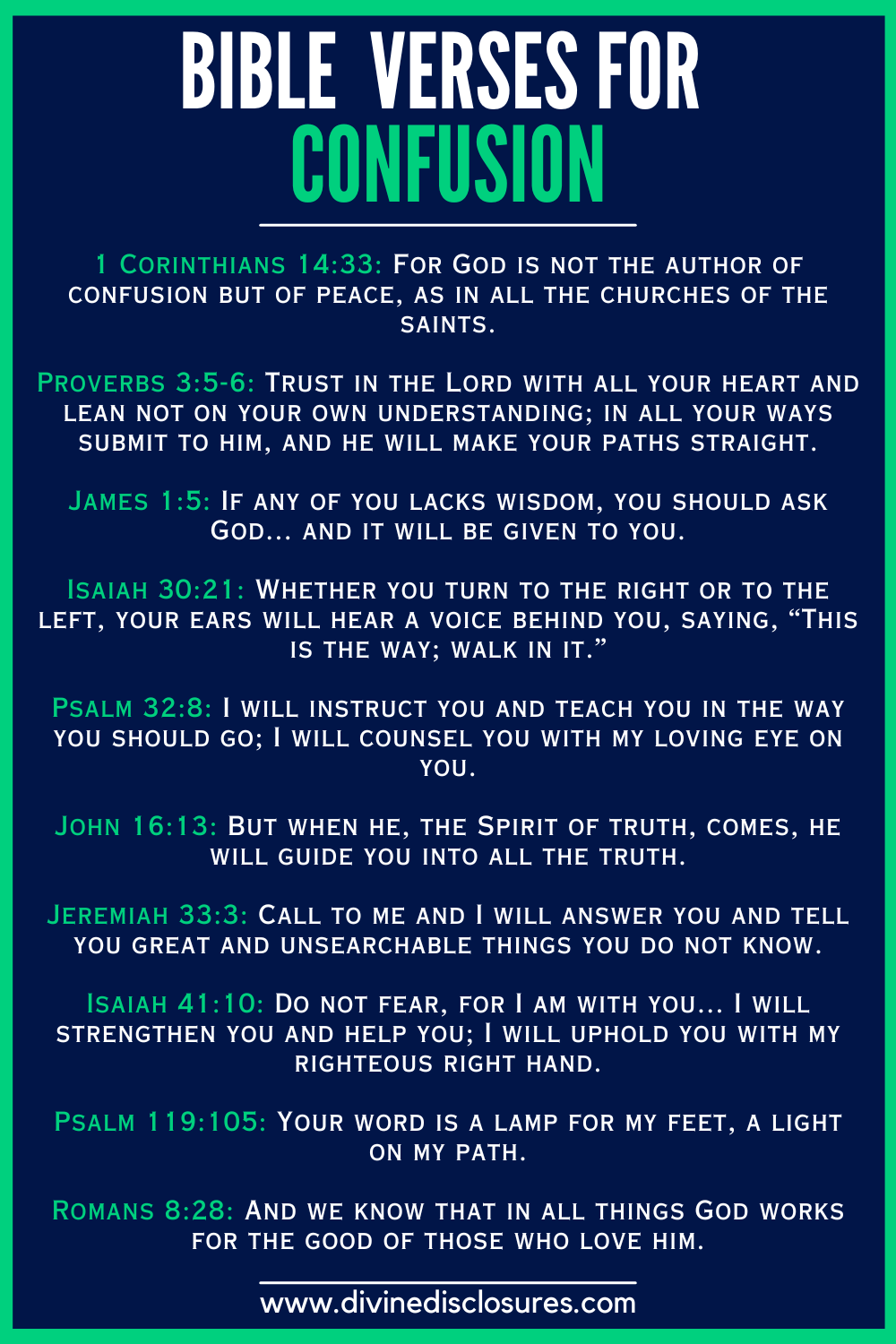
Core Bible Verses About Confusion
These seven passages form the theological backbone of everything the Bible says about confusion. They tell us who God is in relation to our disorientation, and what He has made available to those of us who are genuinely seeking His direction.
1 Corinthians 14:33 — For God is not a God of confusion but of peace, as in all the churches of the saints.
This verse is Paul’s clearest statement about the character of God in relation to confusion. Whatever chaos, disorder, or spiritual fog you are experiencing right now, understand this: it is not sourced in God. He does not traffic in confusion. He does not engineer disorientation as a teaching tool. Confusion may be part of your experience, but it is never part of His nature. This single verse reorients everything — it tells us that when we seek clarity, we are seeking something that God is already inclined to give, because clarity belongs to who He is.
James 1:5 — But if any of you lacks wisdom, let him ask of God, who gives to all liberally and without reproach, and it will be given to him.
James does not say wisdom is available to the spiritually mature, or to those who have prayed long enough, or to those who have already demonstrated good judgment. He says any of you. The invitation is wide open. What strikes me most in this verse is the phrase “without reproach” — God will not scold you for asking, will not remind you of the last time you asked and then ignored His answer, will not make you feel small for needing clarity again. He gives generously, without condition.
Psalm 119:105 — Your word is a lamp to my feet and a light to my path.
The image here is not a floodlight illuminating the entire road ahead. It is a lamp — close, immediate, enough for the next step. This is how God often guides. Not by showing us the full map, but by giving us enough light to move. If you are confused about a decision that is six months away, Scripture may not resolve that today. But it will show you what to do today — and obedience to that is often what unlocks the next lamp-post of clarity.
Isaiah 30:21 — Your ears will hear a word behind you, saying, “This is the way, walk in it,” whenever you turn to the right hand or to the left.
This is one of the most specific guidance promises in all of Scripture. The voice comes when you are at the point of turning — when the decision is actually upon you. God does not always speak when we are anxious about a future fork in the road. He speaks at the fork. The phrase “behind you” is also significant — it suggests the voice of a shepherd following close behind the sheep, ready to redirect at the moment of divergence. You are not ahead of God. He is right there.
Psalm 32:8 — I will instruct you and teach you in the way which you shall go. I will counsel you with my eye on you.
This is God speaking in the first person, making a direct promise. The phrase “counsel you with my eye on you” carries the intimacy of a mentor who never looks away. This is not generic guidance dispatched into the void. This is personal, attentive, relational direction from a God who is watching you specifically. He knows your situation, your options, your temperament, your history. His counsel is not one-size-fits-all — it is made for you.
John 16:13 — However, when he, the Spirit of truth, has come, he will guide you into all truth, for he will not speak from himself; but whatever he hears, he will speak. He will tell you things that are to come.
Jesus is speaking here about the Holy Spirit. One of the Spirit’s primary functions, according to Jesus, is guidance into truth. This is not merely doctrinal truth — it is the whole truth, including the practical, directional, situational truth that we need to navigate our lives. If you are a believer, you have the Spirit of truth living in you. That means your confusion is never the final word. The Guide is present. The question is whether we are still enough to hear Him.
Jeremiah 33:3 — Call to me, and I will answer you, and will show you great and difficult things, which you don’t know.
There is something almost bold in this verse. God is not merely saying He will answer our small questions. He says He will show us things that are difficult — things that are hidden, complex, beyond natural sight. The Hebrew word here is basar, meaning things that are inaccessible without divine disclosure. When your confusion is the kind that feels too layered to untangle, this is the verse to hold. Call. He will answer things you could not have arrived at on your own.
More Bible Verses About Confusion
Confusion does not always look the same. Sometimes it is a specific decision — a career move, a relationship, a city to live in. Sometimes it is a deeper spiritual disorientation — feeling far from God, unsure of your footing, unable to hear what you once heard clearly. And sometimes confusion bleeds into doubt, where the fog is not just about direction but about God Himself.
The verses below are organized around the different forms confusion takes. Each cluster addresses a specific kind of disorientation and what Scripture speaks into it.
Finding God’s Clarity
Psalm 119:105 gives us the image of a lamp, not a floodlight — and that framing matters here. These verses address how clarity actually comes, and none of them promise full illumination in advance. What they promise is light sufficient for the next movement: through seeking, through the Spirit’s illumination of the mind, through a God who reveals rather than withholds. They are practical without being formulaic, and they consistently locate the source of clarity not in our reasoning, but in His disclosure.
- Proverbs 2:1–5 — “My son, if you receive my words, and store up my commandments within you, so as to turn your ear to wisdom, and apply your heart to understanding; yes, if you call out for discernment, and lift up your voice for understanding; if you seek her as silver, and search for her as for hidden treasures: then you will understand the fear of the Lord, and find the knowledge of God.”
- Proverbs 4:18 — But the path of the righteous is like the dawning light that shines more and more until the perfect day.
- Psalm 43:3 — Oh, send out your light and your truth. Let them lead me. Let them bring me to your holy hill, to your tents.
- Isaiah 42:16 — I will bring the blind by a way that they don’t know. I will lead them in paths that they don’t know. I will make darkness light before them, and crooked places straight. I will do these things, and I will not forsake them.
- Daniel 2:22 — He reveals the deep and secret things. He knows what is in the darkness, and the light dwells with him.
- Ephesians 1:17–18 — “…that the God of our Lord Jesus Christ, the Father of glory, may give to you a spirit of wisdom and revelation in the knowledge of him, having the eyes of your heart enlightened, that you may know what is the hope of his calling…”
Divine Disclosures Prayer Handbooks:
Targeted Prayers for Real Battles
You don’t need more information—you need a prayer handbook.
These prayer handbooks give you Scripture-rooted, specific prayers for the pressure you’re actually facing—so you stop circling and start breaking through.
When You Feel Spiritually Lost
There is a form of confusion that is less about decisions and more about displacement — the feeling that you have drifted, that you do not know where you are with God, that you are one of His but cannot find your way back to a sense of that. Scripture meets this honestly. The lost sheep in the Gospels is not a parable about unbelievers only — it is a portrait of what God does when one of His own wanders into the fog.
- Psalm 119:176 — I have gone astray like a lost sheep. Seek your servant, for I don’t forget your commandments.
- Isaiah 53:6 — All we like sheep have gone astray. Everyone has turned to his own way; and the Lord has laid on him the iniquity of us all.
- Ezekiel 34:11–16 — “For thus says the Lord God: ‘Behold, I myself, even I, will search for my sheep, and will seek them out. As a shepherd seeks out his flock in the day that he is among his sheep that are scattered abroad, so I will seek out my sheep; and I will deliver them out of all places where they have been scattered… I will seek that which was lost, and will bring back that which was driven away…'”
- Luke 15:4–7 — “Which of you men, if you had one hundred sheep, and lost one of them, wouldn’t leave the ninety-nine in the wilderness, and go after the one that was lost, until he found it?… I tell you that even so there will be more joy in heaven over one sinner who repents, than over ninety-nine righteous people who need no repentance.”
- John 14:6 — Jesus said to him, “I am the way, the truth, and the life. No one comes to the Father, except through me.”
Making Decisions When You Feel Confused
Much of the confusion we bring to prayer is decisional — we have a genuine choice in front of us and we cannot see clearly. These verses do not give us a formula, but they give us a framework: seek counsel, submit your plans, and trust that God is actively involved in redirecting when needed. The book of Acts even shows us a case where the Spirit closed a door before opening another — sometimes the confusion is itself part of the navigation.
- Proverbs 11:14 — Where there is no wise guidance, the nation falls, but in the multitude of counselors there is victory.
- Proverbs 15:22 — Where there is no counsel, plans fail; but in a multitude of counselors they are established.
- Proverbs 16:9 — A man’s heart plans his course, but the Lord directs his steps.
- Proverbs 20:18 — Plans are established by advice; by wise guidance you wage war.
- Isaiah 58:11 — The Lord will guide you continually, and satisfy your soul in dry places, and make your bones strong; and you will be like a watered garden, and like a spring of water, whose waters don’t fail.
- Acts 16:6–10 — “They went through the region of Phrygia and Galatia, having been forbidden by the Holy Spirit to speak the word in Asia. When they had come opposite Mysia, they tried to go into Bithynia, but the Spirit didn’t allow them… A vision appeared to Paul in the night: a certain man of Macedonia was standing, begging him and saying, ‘Come over into Macedonia and help us.’ When he had seen the vision, immediately we sought to go out to Macedonia, concluding that the Lord had called us to preach the Good News to them.”
Confusion and Doubt
Paul established in 1 Corinthians 14:33 that confusion is not sourced in God. But there is a form of confusion that goes deeper than circumstance — where the fog is not just about which road to take, but about God Himself, about whether He is there, about whether what we have believed is true. The Bible does not shame this. The disciples stood at an empty tomb unsettled. Thomas demanded evidence. Habakkuk climbed a watchtower and argued. These are not portraits of apostasy. They are portraits of honest people bringing their unresolved questions to the one place those questions can actually be answered.
- Mark 9:24 — Immediately the father of the child cried out with tears, “I believe. Help my unbelief!”
- Luke 24:38 — Jesus said to them, “Why are you troubled? Why do doubts arise in your hearts?”
- John 20:27–29 — Then he said to Thomas, “Reach here your finger, and see my hands. Reach here your hand, and put it into my side. Don’t be unbelieving, but believing.” Thomas answered him, “My Lord and my God!” Jesus said to him, “Because you have seen me, you have believed. Blessed are those who have not seen, and have believed.”
- James 1:6–8 — “But let him ask in faith, without any doubting, for he who doubts is like a wave of the sea, driven by the wind and tossed. For let that man not think that he will receive anything from the Lord. He is a double-minded man, unstable in all his ways.”
- Jude 22 — On some have compassion, making a distinction.
- Habakkuk 2:1–3 — “I will stand at my watch, and set myself on the ramparts, and will look out to see what he will say to me… the Lord answered me, ‘Write the vision, and make it plain on tablets, that he who runs may read it. For the vision is yet for the appointed time, and it hastens toward the end, and won’t prove false. Though it takes time, wait for it; because it will surely come. It won’t delay.'”
When God Leads One Step at a Time
Isaiah 30:21 promises that the voice comes at the fork, not before it — and that timing is not an oversight in the design of divine guidance. It is the design. The Israelites did not receive a map of the wilderness. They received a pillar, and it moved only when they were to move. Philip received a road, then a chariot, then a conversation — each step disclosing the next only after the previous one was taken. This pattern holds across the whole of Scripture: God illuminates the path proximately, not panoramically. These verses show what it looks like to be led through fog by that kind of guidance.
- Exodus 13:21–22 — The Lord went before them by day in a pillar of cloud to lead them on their way, and by night in a pillar of fire to give them light, that they might go by day and by night. The pillar of cloud by day, and the pillar of fire by night didn’t depart from before the people.
- Numbers 9:17–23 — “Whenever the cloud was lifted up from over the Tent, then after that the children of Israel traveled; and in the place where the cloud remained, there the children of Israel encamped… Whether it was two days, or a month, or a year that the cloud stayed on the tabernacle, remaining on it, the children of Israel remained encamped, and didn’t travel; but when it was lifted up, they traveled.”
- Deuteronomy 29:29 — The secret things belong to the Lord our God; but the things that are revealed belong to us and to our children forever, that we may do all the words of this law.
- Psalm 37:23–24 — A man’s steps are established by the Lord, and he delights in his way. Though he stumbles, he shall not fall, for the Lord holds him by the hand.
- Proverbs 4:11–12 — I have taught you in the way of wisdom. I have led you in straight paths. When you go, your steps will not be hampered. When you run, you will not stumble.
- Acts 8:26–29 — “But an angel of the Lord spoke to Philip, saying, ‘Arise, and go toward the south to the road that goes down from Jerusalem to Gaza.’… He arose and went. Behold, there was a man of Ethiopia, a eunuch… The Spirit said to Philip, ‘Go near, and join yourself to this chariot.'”
What the Bible Says About Confusion
There is one distinction the Bible makes that I think we most need to hold onto after reading through all of this — and it is the distinction between confusion that is circumstantial and confusion that is volitional.
Circumstantial confusion is what most of us are living in when we land on a page like this. The situation is genuinely unclear. The road genuinely forks. The answer has not come. Scripture does not shame this. The disciples were confused at an empty tomb. The apostolic team in Acts 16 had a plan — a prayed-over plan — and the Spirit closed the door without immediate explanation. Habakkuk was not backsliding when he climbed his watchtower to wait. These are not portraits of weak faith. They are portraits of real people navigating a world where divine disclosure does not arrive on our schedule, and a God who meets them there.
Volitional confusion is different, and James names it precisely. The Greek word he uses in 1:6–8 is diakrino — to be thoroughly divided, to judge two ways at once. The image is a wave driven by wind, going nowhere, at the mercy of whatever is blowing. That kind of confusion is not circumstantial. It is the fog that forms when we are already half-committed to a direction and asking God to bless it, rather than genuinely open to being redirected. James is not being harsh. He is being surgical. You cannot receive guidance with a closed fist.
Once that distinction is clear, the rest of what Scripture says about confusion becomes remarkably coherent.
Consider how James 1:5 frames the asking. The phrase translated “without reproach” is the Greek mē oneidizō — literally, without shaming or casting blame. In the first-century honor-shame world James was writing into, asking for help was socially costly. It signaled that you did not already know. James is deliberately dismantling that barrier: God will not make you feel small for needing clarity again. The door is open, and it opens without a toll.
Consider how Psalm 32:8 frames the guiding. The Hebrew word translated “counsel” is yaats — and it carries the weight of a wise advisor who has fully assessed a situation before speaking. God is not reacting to your circumstances as they develop. He counsels from complete knowledge of your situation, your history, your temperament, and the road ahead. When you feel like no one fully understands the complexity of what you are navigating, that verse answers directly: He does. His counsel is not generic. It is made for you.
Consider what Isaiah 30:21 actually pictures. In the ancient Near East, a shepherd did not lead from the front. He walked behind the flock, watching the movement of each sheep, ready to call out at the precise moment one began to drift toward a dangerous turn. The voice in Isaiah 30:21 — “this is the way, walk in it” — is not coming from ahead of you. It comes from behind. The shepherd is watching. The voice arrives at the fork, not before it, because that is when it is needed. We often want God to speak months in advance, to give us the whole route so we can plan accordingly. But that is not the posture of the text. The posture of the text is: keep moving, and trust that the voice will come when the turn requires it.
And finally, Deuteronomy 29:29 gives us perhaps the most quietly liberating statement in this entire collection. The secret things — nistar in Hebrew, the concealed, the inaccessible — belong to God. Moses is not saying God withholds arbitrarily. He is saying there is a category of things we were never designed to carry in advance. Some of our confusion comes not from disobedience or lack of faith, but from straining to know things that belong to a future we have not yet been given. The release in that verse is real. You do not have to know everything. You have to do what has been revealed. That is the jurisdiction you have been given.
What the whole sweep of these verses tells us is that God is not neutral about your disorientation. He is not observing from a distance, waiting to see if you figure it out. He guides. He counsels with His eye on you. He sends the Spirit of truth to lead into all truth. He makes darkness light before those He is leading. The confusion is real. But the Guide is closer than the confusion.
Move with whatever light you have. The next lamp-post rarely appears until you take the step toward it.
If this article opened something in you, here are a few other pages that might carry the conversation further.
If you are looking for Scripture on a related struggle — the kind of mental spiraling that often accompanies confusion — Bible Verses About Overthinking addresses what happens when the mind will not let a question rest, and where Scripture speaks into that loop.
If the confusion you are carrying has a specific decision at the center of it, Scriptures on Discernment goes deeper into the biblical theology of how we test and recognize the voice of God.
If what you need right now is less study and more prayer — a way to bring your confusion directly to God — Prayers for Guidance and Prayers for Clarity are good next stops.
And if the confusion underneath everything is about whether God is really good, really present, really paying attention — Bible Verses About Trusting God is where I would point you next.