
We live in an instant world. Instant meals. Instant scrolling. Instant opinions. And then we try to do Lent—and wonder why our souls don’t “switch on” by day three. Some of us feel distracted and dull. Others feel ashamed and driven. A few feel both at once: hungry, but not sure what we’re actually hungry for.
That’s where Bible verses for Lent do their quiet work. Lent Scriptures don’t hype you. They re-center desire. They expose false hunger. They cleanse what shame tries to hide. They steady obedience when feelings fluctuate. They keep the cross and resurrection in your line of sight.
I curated these Lent Bible Verses because I keep seeing the same patterns across my years of gospel ministry, counseling, teaching, and mentoring—people wanting God sincerely, but trying to approach Him through either self-punishment or spiritual shortcuts. I remember a quiet conversation outside a church service in Colombo. No drama. No big confession. Just a believer who whispered, “I can’t tell if I’m repentant… or just exhausted.” The texture was familiar: distraction + dullness, shame + striving. Lent, done God’s way, doesn’t grade you for intensity. It trains you for steadiness. Progress is honesty and obedience, not streaks and spikes. Scripture works like seed—real growth is often quiet at first.
I organized these verses in this order because Lent isn’t meant to be read like a poster wall; it’s meant to be walked. These passages move like a wise pastor would move: they call you home, clean you without crushing you, reorder your motives, strengthen you in temptation, renew your inner life, and widen your compassion—until Easter becomes more than a date on the calendar. As you move through these verses, expect God to work quietly but deeply—more like seed in soil than lightning in the sky.
Table of Contents
The Heart of Lent (In One Minute)
- Lent is not earned holiness. It is a season of yielded attention—returning to the Father not because you’ve cleaned yourself up, but because He is merciful and you are His.
- Fasting, prayer, and Scripture are not mechanisms for earning God’s favor. They are tools for re-ordering desire and exposing what has quietly taken the Lord’s place in your appetite.
- Dryness during Lent is not a sign of spiritual failure. Resistance, distraction, and delayed change are part of formation, not obstacles to it—and grace covers the messy middle.
- Progress is steadiness, not intensity. The person who prays short honest prayers every day for forty days is walking out formation more faithfully than the one who chases feelings and burns out by week three.
At a Glance: Key Lent Bible Verses for Your Lenten Journey
| # | Theme | Anchor Verse |
|---|---|---|
| 1 | Returning to God (Repentance + Mercy) | Joel 2:12–13a |
| 2 | Confession and Cleansing | 1 John 1:9 |
| 3 | Fasting with Right Motives | Isaiah 58:6 |
| 4 | Hunger and Drawing Closer to God | Psalm 42:1–2a |
| 5 | Resisting Temptation (Wilderness Training) | Hebrews 4:15 |
| 6 | Spiritual Renewal | Romans 12:2 |
| 7 | Mercy, Generosity, and Justice | Micah 6:8 |
| 8 | Preparing for Easter | Romans 8:38–39 |
Lent Bible Verses for Returning to God (Repentance + Mercy)
Anchor Verse: Joel 2:12–13a
“Yet even now,” declares the Lord, “return to me with all your heart, with fasting, with weeping, and with mourning; and rend your hearts and not your garments.” Joel 2:12–13a
The Pastoral Perspective
The word “return” does a lot of heavy lifting in Lent. I’ve noticed over the years that people often arrive at this season already carrying low-grade guilt—a sense that they’ve drifted and aren’t sure how far. That guilt can go one of two ways. It can become the engine of striving, where Lent becomes a forty-day sprint to feel worthy again. Or it can be handed over. Joel’s God doesn’t say “improve yourself and then come back.” He says return—now, as you are, heart first. The tearing-of-robes image is important.
In the ancient near east, tearing your garment was a public, visible act of grief. The Lord bypasses the performance and goes straight for the interior. I’ve sat with people who were incredibly disciplined in their Lenten practice but emotionally untouched. The outward form was there. The return wasn’t. Lent begins not with the giving-up but with the turning-toward. That’s where these verses live.
Digging Deeper
The Hebrew word translated “return” here is shuv (שׁוּב). It’s one of the most important words in the entire Hebrew Bible—used over a thousand times—and its basic meaning is directional: to turn, to come back, to change course. It’s not primarily an emotional word. It’s a movement word. Which is enormously pastoral.
The Lord isn’t demanding that you feel a certain way before you can return. He’s asking you to turn. Point yourself in the right direction. The weeping and mourning in Joel 2:12 are honest expressions of grief over what the drifting has cost—but they follow the command to return, not precede it. You don’t have to manufacture feeling before you obey the direction. Turn first. The feelings will often come later, sometimes much later. And sometimes in Lent they don’t come in the way we expect, and that’s okay. Shuv is available every morning.
The Reflection Prompt
- What has slowly, quietly taken more of your attention than the Lord this past season—and when did you first notice it without naming it?
- If you could describe what “returning to God” looks like for you in practical, physical terms this week—not theologically but actually, in your day—what would it require you to stop, start, or slow down?
More Bible Verses for Lent on Repentance & Mercy
- Hosea 6:1 — “Come, let us return to the Lord; for he has torn us, that he may heal us; he has struck us down, and he will bind us up.” — This verse corrects the false idea that God is waiting to reject you. It frames the wound and the healing as coming from the same hand—which means the same God who allowed the drifting is also the one drawing you back.
- Isaiah 55:7 — “Let the wicked forsake his way, and the unrighteous man his thoughts; let him return to the Lord, that he may have compassion on him, and to our God, for he will abundantly pardon.” — “Abundantly pardon” is the pastoral punchline here. Not barely pardon, not reluctantly pardon. Lent is a good season to let that phrase do its work on a shame-worn heart.
- 2 Chronicles 7:14 — “If my people who are called by my name humble themselves, and pray and seek my face and turn from their wicked ways, then I will hear from heaven and will forgive their sin and heal their land.” — Notice the sequence: humble, pray, seek, turn. Lent follows this exact movement. Use this verse as a structural map for your forty days, not just a memory verse.
- Isaiah 30:15 — “For thus says the Lord God, the Holy One of Israel: ‘In returning and rest you shall be saved; in quietness and in trust shall be your strength.'” — This verse confronts the instinct to strive harder. Lent’s strength is located in quietness and return, not in the volume of your effort. Meditate on it in the moments you feel like you’re not doing enough.
- Luke 15:18 — “I will arise and go to my father, and I will say to him, ‘Father, I have sinned against heaven and before you.'” — The prodigal’s speech is worth memorizing and praying verbatim. It’s short, honest, and makes no attempt to negotiate terms. That posture is the whole of Lenten return.
- 2 Chronicles 30:9b — “The Lord your God is gracious and merciful and will not turn away his face from you, if you return to him.” — The conditional “if” here is not a threat but an invitation. Lent asks: have you turned? This verse answers the fear beneath the question.
- James 4:8a — “Draw near to God, and he will draw near to you.” — Short. Direct. Treat this as a daily Lent anchor—pray it before you open your Bible, before prayer, before silence. It names the mechanism of return in one line.
- Hebrews 8:12 — “For I will be merciful toward their iniquities, and I will remember their sins no more.” — Lent is not about making God remember your sins clearly enough to forgive them. He has already decided to forget them. Return happens inside that settled mercy, not before it.
PASTORAL FIELD NOTE #1
One of the most common misreads of Lent I’ve encountered is what I’d call the “clean enough to show up” problem. People wait to engage with Scripture and prayer until they feel sufficiently sorry—as though contrition is a ticket you have to purchase before you can enter the presence of the Lord. But the prodigal didn’t clean up before returning. He returned in the middle of the mess, still smelling of the pig pen. The Father ran toward him before the speech was finished. That’s not soft theology. That’s the actual shape of grace. Lent begins in the middle of your mess, not after you’ve sorted it out. The first week especially can feel noisy—lots of distraction, lots of internal resistance, a persistent suspicion that this isn’t working. That’s normal. Lean into the turn anyway.
Divine Disclosures Prayer Handbooks:
Targeted Prayers for Real Battles
You don’t need more information—you need a prayer handbook.
These prayer handbooks give you Scripture-rooted, specific prayers for the pressure you’re actually facing—so you stop circling and start breaking through.
Lent Bible Verses for Confession and Cleansing (Truth Without Condemnation)
Anchor Verse: 1 John 1:9
“If we confess our sins, he is faithful and just to forgive us our sins and to cleanse us from all unrighteousness.” 1 John 1:9
The Pastoral Perspective
Confession is the part of Lent people either rush past or get stuck in. Rushing past it looks like a quick “I’m sorry, Lord” at the start of prayer and then moving on. Getting stuck in it looks like a guilt spiral—re-confessing the same things day after day, treating the throne of grace like a courtroom where the verdict keeps coming back uncertain. Neither is what this verse describes. The faithful and just God of 1 John 1:9 doesn’t need your confession to remind Him of what you did. He needs you to name it because naming it is what breaks agreement with it.
Confession is a reality check, not a performance. I’ve walked with people who carried certain things unspoken for years—not because they hadn’t repented privately, but because they’d never said the words out loud to God or to another trusted person. The relief of honest confession isn’t manufactured emotion. It’s the actual weight coming off. Lent makes space for that kind of honesty. Not to shame you. To free you.
Digging Deeper
The Greek word for “confess” in 1 John 1:9 is homologeō (ὁμολογέω)—literally “to say the same thing.” To confess is to agree with God’s assessment of what happened. You’re not telling Him anything He doesn’t know. You’re aligning your words with His reality. That is important because it means confession isn’t primarily emotional—it’s verbal and relational. You say what is true. He acts on what you say. And notice the word “just” alongside “faithful.” We expect faithful, but just?
The theological point is that because Christ has already absorbed the penalty, it would actually be unjust for God not to forgive the confessing believer. The cross has made forgiveness a matter of justice, not merely mercy. Lent is a season to let that compound truth do its work—confession releases you into the justice of the cross, not the uncertainty of your own performance.
The Reflection Prompt
- Is there something you’ve been re-confessing without actually receiving the Lord’s forgiveness—and what would it look like to stop re-opening that case and let the verdict stand?
- What does honest confession feel like in your body, your posture, your breathing—and what makes you avoid it when you do?
More Lent Bible Verses for Confession & Cleansing
- Psalm 32:1–2 — “Blessed is the one whose transgression is forgiven, whose sin is covered. Blessed is the man against whom the Lord counts no iniquity, and in whose spirit there is no deceit.” — David wrote this after his own prolonged silence about sin. The relief in verse 1 is real because the silence of verses 3–4 was also real. Use Psalm 32 as a map for what unconfessed weight costs and what honest return restores.
- Psalm 51:3–4a — “For I know my transgressions, and my sin is ever before me. Against you, you only, have I sinned and done what is evil in your sight.” — This is the language of Lent. Psalm 51 is worth praying in full during the first week—not as self-punishment but as honest orientation. The point isn’t more guilt. The point is truth-telling.
- Psalm 51:10 — “Create in me a clean heart, O God, and renew a right spirit within me.” — This is a petition, not a demand. Pray it as a Lent morning prayer. It acknowledges that the clean heart is God’s work, not yours—which is exactly where the grace-not-legalism line runs.
- Psalm 51:2 — “Wash me thoroughly from my iniquity, and cleanse me from my sin.” — The image of washing implies process and care, not a judicial stamp. Let this verse slow down your confession—you’re not filing a form, you’re being attended to.
- Romans 8:1 — “There is therefore now no condemnation for those who are in Christ Jesus.” — This verse guards against the guilt spiral. Confession is always followed by this. No condemnation. None. That is not soft—that is the cross doing its work.
- Psalm 34:18 — “The Lord is near to the brokenhearted and saves the crushed in spirit.” — Lent can surface genuine brokenness. This verse promises that the nearness of the Lord isn’t reserved for the put-together—it is specifically calibrated for the crushed. Use it when honesty has cost you something emotionally.
- Proverbs 28:13 — “Whoever conceals his transgressions will not prosper, but he who confesses and forsakes them will obtain mercy.” — This is not a threat but a diagnostic. Concealment is exhausting. It costs more than confession does. Lent is a structured invitation to stop carrying what you don’t have to carry.
- Psalm 32:5 — “I acknowledged my sin to you, and I did not cover my iniquity; I said, ‘I will confess my transgressions to the Lord,’ and you forgave the iniquity of my sin.” — The verb tenses here are immediate—confession followed by forgiveness in the same breath. Pray this verse as a testimony: “I will confess… and you forgave.” Let the past tense of God’s forgiveness anchor your present confession.
Scholar’s Corner: What Does “Repent” Actually Mean?
The New Testament word for repentance is metanoia (μετάνοια)—literally “a change of mind” or “a change of direction in thinking.” It’s not primarily an emotion. It’s a cognitive and volitional reorientation. The Old Testament equivalent, shuv, is directional—to turn around, to come back. Neither word requires you to feel a particular way first. What they require is a decision to think differently and move differently. This matters practically during Lent because it means you are not waiting for a feeling of brokenness to authenticate your repentance. You turn. You name the truth. You point yourself back toward the Lord. The feeling—grief, relief, peace—often follows obedience, not the other way around. So when you read these verses, don’t wait for tears to validate your confession. Say the words. Turn the direction. Let the Lord handle the rest.
Bible Verses for Lent and Fasting with Right Motives
Anchor Verse: Isaiah 58:6
“Is not this the fast that I choose: to loose the bonds of wickedness, to undo the straps of the yoke, to let the oppressed go free, and to break every yoke?” Isaiah 58:6
The Pastoral Perspective
Isaiah 58 is the most uncomfortable chapter to read during Lent if you’re fasting for performance reasons. The Lord’s critique here isn’t about fasting itself—it’s about fasting as theater. “You fast only to quarrel and to fight,” He says two verses earlier. The people were doing the right thing for the wrong reasons and wondering why heaven felt silent. I’ve seen this repeat often enough to recognize it. Someone gives up food for forty days, checks the box, maybe loses a few pounds, and stands at Easter feeling like they’ve earned something. But the appetite underneath the appetite—the one that actually needed to change—was never touched.
The Lord in Isaiah 58 is not abolishing the fast. He’s redirecting it: toward loosing bonds, toward generosity, toward the actual business of justice and mercy. Fasting that stays entirely interior, that never reaches toward another person’s need, has missed half of what the Lord is asking for.
Digging Deeper
Isaiah 58 is set in a context of post-exilic religious practice where outward observance had become disconnected from covenant living. The people were performing fasts while simultaneously exploiting workers and ignoring the poor. The Lord’s response isn’t “stop fasting”—it’s “your fast must be connected to your hands.” The Hebrew structure of verse 6 is poetic and forceful: four parallel clauses, each describing a kind of liberation. Loose. Undo. Let go. Break.
The fast the Lord chooses is not primarily about what you eat. It is about what you release—both from yourself (false appetites, striving, self-protection) and for others (generosity, advocacy, presence). Lent fasting that never asks “what can I give away?” is only half of what Isaiah 58 envisions. This is not a burden—it’s a widening. The fast becomes a doorway out of self-preoccupation and into genuine encounter.
The Reflection Prompt
- What is the appetite underneath the appetite—the thing you’re most reluctant to actually surrender this Lent, not just give up for forty days?
- If your Lenten fast this year never reached toward another person’s need, what does that tell you about where your attention has been living?
More Lent Bible Verses on Fasting & Right Motives
- Matthew 6:16 — “And when you fast, do not look gloomy like the hypocrites, for they disfigure their faces that their fasting may be seen by others. Truly, I say to you, they have received their reward.” — Jesus assumes you will fast (“when you fast,” not “if you fast”). The issue is visibility and motive. Lent is a good season to ask: who am I fasting for?
- Matthew 6:17–18 — “But when you fast, anoint your head and wash your face, that your fasting may not be seen by others but by your Father who is in secret. And your Father who sees in secret will reward you.” — The Father who sees in secret is the one you’re orienting toward. Not community approval, not a sense of spiritual achievement. Use these verses to recalibrate fasting away from performance.
- Ezra 8:23 — “So we fasted and implored our God for this, and he listened to our entreaty.” — Fasting and prayer belong together here. The fast created space for the entreaty to go deeper. Use this verse to frame your fasting as preparation for prayer, not as a discipline disconnected from it.
- Isaiah 58:5 — “Is it a fast like this that I choose, a day for a person to humble himself? Is it to bow down his head like a reed, and to spread sackcloth and ashes under him? Will you call this a fast, and a day acceptable to the Lord?” — This is the Lord questioning the purely external fast. During Lent, use it as a self-check: is my fast producing humility, or just discomfort I’m calling humility?
- Ezra 8:21 — “Then I proclaimed a fast there, at the river Ahava, that we might humble ourselves before our God, to seek from him a safe journey for ourselves, our children, and all our goods.” — This communal fast was practical and honest—they needed something and they knew it. There’s nothing wrong with bringing specific needs into Lenten fasting. Dependence is the point.
- Isaiah 30:18 — “Yet the Lord longs to be gracious to you; therefore he will rise up to show you compassion. For the Lord is a God of justice. Blessed are all who wait for him!” — This verse grounds the waiting in the Lord’s longing, not your effort. The waiting is honored, not wasted.
- Joel 2:12 — “Now, therefore”—this is the Lord’s declaration—”turn to me with all your heart, with fasting, weeping, and mourning.” — This verse anchors fasting to the heart-direction of return. The fast is not the point. The turning is the point. The fast is a physical expression of the interior movement.
- Psalm 35:13 — “But I, when they were sick—I wore sackcloth; I afflicted myself with fasting; I prayed with head bowed on my chest.” — This is fasting for another person’s need—intercessory fasting. During Lent, consider directing at least one fast toward someone else’s situation rather than your own formation.
PASTORAL FIELD NOTE #2
A note for anyone who cannot fast from food: this matters, and it needs to be said directly. Medical conditions, eating disorder history, certain medications, pregnancy, and mental health realities can all make food fasting either dangerous or counterproductive. The Lord knows this. He is not measuring your Lent by the number of meals you skipped. There are other fasts that carry real weight: a media fast (news, social media, streaming), a comfort fast (the habit you reach for when you’re stressed), a convenience fast (ordering out, the easy option you always default to), or a silence fast in reverse—giving up noise and giving yourself to stillness. These are not consolation prizes. Isaiah 58’s vision of loosing bonds and breaking yokes is not primarily about food. What matters is that something you lean on gets surrendered, and space opens for the Lord to occupy. If you’re unsure what to fast from, ask: what do I reach for when I’m anxious? Start there.
Lent Bible Verses for Hunger and Drawing Closer to God
Anchor Verse: Psalm 42:1–2a
“As a deer pants for flowing streams, so pants my soul for you, O God. My soul thirsts for God, for the living God.” Psalm 42:1–2a
The Pastoral Perspective
There’s a particular texture in Lent when the fasting is working as it should—not hunger-as-punishment, but hunger-as-pointer. The body saying “not that” becomes the soul saying “this—Him.” Psalm 42 captures that movement with unusual honesty. The psalmist is not writing from a place of spiritual satisfaction. He’s in exile. The temple is out of reach. He’s being mocked by people asking where his God is. And what comes out of that distress isn’t bitterness—it’s thirst. Active, specific thirst for the living God.
I’ve noticed over the years that people who sit with the discomfort of Lenten hunger—whatever form it takes—without immediately filling the gap, begin to discover appetites they didn’t know they had. The soul’s true thirst starts surfacing when the surface-level substitutes get quieted. That’s not discipline for its own sake. That’s formation. These verses are meant to name what’s already happening in you and point you toward the one your thirst is actually for.
Digging Deeper
Psalm 42 opens with one of the most psychologically acute images in the Psalter. The Hebrew word for “pants” (‘ārag, עָרַג) carries the sense of a longing cry—not a mild preference but a desperate reaching. The deer in a dry landscape is searching for the one thing that can actually help. Ancient readers would have felt this viscerally: drought was life and death, not inconvenience. The psalmist is not being poetic about mild spiritual longing. He is describing genuine, embodied desperation for God. The phrase “living God” (Elohim ḥayyim) sets the object apart from idols that cannot respond.
Lenten hunger is most useful when it learns to point here—toward the God who is actually alive, who actually responds, who is not a static object of meditation but a Person. Use these verses to train your hunger in the right direction, not just to feel it.
The Reflection Prompt
- When you quiet the usual substitutes—the scrolling, the snacking, the noise—what does your actual spiritual appetite seem to be reaching for?
- Do you experience hunger for God as something desirable, or does it feel more like obligation? What do you think accounts for the difference?
More Lent Bible Verses on Hunger & Drawing Near to God
- Matthew 5:6 — “Blessed are those who hunger and thirst for righteousness, for they shall be satisfied.” — The promise of satisfaction sits at the end of the hunger, not the beginning. Lent teaches you to sit in the hunger without resolving it prematurely. The beatitude is an encouragement to stay in the thirst.
- Psalm 63:1 — “O God, you are my God; earnestly I seek you; my soul thirsts for you; my flesh faints for you, as in a dry and weary land where there is no water.” — Another desert thirst image, this time explicitly connected to physical bodily longing. Pray it early in the morning during Lent—it sets the appetite of the day before the day’s distractions arrive.
- Psalm 84:2 — “My soul longs, yes, faints for the courts of the Lord; my heart and flesh sing for joy to the living God.” — The word “faints” (kālāh, כָּלָה) means to be spent, consumed. This is not casual longing. Use this verse when Lent feels dry—it gives language to the soul’s ache that dryness itself cannot.
- Psalm 84:1 — “How lovely is your dwelling place, O Lord of hosts!” — Begin here before the deeper hunger psalms. The loveliness of God’s presence is worth savoring for a moment before you ask why you’re so far from it.
- Psalm 27:4 — “One thing have I asked of the Lord, that will I seek after: that I may dwell in the house of the Lord all the days of my life, to gaze upon the beauty of the Lord and to inquire in his temple.” — “One thing” is worth meditating on through Lent. What is the one thing you want most this season? This verse simplifies the prayer and focuses the hunger.
- Psalm 143:6 — “I stretch out my hands to you; my soul thirsts for you like a parched land.” — The physical gesture of stretching out hands is an action prayer. During times of spiritual dryness in Lent, this verse gives you something to do with your body—a posture of honest reaching.
- Psalm 107:9 — “For he satisfies the longing soul, and the hungry soul he fills with good things.” — This is the answer to Psalm 42’s thirst. Use it alongside the hunger psalms to hold both the longing and the promise in the same hand.
- Psalm 63:5–6 — “My soul will be satisfied as with fat and rich food, and my mouth will praise you with joyful lips, when I remember you upon my bed, and meditate on you in the watches of the night.” — Night meditation—wakeful, attentive prayer in the quiet hours—is a Lenten practice worth recovering. This verse frames that middle-of-night wakefulness as a meeting, not an inconvenience.
Pastoral Clarifier: Why Dryness Can Coexist with Faithfulness
Here’s a thing I’ve had to say to more people than I can count: dryness during Lent is not evidence that you’re doing it wrong. The Psalms are full of dry seasons—seasons where heaven felt silent and the interior landscape felt parched. The psalmists didn’t interpret that silence as abandonment. They kept talking to the Lord inside the silence. Spiritual dryness in Lent often indicates that something is being cleared away—the easy emotional hit of worship, the comfortable feeling of closeness that you’d been mistaking for the Lord Himself. The dry season teaches you to seek the God who is there whether you feel Him or not. That’s a deeper root system. It doesn’t feel like growth. It is growth. So when you read these verses and feel nothing, don’t close the Bible. Say: “Lord, I’m here. That’s all I have today.” That is not a small thing. That is faithfulness.
Love the Word? Live the Word
Join Daniel Niranjan’s inner circle who receive powerful Bible insights, exclusive offers on transformative Christian resources, and Spirit-filled reflections to fuel your faith and deepen your walk with God.
Join 12,000+ believers receiving encouragement
Lenten Scriptures for Resisting Temptation (Wilderness Training)
Anchor Verse: Hebrews 4:15
“For we do not have a high priest who is unable to sympathize with our weaknesses, but one who in every respect has been tempted as we are, yet without sin.” Hebrews 4:15
The Pastoral Perspective
The forty days of Lent mirror the forty days Jesus spent in the wilderness—hungry, isolated, and being tested on every angle of His identity. That parallel is not accidental. Lent puts you in the wilderness on purpose. Not to punish you but to train you. And training involves pressure. What I’ve seen repeatedly is that people hit week two or three of Lent and the temptations become more specific, more personal.
It’s not usually the obvious things—it’s the subtle ones. The passive retreat into distraction. The small compromise that feels harmless. The internal narrative that begins “just this once.” Hebrews 4:15 does something important here: it places a High Priest inside your temptation alongside you. Jesus isn’t observing your wilderness from a distance. He was there. He knows what the pressure feels like from the inside. That changes the nature of the resistance. You’re not gritting your teeth alone. You’re holding ground with someone who held it first.
Digging Deeper
The Greek verb translated “sympathize” in Hebrews 4:15 is sympatheō (συμπαθέω)—to feel with, to suffer alongside. This is not sentimentality. In Hebrews’ theological framework, the high priest required direct experiential knowledge of human weakness to represent the people before God faithfully. The author is making a legal-liturgical argument: Jesus qualifies as your representative because He went through it, not around it. The phrase “in every respect” (kata panta, κατὰ πάντα) is comprehensive.
The Hebrews audience would have understood this as a remarkable claim: no category of human temptation was outside Jesus’ own experience. Lent asks you to bring your specific temptations—the ones you’re not listing for anyone—to this High Priest who has already stood in that exact pressure zone. That’s not naive encouragement. That’s the mechanism of Hebrews’ theology applied to forty days in the wilderness.
The Reflection Prompt
- Where in your Lent have you begun to negotiate quietly—telling yourself something doesn’t really count—and what does that negotiation reveal about what you’re protecting?
- What specific temptation tends to find you when you’re tired, isolated, or emotionally empty, and have you ever brought that one by name to the Lord?
More Lent Bible Verses for Resisting Temptation
- 1 Corinthians 10:13 — “No temptation has overtaken you that is not common to man. God is faithful, and he will not let you be tempted beyond your ability, but with the temptation he will also provide the way of escape, that you may be able to endure it.” — “The way of escape” is not always dramatic. Sometimes it’s five seconds of pause. This verse trains you to look for the exit the Lord has prepared before deciding you’re trapped.
- James 4:7 — “Submit yourselves therefore to God. Resist the devil, and he will flee from you.” — The sequence matters: submit first, then resist. Resistance without submission is willpower. Resistance following submission is the authority of the Lord working through you.
- Matthew 4:1 — “Then Jesus was led up by the Spirit into the wilderness to be tempted by the devil.” — The Spirit led Jesus into the wilderness. Lent’s hard seasons are not accidental—they are led. That reframe changes how you hold the difficulty.
- Matthew 4:4 — “It is written, ‘Man shall not live by bread alone, but by every word that comes from the mouth of God.'” — Jesus’ first response to temptation is Scripture. Not a feeling, not a strategy—the word. Lent is a season to load the word in before the pressure arrives.
- 1 Peter 5:8 — “Be sober-minded; be watchful. Your adversary the devil prowls around like a roaring lion, seeking someone to devour.” — “Be sober-minded” is the watchfulness of Lent—attentive to what is happening beneath the surface of your day, not drifting on autopilot. Use this verse to stay alert in the ordinary.
- 2 Timothy 1:7 — “For the Spirit God gave us does not make us timid, but gives us power, love and self-discipline.” — Self-discipline (sōphronismos, σωφρονισμός) here means soundness of mind—not white-knuckled willpower but clear, Spirit-given thinking. Lenten self-discipline is this: not a grind, but a grace.
- Romans 13:14 — “But put on the Lord Jesus Christ, and make no provision for the flesh, to gratify its desires.” — “Make no provision” is practical. What provision are you making? What are you keeping conveniently available? Lent asks you to look at the architecture of your day honestly.
- Hebrews 4:16 — “Let us then with confidence draw near to the throne of grace, that we may receive mercy and find grace to help in time of need.” — This is the follow-through from Hebrews 4:15. The wilderness is where you learn to draw near with boldness. Use it as a short prayer: “I’m drawing near. I need grace right now.”
PASTORAL FIELD NOTE #3
Lent is not an endurance competition. I want to say that clearly. The goal is not to survive forty days with your streak intact. The goal is formation—which sometimes includes falling and getting back up. What I watch for in people walking through Lent is not perfect execution. It’s the pattern of return. Did you come back the next day after the day you failed? Did you pray a short, honest prayer instead of a long, elaborate one? Did you keep the Bible open even when you didn’t feel like reading it? That pattern of return—three steps forward, one step back, three steps forward again—is not failure. That is what walking out formation looks like. The person who broke their fast on day nine and came back on day ten is doing something more honest and more sustainable than the person who pushes through in private pride. Grace is not reserved for the people who kept their streak. Grace is the whole environment.
Lent Bible Verses for Spiritual Renewal
Anchor Verse: Romans 12:2
“Do not be conformed to this world, but be transformed by the renewal of your mind, that by testing you may discern what is the will of God, what is good and acceptable and perfect.” Romans 12:2
The Pastoral Perspective
Renewal is the word that sits at the middle of Lent. You’ve returned. You’ve confessed. You’ve fasted. You’ve walked through the wilderness. Now what? Paul’s answer in Romans 12:2 is not a feeling—it’s a direction. Be transformed. The passive voice is important: you are being transformed, not transforming yourself. But the active piece is the mind—specifically, what you feed it, what you expose it to, what you meditate on. Lent is a mind renovation, not just a soul renovation.
I’ve seen people walk through genuinely difficult Lenten seasons and come out the other side with a different relationship to their own desires. Not because they had a dramatic encounter, though sometimes they did. Mostly because forty days of redirecting the mind—toward Scripture, toward silence, toward prayer—slowly rewired what felt natural. That’s not dramatic. That’s what formation does when it’s given enough sustained attention.
Digging Deeper
The Greek word for “transformed” in Romans 12:2 is metamorphoō (μεταμορφόω)—the same word used for the Transfiguration of Jesus. Paul uses it here as a present passive imperative: keep being transformed, continuously, from the outside in by something you are submitting to. The word for “renewal” is anakainōsis (ἀνακαίνωσις)—a making new again, a complete renovation. And the word for “mind” (nous, νοῦς) in Paul’s framework refers to the whole rational, moral, and spiritual faculty—your entire orientation toward reality.
Lent is a renovation project for the nous. Not just willpower, not just emotion—the deep frameworks by which you see, interpret, and respond to the world. Forty days of Scripture saturation, silence, prayer, and fasting is forty days of renovation material. Don’t rush past the transformation because you can’t see it yet.
The Reflection Prompt
- What in your regular mental diet—what you consistently read, watch, scroll through, or dwell on—has been shaping your mind more than Scripture has this past year?
- If “being transformed” is something you submit to rather than achieve, what would it look like to be more yielded to that process this week rather than more effortful?
More Lent Bible Verses for Spiritual Renewal & Formation
- Ezekiel 36:26 — “And I will give you a new heart, and a new spirit I will put within you. And I will remove the heart of stone from your flesh and give you a heart of flesh.” — Renewal is a divine surgery, not a human renovation project. Use this verse to surrender the pressure of self-improvement and invite the Lord’s direct work.
- Psalm 51:10 — “Create in me a clean heart, O God, and renew a right spirit within me.” — Pray this as a Lenten morning petition. The “right spirit” (rûaḥ nākôn, רוּחַ נָכוֹן) means a steadfast, established spirit—not emotional intensity but stable orientation.
- 2 Corinthians 5:17 — “Therefore, if anyone is in Christ, he is a new creation. The old has passed away; behold, the new has come.” — Lent is lived out of new-creation identity, not old-self effort. This verse corrects the performance trap: you are not becoming something new—you are learning to live from what you already are.
- Ephesians 4:30 — “And do not grieve the Holy Spirit of God, by whom you were sealed for the day of redemption.” — Lent asks: what grieves the Spirit in my life that I’ve been ignoring? This is not a shame prompt—it’s a diagnostic one. Honesty about this is part of the renewal process.
- Isaiah 40:31 — “Those who wait for the Lord shall renew their strength; they shall mount up with wings like eagles; they shall run and not be weary; they shall walk and not faint.” — Waiting is not passive in Isaiah—it is an active, expectant posture. Lent is a season of trained waiting. The strength is renewed in the waiting, not after it ends.
- Psalm 23:3 — “He restores my soul. He leads me in paths of righteousness for his name’s sake.” — Soul restoration is the Lord’s initiative, not yours. During weeks of Lent that feel empty, return to this. The Shepherd is restoring. You may not see it yet.
- Galatians 2:20a — “I have been crucified with Christ. It is no longer I who live, but Christ who lives in me.” — This is the theological spine of Lenten renewal. Lent walks you toward Easter’s resurrection by taking you through death first—not physical death but the ongoing death of self-sufficiency and self-direction.
- 2 Corinthians 3:18 — “And we all, with unveiled face, beholding the glory of the Lord, are being transformed into the same image from one degree of glory to another.” — “From one degree of glory to another” corrects the idea that transformation should be instant. Lent is one degree. Then another. The trajectory matters more than the pace.
Somatic Practice: A Physical Anchor for Scripture Meditation
One of the most underused tools in Lenten Scripture meditation is breath-anchored reading. Here’s how it works: before you read a verse, take a slow breath in through the nose for four counts, hold for two, and release for six. Do this three times before opening the text. This is not mysticism—it’s basic neuroscience. The longer exhale activates the parasympathetic nervous system, lowering the ambient anxiety that blocks attentive reading. Your body stops preparing for urgency and becomes capable of slow, receptive attention. Then read the verse aloud, slowly, once. Pause. Breathe. Read it again. Let one word or phrase surface. Stay with it. This is lectio divina in its simplest form. It requires no special skill or training. So when you read these renewal verses, start with the breath. You’re not rushing toward insight. You’re opening yourself to receive it.
Lent Scriptures for Mercy, Generosity, and Justice (Almsgiving and Compassion)
Anchor Verse: Micah 6:8
“He has told you, O man, what is good; and what does the Lord require of you but to do justice, and to love kindness, and to walk humbly with your God?” Micah 6:8
The Pastoral Perspective
Lent without outward movement stays too comfortable. The traditional three pillars of Lent—prayer, fasting, and almsgiving—are not separate practices but a single unified posture. Prayer turns you toward the Lord. Fasting creates space. Almsgiving fills that space with someone else’s need. I’ve noticed that the people who miss the almsgiving piece often complete Lent feeling slightly more self-focused than when they began—which is the exact opposite of what formation is meant to do.
Micah 6:8 is blunt: what does the Lord require? Not extraordinary religious achievement. Three things. Justice in your actions. Steadfast love (hesed, חֶסֶד) in your disposition toward others. And a humble walk with God. That third element doesn’t allow for pride about the first two. Lent asks: who in your actual proximity is in need? Not a general vague someone. A specific person. And what are you willing to do about it?
Digging Deeper
The Hebrew word hesed (חֶסֶד), translated “kindness” or “steadfast love” in Micah 6:8, is one of the richest covenant words in the Old Testament. It means loyal, tenacious, covenantal love—the kind that keeps showing up even when it costs something. English translations render it as lovingkindness, mercy, steadfast love, or kindness, but none of them quite catches the full weight.
Hesed is what God demonstrates when He keeps His promises to a faithless people. When Micah says “love kindness” (‘āhab ḥesed, אָהַב חֶסֶד), he’s asking you to be drawn toward that kind of love—to like it, to want to do it. Not obligatory generosity. Generosity that comes from a renovated appetite. Lent is a season to ask the Lord to give you hesed as a genuine desire, not just a duty.
The Reflection Prompt
- Who in your actual life—not in the abstract—is in need of justice, mercy, or practical generosity right now, and what has been keeping you from moving toward them?
- Is your Lent expanding outward toward others, or is it remaining entirely interior? What is one concrete step that would change that this week?
More Lent Bible Verses on Mercy, Generosity & Justice
- Luke 6:38 — “Give, and it will be given to you. Good measure, pressed down, shaken together, running over, will be put into your lap. For with the measure you use it will be measured back to you.” — Generosity during Lent is not depletion—it’s participation in an economy that runs by different rules than the one you’re used to. Use this verse to loosen the grip on what you’ve been holding.
- Proverbs 19:17 — “Whoever is generous to the poor lends to the Lord, and he will repay him for his deed.” — The Lord treats your generosity toward the poor as a personal transaction with Himself. That reframe is remarkable. During Lent, every act of giving is given to the Lord.
- Hebrews 13:16 — “Do not neglect to do good and to share what you have, for such sacrifices are pleasing to God.” — The word “sacrifices” here places generosity alongside worship. During Lent, giving is liturgy—not an add-on to your spiritual practice but part of it.
- James 2:15–16 — “If a brother or sister is poorly clothed and lacking in daily food, and one of you says to them, ‘Go in peace, be warmed and filled,’ without giving them the things needed for the body, what good is that?” — James connects faith and mercy with characteristic bluntness. During Lent, ask not just “am I praying?” but “am I doing?” These two are not in competition.
- Isaiah 1:17 — “Learn to do good; seek justice, correct oppression; bring justice to the fatherless, plead the widow’s cause.” — “Learn to do good” implies that mercy is a practiced skill, not a natural impulse. Lent is a training season for justice, not just an interior spiritual exercise.
- Matthew 25:35 — “For I was hungry and you gave me food, I was thirsty and you gave me drink, I was a stranger and you welcomed me.” — Jesus identifies Himself with the hungry, the thirsty, the stranger. During Lent, every act of practical mercy is a meeting with Christ. That changes the texture of giving entirely.
- Proverbs 22:9 — “Whoever has a bountiful eye will be blessed, for he shares his bread with the poor.” — “Bountiful eye” is a Hebrew idiom for a generous disposition—literally seeing others’ need and responding to it. Lent can develop this way of seeing if you ask the Lord for it.
- Psalm 41:1 — “Blessed is the one who considers the poor! In the day of trouble the Lord delivers him.” — The word “considers” (śākal, שָׂכַל) means to discern, to give wise attention to. Generous mercy starts with actually seeing people—paying attention before paying money. Train the attention first.
Composite Pastoral Moment: The Generosity Resistance
A pattern I’ve seen often: someone arrives at Lent with a genuine desire to be more generous, but by week three, the generosity practice has quietly disappeared back into intention. What happened? Usually one of two things. Either the giving felt too uncertain—they didn’t know if it would really help—or the interior cost felt larger than expected. Generosity exposes our grip on security. It asks us to trust that enough will remain after we give. That fear is worth naming rather than suppressing. Bring it to the Lord directly: “I want to be generous but I’m afraid.” That honesty is the beginning of the hesed appetite Micah 6:8 is asking for. The generosity doesn’t have to be large to be formative. One meal shared, one conversation given, one hour offered—done from surrendered heart—is more than impressive charity done for appearance. So when you read these verses, start small. Start specific. Start today.

PASTORAL FIELD NOTE #4
Comparison is one of the quieter ways Lent gets derailed. You hear what someone else gave up. You read about another person’s profound breakthrough. And suddenly your own quiet, ordinary Lent feels inadequate. But the Lord has never compared your Lent to anyone else’s, and He’s not about to start. What He’s looking at is the direction of your heart toward Him—not the impressiveness of the sacrifice. A person caring for a sick parent who prays five minutes a day in the bathroom and calls that their Lent is offering something genuinely costly. A person fasting elaborate meals while their spouse goes quietly unheard is missing the point in a different way. The question is not “how does my Lent compare?” The question is “am I actually turned toward the Lord, and is that turn showing up in how I live?” Keep your eyes on your own path. It’s the only one He’s walking you on.
Bible Verses for Lent and Preparing for Easter
Anchor Verse: Romans 8:38–39
“For I am sure that neither death nor life, nor angels nor rulers, nor things present nor things to come, nor powers, nor height nor depth, nor anything else in all creation, will be able to separate us from the love of God in Christ Jesus our Lord.” Romans 8:38–39
The Pastoral Perspective
Lent moves toward Easter, and the final stretch is where the whole journey finds its meaning. The cross that Easter approaches is not a crisis that caught God off guard—it was the plan. And the love that held Jesus to the cross is the same love that nothing in all creation can interrupt. Romans 8:38–39 is not a warm feeling. It’s a theological declaration with legal force. Paul lists every conceivable category of opposition—death, rulers, present circumstances, future unknowns, cosmic powers—and declares each one insufficient to break this love.
After forty days of returning, confessing, fasting, and walking through the wilderness, you arrive at Easter not because you completed the course successfully but because you are held by a love that doesn’t release you when you fail it. That’s the note Lent should end on—not “I made it” but “He held.”
Digging Deeper
Romans 8:38–39 closes one of the most theologically dense chapters in the New Testament. Paul has moved from condemnation (8:1) through the Spirit’s intercession (8:26) to the God who is for us (8:31) and now to this final, unshakeable declaration. The word translated “separate” is chōrizō (χωρίζω)—to divide, to separate, to put apart. It’s used in legal and relational contexts. Paul’s point is that no force—natural, supernatural, temporal, or eternal—can execute a legal or relational separation between you and the love of God in Christ.
The phrase “in Christ Jesus” is the operative location. You are loved in Him, by virtue of being in Him. Lent’s preparation for Easter is ultimately a preparation to receive this truth: the resurrection is not just a historical event you’re celebrating—it’s the announcement that the love holding you is stronger than death itself.
The Reflection Prompt
- As you move toward Easter, what truth about who God is—not what you’ve done—are you most in need of receiving and resting in?
- If the resurrection means that nothing can finally separate you from the love of God, what fear or shame have you been carrying this Lent that you haven’t yet handed over?
More Lent Bible Verses for Holy Week & Easter Preparation
- John 3:16 — “For God so loved the world, that he gave his only Son, that whoever believes in him should not perish but have eternal life.” — Every Lenten practice points here. The gift of the Son is the center of the story you’ve been preparing to enter. Don’t let familiarity with this verse dull its weight.
- Isaiah 53:5 — “But he was pierced for our transgressions; he was crushed for our iniquities; upon him was the chastisement that brought us peace, and with his wounds we are healed.” — Isaiah 53 is one of the most Lent-and-Easter-facing passages in the Old Testament. Read it slowly in Holy Week. The specific language—pierced, crushed, chastisement, wounds—deserves full attention.
- John 15:13 — “Greater love has no one than this, that someone lay down his life for his friends.” — Jesus names His own act before He performs it. Lent is forty days of receiving that love before you celebrate it. Let this verse do its work in the quiet, not just in the celebration.
- 1 Peter 3:18a — “For Christ also suffered once for sins, the righteous for the unrighteous, that he might bring us to God.” — “That he might bring us to God”—the purpose of the cross is access and presence. All of Lent’s return-language ends here: He suffered so that our returning would have somewhere to land.
- 1 Peter 2:24 — “He himself bore our sins in his body on the tree, that we might die to sin and live to righteousness. By his wounds you have been healed.” — Past tense: “you have been healed.” Easter doesn’t make healing possible—it declares what has already been done. Use this verse in Holy Week as a statement of completed work.
- Galatians 2:20 — “I have been crucified with Christ. It is no longer I who live, but Christ who lives in me. And the life I now live in the flesh I live by faith in the Son of God, who loved me and gave himself for me.” — This is the Easter life described from the inside—not an event you observe but an identity you inhabit. Lent prepares you to receive this identity more fully.
- John 11:25 — “Jesus said to her, ‘I am the resurrection and the life. Whoever believes in me, though he die, yet shall he live.'” — Jesus says this before raising Lazarus—He announces Himself as the mechanism, not just the agent. Lent ends by standing in front of this claim. He is the resurrection. Not a symbol of it.
- Luke 9:23 — “And he said to all, ‘If anyone would come after me, let him deny himself and take up his cross daily and follow me.'” — “Daily” is the Lenten word that extends Easter into ordinary life. The cross-shaped life doesn’t end on Easter Sunday. Lent trains you to pick it up again on Monday.
The Divine Disclosures Scripture Path for Lent
This is not a complicated method. It’s a repeatable rhythm you can carry through forty days without burnout.
Start with your Bible open, not your phone open. That distinction matters more than it sounds. The physical book carries a different kind of attention than a screen. If you use a Bible app, put the phone face down once you’ve found the verse.
The rhythm is this: worship → Scripture → reflection → short prayer → silence → obedience step.
Begin with two or three minutes of worship—sung, spoken, or simply sitting in gratitude before you say anything. This is not a warm-up. It’s an orientation. You’re placing yourself before a Person before you open a text.
Then open the Scripture. Read the passage aloud if you’re able. There’s something the spoken voice does to comprehension and attentiveness that silent reading doesn’t always do. Read it once straight through. Then read it again slowly. Let one phrase or word surface. Stay with it.
Reflection means asking two things: what is this verse saying about God? And what is this verse saying about me or asking of me? Keep it that simple. You don’t need a commentary. You need honest attention.
The short prayer that follows should be short. Two or three sentences. Tell the Lord what the verse surfaced. Tell Him what you need. Don’t perform.
Then sit in silence for at least two minutes. This is harder than it sounds, and more important than most people believe. Fasting prayers and this kind of listening silence belong together—what fasting opens, silence allows you to receive. You’re not trying to manufacture a word from the Lord. You’re making space for the work He’s already doing.
The obedience step is one small, concrete thing. Not a resolution. Not a new discipline. One thing you’ll do differently today because of what you just read. Write it down if you can.
Expect the messy middle. Week two and three will likely feel flatter than week one. The initial energy fades. The silence gets heavier. The distractions multiply. That’s not a sign it’s not working—it’s the point where formation happens under the surface, below what you can feel. Stay in the rhythm. Progress during Lent is not measured by intensity of experience. It’s measured by steadiness of return.
Scholar’s Corner: The Word “Fast” — What Does It Actually Mean?
The Hebrew word for fast, tsôm (צוֹם), simply means to abstain from food—but its use in the Old Testament is almost always attached to a relational posture: humility before God, mourning, intercession, or urgent petition. It was never a neutral practice. The New Testament Greek equivalent, nēsteuō (νηστεύω), carries the same weight. Jesus assumes His followers will fast (Matthew 6:16)—not as an advanced spiritual discipline but as a regular practice of hunger-redirection. What’s often missed is that biblical fasting was rarely private. It was almost always accompanied by communal prayer and outward action. The Isaiah 58 vision of fasting connected to justice is not an exception—it’s the normative shape. So when you read the fasting verses in this collection, hold them together with the mercy and generosity verses. They belong to the same conversation.
Pastoral Clarifier: Why Your Lent Doesn’t Have to Be Impressive
There’s a quiet pressure in Christian community to have a significant Lent—a meaningful sacrifice, a powerful breakthrough, a testimony to share at Easter. That pressure is not from the Lord. The Pharisees in Matthew 6 had impressive fasts. Their faces showed it. Jesus calls it theater and moves on. What the Lord looks for in Lent is not impressiveness but honesty. A person who managed only ten minutes of prayer three times a week and kept coming back is doing something real. A person who gave up one habit and meant it from the heart is doing something real. The quietness of your Lent does not diminish it. The question is direction and honesty, not scale and spectacle. So when you read these verses, don’t measure yourself against someone else’s Lent. Measure yourself against yesterday’s turn toward God, and make today’s turn a little more honest.
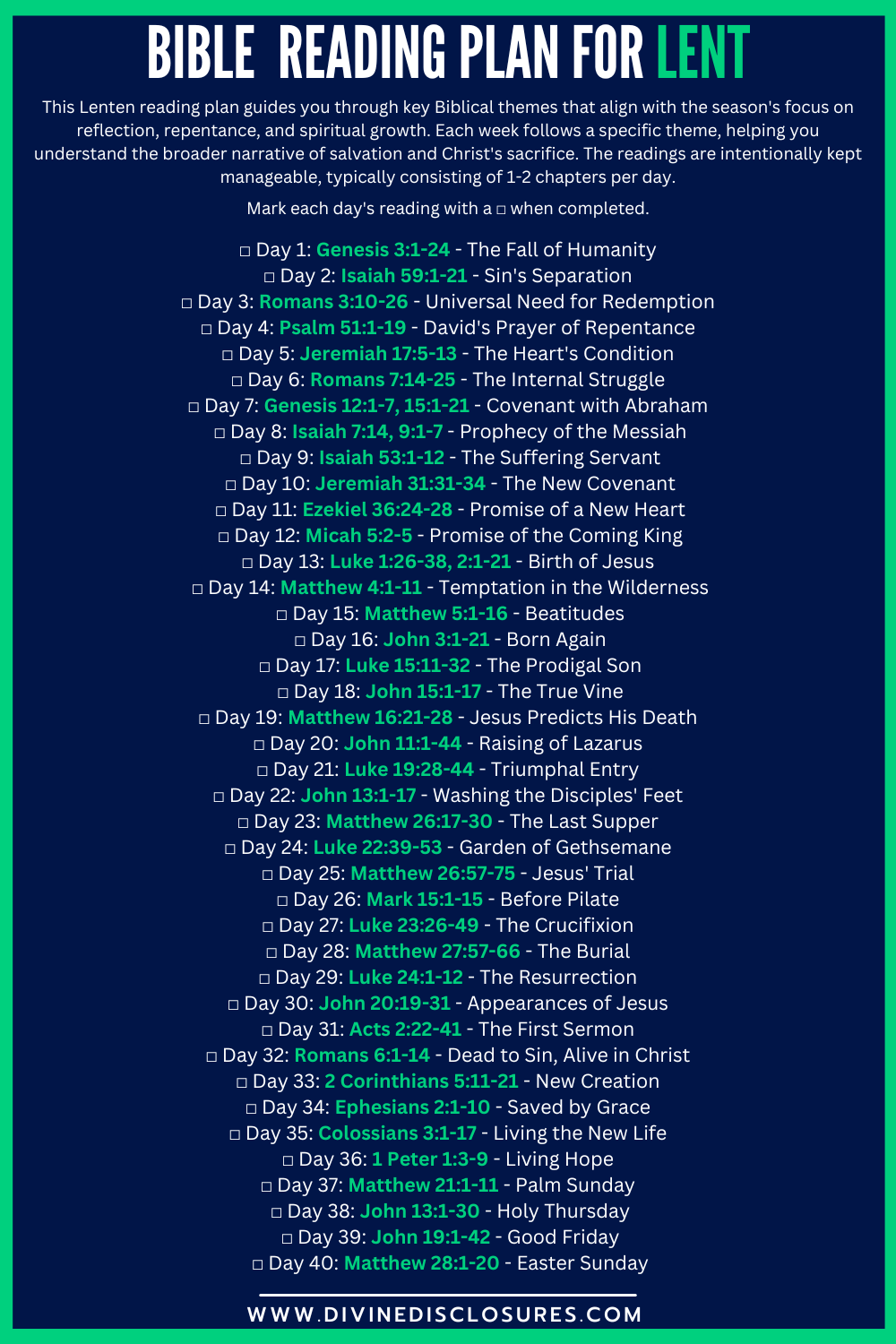
40-Day Lent Bible Reading Plan
This Lenten reading plan guides you through key Biblical themes that align with the season’s focus on reflection, repentance, and spiritual growth. Each week follows a specific theme, helping you understand the broader narrative of salvation and Christ’s sacrifice. The readings are intentionally kept manageable, typically consisting of 1-2 chapters per day.
Print this section out and mark each day’s reading with a ☐ when completed.
Week 1: The Need for Salvation
Theme: Understanding our need for a Savior
☐ Day 1: Genesis 3:1-24 – The Fall of Humanity
☐ Day 2: Isaiah 59:1-21 – Sin’s Separation
☐ Day 3: Romans 3:10-26 – Universal Need for Redemption
☐ Day 4: Psalm 51:1-19 – David’s Prayer of Repentance
☐ Day 5: Jeremiah 17:5-13 – The Heart’s Condition
☐ Day 6: Romans 7:14-25 – The Internal Struggle
Week 2: God’s Promise of Redemption
Theme: God’s covenant and promises
☐ Day 7: Genesis 12:1-7, 15:1-21 – Covenant with Abraham
☐ Day 8: Isaiah 7:14, 9:1-7 – Prophecy of the Messiah
☐ Day 9: Isaiah 53:1-12 – The Suffering Servant
☐ Day 10: Jeremiah 31:31-34 – The New Covenant
☐ Day 11: Ezekiel 36:24-28 – Promise of a New Heart
☐ Day 12: Micah 5:2-5 – Promise of the Coming King
Week 3: The Life of Christ
Theme: Understanding Jesus’ ministry and teaching
☐ Day 13: Luke 1:26-38, 2:1-21 – Birth of Jesus
☐ Day 14: Matthew 4:1-11 – Temptation in the Wilderness
☐ Day 15: Matthew 5:1-16 – Beatitudes
☐ Day 16: John 3:1-21 – Born Again
☐ Day 17: Luke 15:11-32 – The Prodigal Son
☐ Day 18: John 15:1-17 – The True Vine
Week 4: The Path to the Cross
Theme: Jesus’ journey toward sacrifice
☐ Day 19: Matthew 16:21-28 – Jesus Predicts His Death
☐ Day 20: John 11:1-44 – Raising of Lazarus
☐ Day 21: Luke 19:28-44 – Triumphal Entry
☐ Day 22: John 13:1-17 – Washing the Disciples’ Feet
☐ Day 23: Matthew 26:17-30 – The Last Supper
☐ Day 24: Luke 22:39-53 – Garden of Gethsemane
Week 5: The Crucifixion and Resurrection
Theme: The ultimate sacrifice and victory
☐ Day 25: Matthew 26:57-75 – Jesus’ Trial
☐ Day 26: Mark 15:1-15 – Before Pilate
☐ Day 27: Luke 23:26-49 – The Crucifixion
☐ Day 28: Matthew 27:57-66 – The Burial
☐ Day 29: Luke 24:1-12 – The Resurrection
☐ Day 30: John 20:19-31 – Appearances of Jesus
Week 6: New Life in Christ
Theme: The meaning and power of resurrection
☐ Day 31: Acts 2:22-41 – The First Sermon
☐ Day 32: Romans 6:1-14 – Dead to Sin, Alive in Christ
☐ Day 33: 2 Corinthians 5:11-21 – New Creation
☐ Day 34: Ephesians 2:1-10 – Saved by Grace
☐ Day 35: Colossians 3:1-17 – Living the New Life
☐ Day 36: 1 Peter 1:3-9 – Living Hope
Holy Week
Theme: Final reflection on Christ’s passion
☐ Day 37: Matthew 21:1-11 – Palm Sunday
☐ Day 38: John 13:1-30 – Holy Thursday
☐ Day 39: John 19:1-42 – Good Friday
☐ Day 40: Matthew 28:1-20 – Easter Sunday
A Biblical Framework for Lent Scriptures
Why We Return to God in Lent
Scripture gives us several interlocking reasons why returning to God is not optional maintenance but the heartbeat of covenant life.
We return because we are covenant people, not autonomous individuals. The repeated calls to return in the Old Testament—in Hosea, Joel, Jeremiah, and Isaiah—are addressed to a people in relationship with a God who has bound Himself to them. Drift is not merely personal spiritual failure. It is a movement away from a covenant. Lent names that movement and invites the reversal. The God calling you back is not a stranger—He is your Father, and the covenant He made is still standing.
We return because the human appetite is a wandering thing. Left to itself, desire migrates toward what is immediate, familiar, and manageable. The Lord understands this—Ezekiel’s vision of a new heart is not given to people who didn’t need one but to people whose old hearts had proven themselves unfaithful again and again. Lent works with the grain of human nature by building structure around the tendency to wander. It doesn’t shame the wandering. It provides a season for the return.
We return because repentance is a grace, not an achievement. The very ability to feel the pull toward God, to want to come back, to recognize the drift—this is the work of the Holy Spirit. You are not generating your own repentance. You are responding to a drawing that is already happening. Lent teaches you to cooperate with that drawing rather than resist or ignore it.
We return because formation requires repetition. The Scriptures describe change in agricultural terms—seed, soil, seasons, growth. The forty days of Lent are not a sprint toward a breakthrough. They are a season of sustained exposure to truth, silence, prayer, and worship. Real formation happens in the repetition, not in the peak moments. This is why the structure of Lent matters: the daily rhythm trains the soul’s habit of turning, which becomes the architecture of a whole life.
We return because Christ has already gone ahead. He went into the wilderness before us. He went to the cross before us. He went through death before us. Lent’s forty days are not a solo journey—they follow the path He already walked, and He is in them with us.
Practices That Strengthen Lent Scripture Meditation
Scripture meditation during Lent is not primarily about volume. Reading forty chapters in forty days and retaining nothing is less formative than sitting with one verse per day and letting it press itself into the week.
Praying the Scripture back to God is one of the most effective practices I’ve seen. Read the verse. Then pray it in first person, slowly, as a petition or declaration. “Create in me a clean heart, O God” becomes “I’m asking you, Father—create in me a clean heart. I can’t do this renovation myself. Do it.” This moves the text from information to conversation.
Reading Scripture aloud gives the body access to the Word, not just the mind. The early church read Scripture communally and orally—silence during reading is actually the more recent historical practice. Speaking the verse engages memory differently. If you’re meditating on a verse for a whole week, read it aloud in the morning. Let your own voice carry it.
Journaling a single line of response after reading keeps the mind from passive drifting. Not elaborate journaling—one sentence. “What this verse is asking of me today is…” or “What this verse tells me about the Lord is…” Writing anchors the meditation against the day’s distraction.
Fasting from other content creates space for the Word. A media fast during Lent—even a partial one—is not about deprivation. It’s about clearing the channel. The mental noise that fills the space left by Scripture is usually not neutral. Deliberately leaving that space open and filling it with the Word is a form of discernment.
A word of pastoral honesty: scriptures on discernment are helpful alongside these practices because Lent asks you to pay attention to what is actually happening in you—not what you think should be happening. Discernment during Lent means noticing what these verses are touching, what is resisting, and what is quietly softening. That attention is itself a spiritual discipline.
Finally, carry one verse per week. Not the full list. One. Write it on a small piece of paper. Put it where you’ll see it—above the sink, on the dashboard, in your pocket. Seven days with one verse, brought back every morning, does more than speed-reading a chapter does. Lent is not a reading challenge. It’s a return.
Common Questions Related to Lent – Theological FAQ
What is Lent?
Lent is a significant 40-day period in the Christian liturgical calendar that begins on Ash Wednesday and ends on Holy Saturday, the day before Easter Sunday. During this time, many Christians engage in fasting, prayer, and acts of self-denial to commemorate Jesus Christ’s 40-day fast in the wilderness and his subsequent death and resurrection. The number 40 holds biblical significance, mirroring not only Jesus’ time in the desert but also the 40 days of the Great Flood and the Israelites’ 40 years in the wilderness.
Traditional Lenten practices include giving up certain foods or luxuries, increasing prayer and charitable giving, and focusing on spiritual reflection and repentance. The period excludes Sundays in its count, as these are considered “mini-Easters” celebrating Christ’s resurrection.
Why does Lent feel emotionally flat, even when I’m doing everything “right”?
The flatness you’re feeling is not a sign that something has gone wrong. It may be the most important thing happening during your Lent. What Lent strips away first is the emotional hit—the warm feeling of closeness, the sense that your prayers are landing somewhere, the small glow of spiritual effort. When that goes, you’re left with what the older Christian writers called aridity. It’s the condition of practicing faithfulness without feeling it. This is not abandonment. It’s the Lord moving you from faith-that-feels-good to faith-that-holds-steady.
Think of it like a radio signal: the static doesn’t mean the signal stopped broadcasting. It means you’re learning to tune differently. The work is to keep showing up in the flatness without manufacturing emotion to replace what left. That quiet, unglamorous perseverance is formation. It builds something that peak emotional experiences don’t.
How do I know if my Lenten fasting is coming from right motives or from hidden guilt?
This is worth sitting with honestly. Performance-driven fasting has a texture: it keeps score, compares itself to others, feels righteous when maintained and ashamed when broken, and treats God like a judge who needs placating. Grace-driven fasting has a different texture: it comes from a desire to create space for the Lord, it can acknowledge failure without collapsing, and it connects outward abstinence to inward re-ordering rather than outward impression management.
Ask yourself: if no one would ever know what you gave up this Lent—not your community, not your small group, not anyone—would you still do it? And: are you fasting to feel clean, or to draw close? The first question belongs to penance. The second belongs to formation. Both can start in the same action, but they end up in very different places. Bring the hidden guilt to the Lord directly rather than trying to fast it away.
What about people who struggle with guilt spirals during Lent—how do they engage with confession and repentance without it becoming harmful?
Guilt spirals are one of the things I watch for most carefully during Lent. They look like this: confess → feel temporarily better → repeat the same sin or perceived failure → feel worse than before → confess again, now with added shame. The cycle depletes rather than forms. The pastoral move here is to separate confession from emotional resolution. Confession is not a transaction whose completion you feel. It’s a declaration you make and a truth you receive. You confess once, clearly and honestly. You receive the forgiveness that 1 John 1:9 declares. You close that case.
If the feeling of guilt returns—and it often does—you don’t re-open the file. You say: “I’ve confessed this. The Lord is faithful and just. This is forgiven.” Then you redirect. The guilt that returns after genuine confession is not the Holy Spirit’s conviction—it’s the accuser’s harassment. Treat those two things as different. Conviction leads to confession and peace. Accusation leads to spiraling and shame. Lent should make you more honest, not more tormented.
What would be the best 5 Lent Bible verses to meditate on or memorize this season?
Here are five verses worth giving extended attention to—one for each major movement of Lent.
Joel 2:12–13a — A Lent Bible verse for the starting posture: “Return to me with all your heart.” The heart-direction of return is the whole foundation. Start here. Come back to it whenever you feel like you’ve drifted.
Psalm 51:10 — Another Bible verse for Lent that belongs early in the season: “Create in me a clean heart, O God.” It’s short enough to memorize in a day and deep enough to pray for forty. Say it in the morning before the day gets loud.
Isaiah 58:6 — This Scripture would also be an excellent Scripture for Lent because it refuses to let fasting remain purely interior. It asks: who is being freed because you are fasting? It keeps Lent outward-facing and connected to mercy.
Hebrews 4:15 — A Lent Bible verse for the wilderness weeks: “We do not have a high priest unable to sympathize with our weaknesses.” When temptation increases, when the middle weeks get hard, this verse puts a Person beside you in the pressure. Memorize it for those moments.
Romans 8:38–39 — Another Bible verse for Lent that belongs at the end—read it in Holy Week. Nothing can separate you from the love of God in Christ Jesus. That’s not a feeling. That’s a declaration. Lent is forty days of preparation to receive it.
Simple memorization tip: write the reference and the first five words of each verse on a small card. Review the card each morning for seven days. By the end of the week, the verse will be in you. By the end of Lent, it will have done its work.
Can Lent cause spiritual harm if approached with the wrong expectations?
Honestly, yes—if Lent is treated as forty days to earn Easter, it can produce either pride (if you “succeeded”) or shame (if you didn’t), and neither of those is formation. Lent approached as performance produces the exact opposite of what it’s designed to do.
The safeguard is this: keep returning to grace as the starting environment, not the reward at the end. You do not fast your way into God’s favor. You do not confess your way into His love. You are already held by a covenant love that predates your Lent practice and will outlast it. What Lent does is create conditions for you to receive that love more deeply—to clear away the noise, re-order the appetites, and return your attention to the Lord. Done from that foundation, Lent is life-giving. Done as performance, it becomes another form of striving. The verses in this collection are meant to keep you in the first category.
When Does Lent Start?
Lent traditionally begins on Ash Wednesday, which is 46 days before Easter Sunday. This period includes 40 days of fasting, symbolizing the 40 days Jesus spent fasting in the desert, plus six Sundays, which are not considered part of the fast
When Is Lent Over?
Lent concludes on Holy Saturday, the day before Easter Sunday. The season is marked by the culmination of Holy Week, including significant observances like Maundy Thursday and Good Friday, leading up to the celebration of Jesus’ resurrection on Easter.
What to Give Up for Lent?
During Lent, individuals often choose to give up certain luxuries or engage in practices of self-denial as a form of penance and spiritual discipline. Common sacrifices include abstaining from favorite foods, social media, or other personal indulgences to focus on prayer and reflection.
Can You Eat Chicken During Lent?
On Fridays during Lent, Catholics traditionally abstain from eating meat, which includes chicken, as a form of sacrifice and remembrance of Jesus’ suffering. Fish, however, is allowed, as it is not considered meat in this context.
Is Lent Catholic or Christian?
Lent is observed by many Christian denominations, including Catholics, Orthodox Christians, and some Protestant groups. While it is most closely associated with the Catholic Church, its observance is widespread among various Christian traditions, focusing on reflection, repentance, and preparation for Easter.
A Lent Commission: From What to So What
Lent is not earned holiness. I want to say that one final time, clearly, before I send you out. The forty days you’ve just walked through—or are about to walk through—are not a payment. They are not a negotiation. You don’t arrive at Easter having paid off a spiritual debt through forty days of discipline. You arrive at Easter because Jesus went ahead of you, through the wilderness, through the suffering, through the grave, and He is standing on the other side of it all. Your Lent is a response to that love, not a means of producing it.
So here’s what I want you to do with everything you’ve just read.
Pick one verse that felt like a hand on your shoulder. Not the most impressive verse. Not the one you think you should choose. The one that stopped you. The one that made something shift. You know which one it is.
Write it down. Not in your phone—on paper if you can. Put it somewhere you’ll see it when you wake up.
Pray it tomorrow morning. Not a long prayer. Just the verse, and then: “Lord, this is what I need. Do this in me.”
Repeat it for seven days. One verse, seven mornings, before the day gets loud.
Don’t try to apply all sixty-plus lent bible verses at once. That’s not how seed grows. Pick up the one verse. Pray the one verse. Let the Lord work in the quiet. The rest of the collection will be here when you’re ready to return to it.
Here is a short commissioning for the days ahead:
You are not fighting for God’s attention. You have it. You are not earning His love. You are living inside it. Confess honestly. Return steadily. Fast from what has taken His place. Give generously from what He has given you. Walk through the wilderness with the one who walked it first. And when Easter comes—not if, but when— receive it not as a reward you earned but as a declaration that was always already true: He is risen. You are held. Nothing can separate you from this.
Go. And come back to the Word tomorrow.
For more Lenten prayer and Scripture resources, explore the Good Friday Bible Verses collection as Holy Week approaches.
Has this Article been a a Blessing?
Your Next Step to Spiritual Growth
Consider Partnering with Divine Disclosures
Access Resources & Personal Guidance
Access 150+ Prayers exclusive Prayer Handbooks and support the ministry
Submit A Prayer Request
Access the primary portal or use one of the specific submission links below for immediate, targeted prayer
Spiritual Growth & Content Articles
Deepen your knowledge of the Word with study, scriptures, and more prayers
Share This Article
Help others discover God’s word. Share your thoughts below and spread the message!
Show more on Divine Disclosures →