Do you feel under ATTACK? Pastor Danny prays this powerful PRAYER AGAINST EVIL for you, your family, and your house - Watch Now


A prayer for nightmares and bad dreams is not superstition. It is not drama. It is a Scripture-aligned way to seek peace, cleanse the mind, and re-establish rest under God’s covering — bringing what happens in the night under the authority of Christ.
I wrote and curated these prayers for bad dreams and nightmares because I’ve sat with too many people who were ashamed to mention their dreams — as if nightmares were a sign of weak faith, or worse, that prayer couldn’t reach that far. Over time I’ve seen a clear pattern: the disruption is real, the exhaustion is real, and a targeted, biblically grounded prayer makes a measurable difference in how people return to sleep and carry themselves the next day.
I remember a season of ministry in Colombo where I was walking with a small group of people from a particular neighborhood — most of them carrying years of accumulated dread and hypervigilance from things they had lived through. One woman, waking repeatedly from the same sequence of images, had stopped even trying to sleep before midnight. What shifted things for her began with a single, direct warfare prayer against nightmares — one that named what was operating, renounced its access, and released the authority of Christ over her sleep. And honestly, for some people, that is exactly what happens: one prayer, prayed with the Spirit’s unction, dismantles a demonic root and the nightmares stop. God is fully capable of that kind of breakthrough, and I’ve seen it.
But I’ve also seen something else just as often — nightmares and bad dreams that carry layers. Fear of sleep sitting underneath the dream itself. Shame residue from dream content the person didn’t choose. Stress accumulated over months feeding the imagery. A traumatic memory surfacing in new form. Sometimes a spiritual root and a psychological one tangled together. A single prayer for nightmares may break one layer and leave others untouched — not because the prayer lacked power, but because the problem has more than one face.
That’s why this article contains many prayers for bad dreams. Not because one prayer is weak. Because accuracy matters as much as intensity. Panic-waking at 3am needs a different prayer than the dread that lingers into morning. A child’s nightmare needs a different approach than a shame-soaked dream. Recurring cycles need to be addressed differently than a one-off disturbance. Matching the prayer to the specific moment is how you pray with precision — and precision, sustained over time, is what produces lasting rest.
Table of Contents
A Prayer When Nightmares and Bad Dreams Have Been Wearing You Down — Start Here
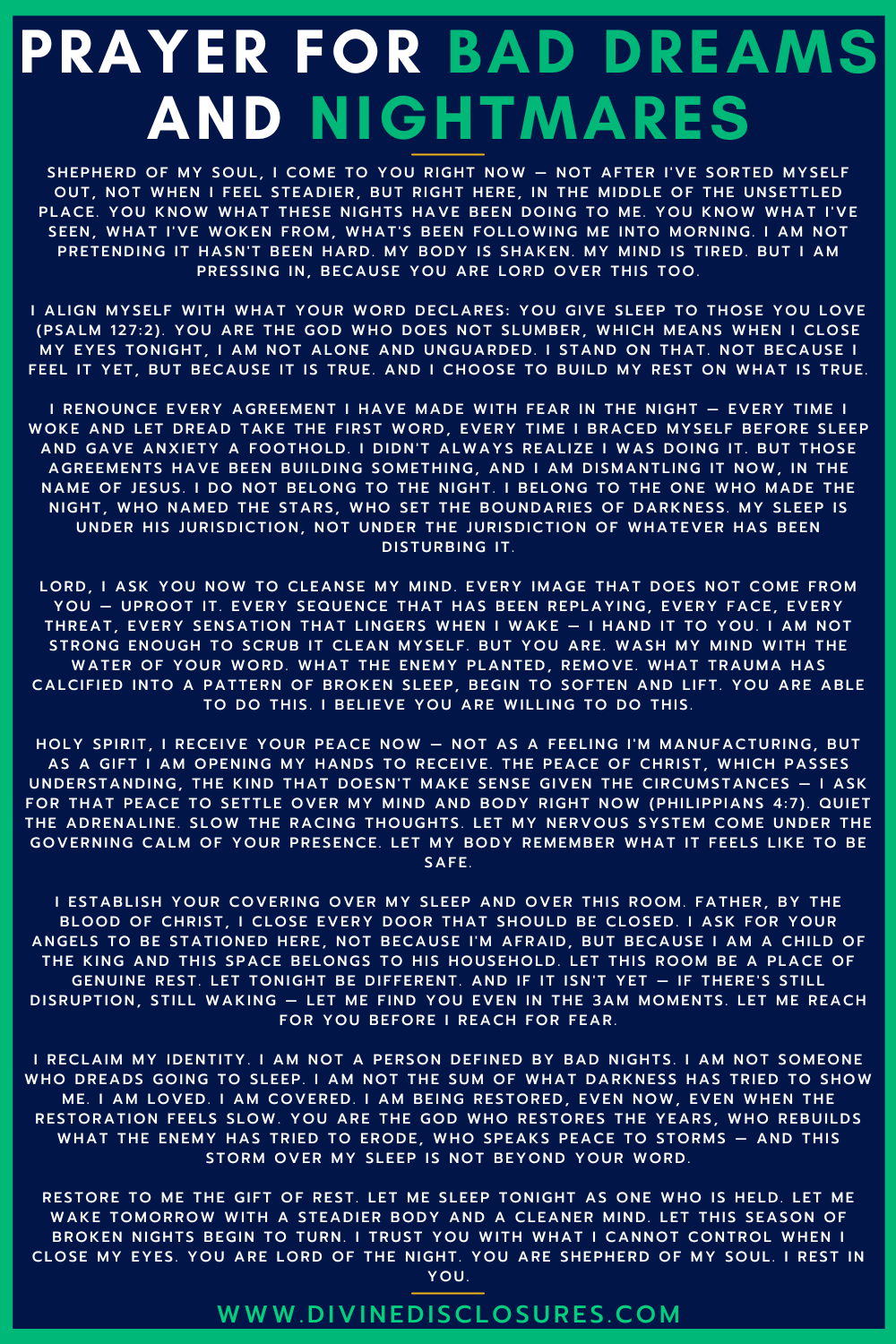
Shepherd of my soul, I come to You right now — not after I’ve sorted myself out, not when I feel steadier, but right here, in the middle of the unsettled place. You know what these nights have been doing to me. You know what I’ve seen, what I’ve woken from, what’s been following me into morning. I am not pretending it hasn’t been hard. My body is shaken. My mind is tired. But I am pressing in, because You are Lord over this too.
I align myself with what Your Word declares: You give sleep to those You love (Psalm 127:2). You are the God who does not slumber, which means when I close my eyes tonight, I am not alone and unguarded. I stand on that. Not because I feel it yet, but because it is true. And I choose to build my rest on what is true.
I renounce every agreement I have made with fear in the night — every time I woke and let dread take the first word, every time I braced myself before sleep and gave anxiety a foothold. I didn’t always realize I was doing it. But those agreements have been building something, and I am dismantling it now, in the name of Jesus. I do not belong to the night. I belong to the One who made the night, who named the stars, who set the boundaries of darkness. My sleep is under His jurisdiction, not under the jurisdiction of whatever has been disturbing it.
Lord, I ask You now to cleanse my mind. Every image that does not come from You — uproot it. Every sequence that has been replaying, every face, every threat, every sensation that lingers when I wake — I hand it to You. I am not strong enough to scrub it clean myself. But You are. Wash my mind with the water of Your Word. What the enemy planted, remove. What trauma has calcified into a pattern of broken sleep, begin to soften and lift. You are able to do this. I believe You are willing to do this.
Holy Spirit, I receive Your peace now — not as a feeling I’m manufacturing, but as a gift I am opening my hands to receive. The peace of Christ, which passes understanding, the kind that doesn’t make sense given the circumstances — I ask for that peace to settle over my mind and body right now (Philippians 4:7). Quiet the adrenaline. Slow the racing thoughts. Let my nervous system come under the governing calm of Your presence. Let my body remember what it feels like to be safe.
I establish Your covering over my sleep and over this room. Father, by the blood of Christ, I close every door that should be closed. I ask for Your angels to be stationed here, not because I’m afraid, but because I am a child of the King and this space belongs to His household. Let this room be a place of genuine rest. Let tonight be different. And if it isn’t yet — if there’s still disruption, still waking — let me find You even in the 3am moments. Let me reach for You before I reach for fear.
I reclaim my identity. I am not a person defined by bad nights. I am not someone who dreads going to sleep. I am not the sum of what darkness has tried to show me. I am loved. I am covered. I am being restored, even now, even when the restoration feels slow. You are the God who restores the years, who rebuilds what the enemy has tried to erode, who speaks peace to storms — and this storm over my sleep is not beyond Your word.
Restore to me the gift of rest. Let me sleep tonight as one who is held. Let me wake tomorrow with a steadier body and a cleaner mind. Let this season of broken nights begin to turn. I trust You with what I cannot control when I close my eyes. You are Lord of the night. You are Shepherd of my soul. I rest in You.
Download your Bad Dreams & Nightmares Prayer Handbook – details below
Why We Pray Like This for Nightmares and Bad Dreams
Scripture is direct about the night being under God’s authority. Psalm 4:8 establishes that genuine peace at night is not wishful thinking — it is a covenant reality for those who dwell under the Lord’s care. Philippians 4:7 frames the peace of God as something that actively guards both mind and heart. The mechanism at work in this kind of prayer is covenant identity — we are not praying as those who hope God might help, but as those who already belong to Him, re-anchoring that truth over a mind and body that has been unsettled.
One false expectation worth correcting: if you still feel shaken after praying, it doesn’t mean the prayer didn’t work. The body takes time to catch up with what the spirit has received. Steadiness comes, but it comes incrementally — and that’s not a failure of faith. It’s how restoration typically moves.
The Divine Disclosures Night Watch Path for Nightmares and Bad Dreams
This isn’t a generic prayer method. It was built specifically for the terrain of nightmares — the 3am waking, the racing heart, the residue that follows you into morning. It works in two modes: a pre-sleep version and an after-waking version. Use whichever fits the moment.
1. Settle Before You Seek – Before you pray anything, sit up. Feet on the floor if you can. One slow breath. This is not about manufacturing calm — it’s about stopping the free-fall. Panic closes down coherent thought and coherent prayer. A simple physical repositioning signals to your body that you are no longer inside the threat. You’re not performing; you’re just getting steady enough to speak. (Pre-sleep version: this step is already done. Skip to step 2.)
2. Name It, Don’t Replay It – Identify what’s present in one or two words — dread, panic, shame residue, intrusive imagery, fear of sleep — without narrating the whole dream back to yourself. Naming it gives you something specific to bring to God. Replaying it deepens the groove and makes re-entry to sleep harder. One word is enough: dread. Fear. Shame. Hand that word to the Lord.
3. Speak Truth Before You Ask – Before making any requests, speak one declaration aloud — even quietly. “You are Lord of the night.” “I am covered.” “This dream does not define me.” One sentence. This step matters because it repositions you. You are not praying as someone exposed and begging for help; you are praying as someone who belongs to God and is standing on that fact. Identity before petition.
4. Pray and Release – Now bring the actual prayer — short or long, depending on your capacity. After you finish, open your hands — physically, or deliberately in your mind — as a release gesture. You are not white-knuckling the prayer or hoping you prayed hard enough. You are placing what you carried into hands that are stronger than yours. The open hand is the posture of trust, not passivity.
5. Return, Don’t Review – Close with one quiet line — spoken or whispered — and move toward sleep without reviewing the dream, rehearsing the fear, or checking the clock. “You hold the night. I rest in You.” The goal of this final step is re-entry, not resolution. Full resolution may take time. Tonight’s goal is simply to return to rest under God’s covering, not to have every question answered before you close your eyes again.
The pre-sleep version of this path naturally collapses to steps 3 and 4 — speak one truth aloud, pray and release — which keeps it sustainable as a nightly rhythm without feeling like a full ritual. Consistency over weeks matters more than intensity on any one night.
If you’re also carrying an overthinking pattern that bleeds into your pre-sleep hours, the Prayers for Overthinking page addresses that specific overlap.
A Short Case Study — What Changes When We Pray for Nightmares and Bad Dreams Like This
I worked over several months with someone who had been waking at the same point every night — disoriented, heart pounding, unable to identify what had actually happened in the dream. What we changed wasn’t dramatic. Before bed, they began opening their Bible to Psalm 91 and speaking one verse aloud — not a full reading, just one line with intention. After waking from a nightmare, instead of lying in the dark replaying it, they would sit up, place their hands open in their lap, and pray the same short prayer every time: You are Lord of the night. I receive Your peace. No performance. No length. Just positioning.
What changed over the following weeks wasn’t that the nightmares vanished overnight. What changed was the body’s response to waking. The heart rate came down faster. The dread lingered for shorter intervals. By the end of the second month, the pattern of waking at the same point had broken. What the consistent posture did was re-train the body’s first move from panic to prayer — and that shift, small as it sounds, changed everything about the night.
Ministry Field Note — What I’ve Noticed Before People Start Praying
I’ve noticed that people who come to prayer for nightmares are often dealing with two separate problems at once: the dream itself, and the fear of having another one. Those are different issues and they need different prayers. The first is about cleansing and authority. The second is about pre-sleep anxiety — a kind of anticipatory dread that actually affects sleep onset and dream quality before a single image even appears. Over time, I’ve seen people spend all their energy praying against the dreams and none of it addressing the bracing that happens at bedtime. If going to sleep feels like walking into a threat, that posture is already doing damage.
The other thing I’ve observed — and this one surprises people — is that the prayers you pray before a nightmare do more structural work than the prayers you pray after one. Reactive prayer is necessary and good. But pre-sleep prayer that establishes covering, names God as Lord of the night, and releases the day’s weight is what changes the baseline over time. Reactive prayer deals with the immediate crisis. Pre-sleep prayer reshapes the environment that crisis keeps occurring in. Both matter, but if you’re only praying when you wake in panic, you’re doing half the work.
Love to Pray? Live in His Presence
Join Daniel Niranjan’s inner circle who receive Spirit-filled prayers, prophetic encouragement, prayer insights and practical guides to help you pray with authority and confidence.
Join 12,000+ Believers Growing in Prayer and Power
Prayer Against Nightmares That Keep Recurring
Lord of peace, I come to You about this pattern — this cycle that has been running in the night, the same sequence returning again and again. I am not willing to accept this as simply how my nights are. This is not who I am and it is not what You have for me.
In the name of Jesus, I break this cycle at its root. I do not just ask You to interrupt it tonight — I ask You to uproot whatever has been feeding it. If there is a door I opened, I close it now, consciously, by the blood of Christ. If there is an agreement with fear or dread that I made without realizing it, I renounce it fully. I do not give the night permission to run this sequence again.
I speak Your Word into this pattern: You make me dwell in safety. That word dwell is not accidental — it describes a settled, established state, not a temporary respite. I am asking for that settled state over my sleep. Establish it, Lord. Let tonight be the beginning of a different pattern — one You author.
Cleanse the mental pathway that this dream has worn. Quiet the images. Uproot the emotional residue that follows me into morning. Where the enemy has been exploiting a weakness, close that access. Where my own mind has been caught in a loop, interrupt it by the peace of Your Spirit.
I receive Your rest. Not as something I am working up to, but as something that already belongs to me in Christ. I lie down under Your covering tonight — steady, held, and free from this cycle.
Pastoral Perspective on Praying Against Recurring Nightmares
Recurring nightmares follow a groove — the same images, the same sequence, the same jolting awake. Over time I’ve observed that these patterns are rarely just psychological; they often represent a point of agreement that needs to be explicitly broken, not just prayed around. Pray this one with intention and authority, not desperation.
Digging Deeper
The Hebrew word shalam — from which shalom derives — means not just peace but completeness, wholeness, nothing broken and nothing missing. When David writes of lying down in peace, he is invoking something total. Recurring nightmares represent a fracture in that wholeness, a breach that keeps reopening. Praying for shalom over sleep is not asking for a mild calm; it is asking for a restoration of what belongs to a life under God’s covenant care. That understanding sharpens the prayer considerably.
“I will lie down and sleep in peace, for you alone, Lord, make me dwell in safety.” — Psalm 4:8 (NIV)
Ministry Field Note — The Mistake That Costs People the Most
Something I want to address that tends to get skipped in articles like this: the difference between a nightmare that is spiritually sourced and one that is the mind’s own processing work. In practice, most disrupted sleep sits somewhere between the two — and the mistake I’ve seen repeatedly is people either over-spiritualizing everything (turning every bad dream into a warfare event) or under-spiritualizing everything (dismissing every disturbing pattern as “just stress”). Both errors have a cost. Over-spiritualizing produces fear and hypervigilance; under-spiritualizing leaves real spiritual dynamics unaddressed.
The more useful question is not “which is this?” but “what does this pattern require?” A nightmare that follows a heavy news cycle and too much screen time before bed probably needs a different response than one that carries a specific, oppressive atmosphere and recurs without obvious psychological cause. I’ve learned to ask people: does this feel like your mind working something out, or does it feel like something working on you? That distinction, while not always clean, usually points toward the right prayer and the right pastoral lane.
What I’ve come to trust is this: the prayers for bad dreams in this article work for both sources. Cleansing the mind, establishing God’s covering, renouncing fear — those are right moves regardless of what is driving the disruption. The distinction matters most when the pattern is severe and persistent, which is when a pastoral conversation or professional support should enter the picture.
💡 Did You Know?
Not every bad dream means the same thing. Some nights reflect stress, fear, or exhaustion. Others feel spiritually oppressive. This handbook helps you pray wisely through both—covering your mind, your sleep, your home, and your peace. Details below!
Prayer for Nightmares That Make You Afraid to Sleep
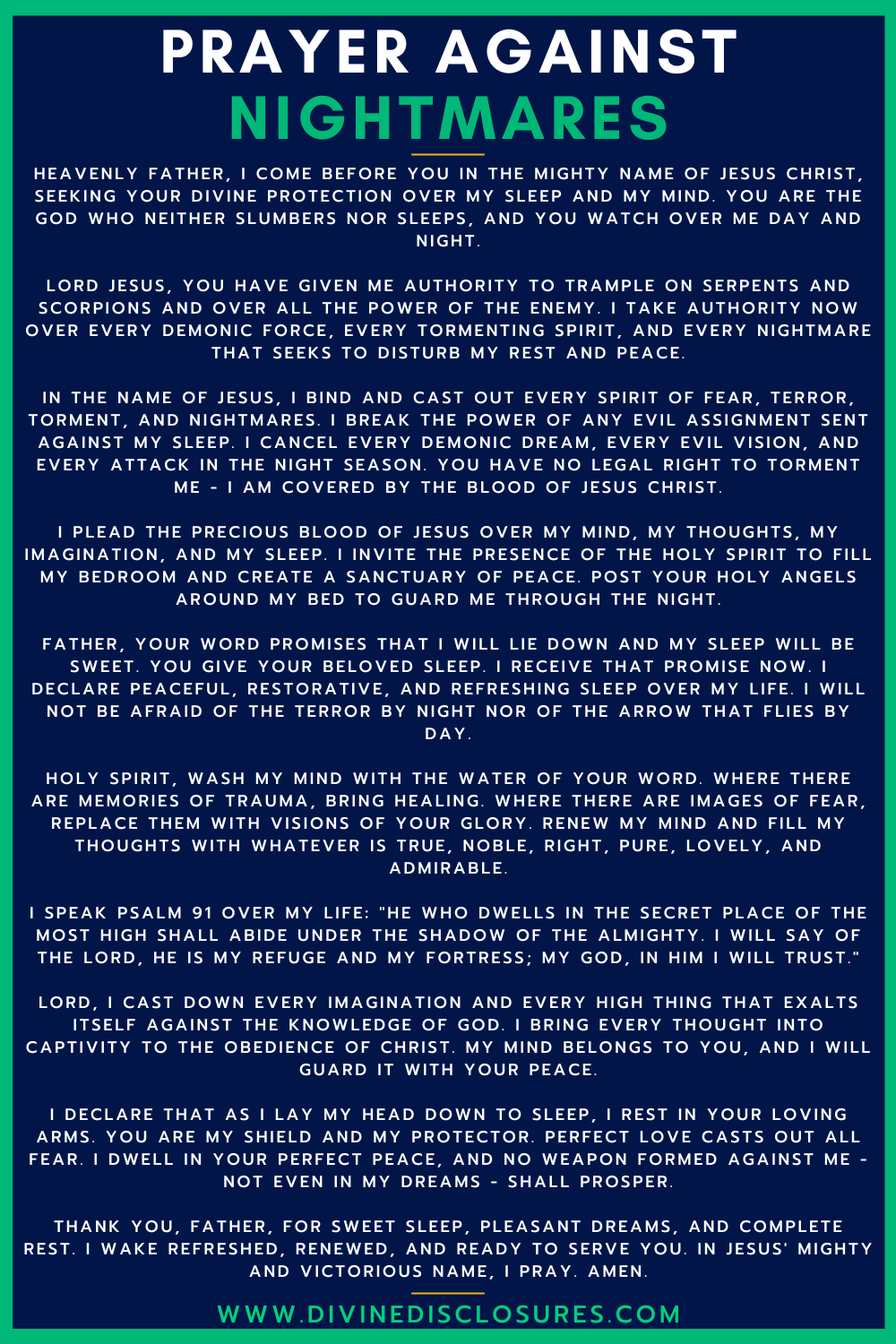
Father of mercies, I am sitting here at the edge of sleep and something in me is bracing. I want to name that honestly before You: I am afraid to close my eyes. Not because I don’t trust You — but because my body has learned, over enough nights, to expect disruption. That expectation is running right now, and I am bringing it to You.
I do not want to white-knuckle my way to sleep. I ask You to meet me here, in this specific moment, before my eyes even close.
Quiet the anticipatory dread. Let the bracing in my chest release. You hold the night — that means You hold what is on the other side of sleep for me. I don’t have to brace against it. I can enter rest in confidence, because You are already there.
I receive the promise of Proverbs 3:24 — sweet sleep, undisturbed rest, a mind that is held by wisdom rather than rattled by fear. That promise is not for someone else. It is for me, tonight.
Holy Spirit, be the last thing I am conscious of as I fall asleep. Let Your presence be what I drift into, not the dread. Steady my breathing. Soften the hypervigilance. Let my body learn what it feels like to enter sleep without armor.
I trust You with tonight. I trust You with what I cannot see or control when I close my eyes. You are the Shepherd who does not sleep. I rest in that. I let go now.
Pastoral Perspective on Praying When Fear of Sleep Has Set In
The fear of falling asleep is sometimes more disruptive than the nightmares themselves. I’ve walked with people who weren’t even sure what they were afraid of — just a creeping unease as bedtime approached. Pray this one slowly, before you get into bed, with something worshipful playing quietly if that helps ground you.
Digging Deeper
Proverbs 3:24 carries a striking Hebrew word for “sweet” — arevah, which can also suggest pleasant and agreeable. The verse is embedded in a passage about holding onto wisdom and instruction; the implication is that guarded sleep follows a guarded mind. Pre-sleep fear is often a sign that the mind hasn’t been given anything steady to hold. This prayer addresses that directly — not by suppressing the fear but by giving the mind something true to grip before it crosses into sleep.
“When you lie down, you will not be afraid; when you lie down, your sleep will be sweet.” — Proverbs 3:24 (NIV)
Expert Box — What the Hebrew Actually Says About Your Sleep
Psalm 121:4 declares that God “neither slumbers nor sleeps” — a statement that does more than describe His wakefulness. In the ancient Near East, a sleeping god was a compromised god. Neighboring cultures genuinely feared that their deities might be inattentive or unavailable at night. Israel’s confession was a direct counter to that: their God does not drift. The word yanum (slumber) and yishan (sleep) are both used to underscore total, unbroken vigilance. When you close your eyes tonight, you are not entering a space where God’s attention has lapsed. You are entering a space He is actively watching. That is the specific theological ground under every nightmare prayer.
Takeaway: Your sleep is not unsupervised. The One who watches over you has not looked away.
Prayer for Bad Dreams That Leave a Dirty Feeling Behind
Lord, the images from that dream are still here. I can feel them sitting on my mind, and I don’t want them. I am bringing them to You right now, before I do anything else.
I ask You to cleanse my mind. Not suppress — cleanse. Every image that was dark, defiling, frightening, or disorienting: I hand it to You. I do not want to carry it into today. I do not consent to it sitting in my memory and doing damage through the hours ahead.
Displace what the dream placed there. Replace it with what is true, noble, right, and pure — the categories of Philippians 4:8. Let my mind come back to solid ground. Let the imagery lose its grip as Your presence takes up space in my thoughts.
Where I was made to see things I did not choose to see, I ask for a specific washing. The blood of Christ covers the mind as much as it covers the conscience. I receive that covering now over every image from last night.
Restore a clean interior. Let me move into today without dragging the residue of what happened in the night. Let the cleansing be thorough. And where the images try to surface again through the day — remind me that they have been handed over, that they don’t belong to me, that I am clean.
Thank You that You are able to do this. I receive it.
Pastoral Perspective on Praying Through Disturbing Dream Imagery
Pray this one immediately after waking — before you reach for your phone, before you replay what you saw. The goal is to displace the imagery quickly, not dwell on it. Sit up, if you can. Speak the prayer aloud; it helps break the mental loop faster than praying silently.
Digging Deeper
Philippians 4:8 uses the Greek logízomai for “think” — which means to reckon, to take account of, to deliberately set the mind toward. Paul is not describing passive thought; he’s describing an intentional mental act. After disturbing dream imagery, the mind tends to replay what it has seen. This prayer interrupts that loop by invoking a deliberate re-anchoring — asking the Spirit to actively displace what the dream placed there and replace it with what is pure and true.
“Finally, brothers and sisters, whatever is true, whatever is noble, whatever is right, whatever is pure… think about such things.” — Philippians 4:8 (NIV)
Prayer for Bad Dreams Brought On by Prolonged Stress
Jesus, I come to You weary. Not just tired — the deeper kind of worn down that has been building for a long time. The stress I’ve been carrying has found its way into my sleep, and what’s happening in the night is showing me something my waking hours have been too busy to acknowledge: I am burdened, and I need rest.
I receive the invitation of Matthew 11:28 right now. I stop striving, even in this prayer. I don’t come to You with performance or formulas. I come with my hands open, palms up, setting down what I’ve been holding.
I release the weight of what I’ve been carrying. I release the pressure, the uncertainty, the accumulated load of the season I’ve been in. I do not need to solve it tonight. I do not need to figure it out before I can rest. I hand it to You, and I trust that Your shoulders are broad enough.
Let my body respond to that release. Let the nervous system slow. Let the sleep that comes tonight be genuinely restoring — not just hours logged, but actual rest received. Let the dreams reflect the reality that the burden has been handed over, not the anxiety of still carrying it.
Where prolonged stress has worn a groove of disrupted sleep, begin to fill that groove with peace. Let rest return not all at once, but steadily — night by night, incrementally. I don’t need instant transformation. I just need to begin moving in the right direction.
Lift the load, Lord. Give me rest. The real kind.
Pastoral Perspective on Praying for Rest When Stress Is the Root
Stress-related bad dreams are different from spiritually sourced ones — though they can overlap. Over time I’ve found that these prayers need to address the body as much as the mind. Pray this one with your hands open, palms up, if you’re able. The posture matters; it’s a physical signal of release.
Digging Deeper
In Matthew 11:28, the Greek word for “rest” is anapauō — meaning to cause to cease from labor, to give intermission from toil. It’s not just inner peace; it’s a stopping. The word “weary” (kopiaō) describes the fatigue of hard labor — exactly the state a person carries after months of sustained stress. Jesus is speaking directly to this condition. Prolonged stress leaves a biochemical and psychological residue that shows up in disturbed sleep. This prayer asks God to address both the symptom (the dreams) and the underlying load that is feeding them.
“Come to me, all you who are weary and burdened, and I will give you rest.” — Matthew 11:28 (NIV)
Expert Box — Why Feeling Shaky After Prayer Isn’t a Failure
Here’s something that runs counter to what most people expect: the goal of prayer after a nightmare is not to feel peaceful before you go back to sleep. It is to position yourself correctly regardless of how you feel. Peace, in the biblical sense, is not an emotional state you achieve before you act — it is a reality you receive and then act from. A person who prays the Night Watch Path and still feels shaky when they lie back down has not failed. They have re-established the right posture. The body catches up to what the spirit has received, but it does so on its own timetable. Waiting for calm feelings before returning to sleep means letting the body set the agenda. The prayer sets the agenda. The calm follows.
Takeaway: Pray accurately, then return to rest. Don’t wait for peace to feel complete before you act on it.
Blessed by these prayers? Get your Bad Dreams & Nightmares Prayer Handbook today — details below
Prayer Against Nightmares: Establishing Night Covering Over Your Sleep
Most High God, I stand in this room under Your authority, and I establish Your covering over this space and over my sleep tonight.
This room belongs to You. I declare that now — not as a wish, but as a covenant fact. The peace of God governs this space. What is dark and disruptive has no jurisdiction here. I close every door that should be closed: every entry point for disturbance, every crack that fear has tried to keep open. By the blood of Jesus, I seal this space for rest.
I ask for Your angels to be stationed here. Not because I am afraid, but because I am Your child, and this is Your household’s territory. Let Your presence fill what the darkness would try to occupy. Let this room carry the weight of peace — the kind that is felt, not just believed.
I speak Psalm 91:1 over myself tonight: I dwell in the shelter of the Most High. I rest in the shadow of the Almighty. I do not rest exposed. I do not sleep vulnerable. I sleep covered, held, established under Your protection.
Let this covering persist through every hour of the night. When I shift in sleep, when I pass from one stage of rest to another — let Your covering remain unbroken. What I establish now, let it hold until morning.
I receive Your peace over this room. I receive Your covering over my sleep. I lie down in safety, because You are my shelter and my God.
Pastoral Perspective on Praying Night Covering Over Your Space
Pray this one standing in the room if you can — at least initially. There is something in the physical act of claiming space that corresponds to the spiritual reality you are establishing. This is not superstition; it is the same principle behind anointing a doorpost or dedicating a space. The room is yours, under God’s authority, and this prayer makes that explicit.
Digging Deeper
Psalm 91:1 uses tsēl for “shadow” — the shadow of the Almighty. In Hebrew culture, to be in someone’s shadow was to be under their direct protection and patronage. It was a term for the closest possible covering. The word yashab (“dwell”) implies settled, ongoing habitation, not a brief visit. This prayer isn’t asking for a one-night covering; it’s establishing an ongoing residency under God’s protection. That distinction matters: you’re not doing this prayer every night from scratch — you’re reinforcing a covering that, once established, has ongoing effect.
“He who dwells in the shelter of the Most High will rest in the shadow of the Almighty.” — Psalm 91:1 (NIV)
Expert’s Lens: Why 3am Is the Most Spiritually Significant Hour of Sleep
Sleep researchers have identified that the hours between midnight and 4am are disproportionately REM-heavy — which is precisely when emotionally charged and fear-based dreams are most likely to occur. This is not coincidental from a spiritual standpoint. It means the most vulnerable window of sleep corresponds to the hours that many prayer traditions across church history have called the “night watch.” The early church took 3am seriously as a prayer hour not because it was mystical but because it was recognized as a threshold. What the biological research confirms is that this window is genuinely distinct — the brain is doing different, more emotionally active work during these hours. Praying over that window before sleep, rather than only reacting to it after waking, is both spiritually and neurologically sound practice.
Takeaway: Pre-sleep prayer that specifically covers the night-watch hours is not superstition. It addresses the most vulnerable sleep window directly.
Targeted Prayers for Nightmares and Bad Dreams (Specific Moments)
Prayer When You Wake in Panic and Your Heart Is Racing
Lord, my heart is pounding and I can’t slow it down. I just woke from something frightening and my body doesn’t know it’s over yet. I bring my body to You right now. Let my breathing slow. Let my chest release. You are here, in this room, in this moment — the threat was not real, and even if something real has been weighing on me, You are greater than it. I choose You over the panic. I receive Your steadying presence. Quiet my nervous system, Lord. Let my heart rate drop under the governing calm of Your Spirit. I am safe. I am held. You are Lord of this moment and of every 3am moment I will ever face. I breathe in. I receive Your peace. I am not alone in the dark.
Prayer When a Nightmare Leaves a Lingering Sense of Dread
Lord, the dream is over but the dread stayed behind. I can feel it sitting in my chest — a heaviness that doesn’t have a specific image attached to it anymore, just weight. I refuse to carry this into the day. In the name of Jesus, I lift this dread off me right now. It doesn’t belong to me. I don’t consent to it. I hand it to You — the shapeless heaviness, the vague threat, the residual fear that the dream left behind. Replace it with something solid. Replace it with the awareness of Your presence, the fact of Your love, the truth that I am covered. Let the dread dissolve under the light of what is actually true: I am Yours, You are near, and this day belongs to You. Let me walk into today free from what last night tried to attach to me.
Prayer for a Child Who Wakes Up Crying From Nightmares
Father, this child is frightened and I am asking You to move on their behalf right now. Come close to them in this moment. Let them feel Your nearness — the safe, gentle, real presence of a God who loves them and holds them. Quiet their crying. Steady their breath. Let their little body come down from the fear. I speak peace over them right now, in Jesus’ name: peace over their mind, peace over their sleep, peace over the rest of this night. Cleanse away what frightened them. Close every door that fear tried to open. Establish Your covering over their room and their rest. Let them sleep again — gently, without fear, held by You. And Lord, give wisdom to the adults who care for them, to know how to comfort well and pray consistently over this child’s nights.
Prayer When Dreams Replay Painful Memories and Old Wounds
Lord, the dream went back to places I thought I had left behind. Old pain. Old scenes. Things that happened that I’ve carried longer than I should have. I don’t want to minimize what happened — it was real, and it hurt. But I also don’t want to be pulled back into it every night. I bring those memories to You now, openly. What has not yet been fully healed — I ask You to reach into it. Where forgiveness is still unfinished, give me the grace to complete it. Where grief is still sitting in those old images, let it come to the surface and be met by Your comfort. You are the God who heals the brokenhearted. You don’t ask me to pretend those wounds didn’t exist — but You also don’t intend for me to be held hostage by them in the night. Begin a deeper healing. Let the dream’s grip over those memories begin to loosen.
Prayer When Disturbing Images Keep Flashing Back After You Wake
Lord, the images are still coming — intrusive, unwelcome, flashing back even now that I’m awake and trying to move on. I take these thoughts captive in the name of Jesus, as Your Word instructs. I do not receive them. I do not dwell on them. Every image that is trying to root itself in my mind right now — I hand it over to You, one by one. I do not have the strength to scrub my own mind clean, but You do. Displace what is disturbing with what is true. Let each intrusive image lose its charge as Your peace moves through the places where it has been landing. I speak directly to this flashback pattern: you are broken, in the name of Jesus. You do not have the authority to keep running. My mind belongs to Christ and is under His peace. I receive clarity, steadiness, and a clean mind right now.
Prayer After Dreams of Being Chased, Trapped, or Unable to Escape
Father, in that dream I felt cornered. Pursued. Unable to get away. That feeling is still in my body, and I want to address it directly: I am not cornered. I am not trapped. I am not someone without options or without a way forward. In Christ I have been set free — genuinely free, not symbolically. Whatever that dream was expressing — fear of a situation, a pattern of feeling overwhelmed, or something else — I bring it to You now. I do not want to outrun my problems; I want to stand in the authority I have in Jesus. So I stop running in this prayer. I turn around. I face whatever I’ve been fleeing, with You beside me. Speak peace to the feeling of being trapped. Remind me that no circumstance has the final word over my life, that You make a way where there is none, that I am led by the Spirit and not driven by fear. I walk out of this dream free.
Prayer After Dreams Where Loved Ones Are in Danger
Lord, I woke up from something where people I love were in danger, and the fear for them followed me out of the dream. I hand that fear to You right now. I am not able to protect everyone I love by worrying about them — I know that. What I can do is pray. So I pray: cover the people I love with Your protection tonight. Surround them with Your presence. Let no weapon formed against them prosper. I release them from the grip of my fear and place them deliberately in Your hands — which are stronger, steadier, and more capable than my anxiety. Where the dream was surfacing real concern I’ve been carrying about someone, I bring that concern to You in prayer and leave it here. I will not take it back when I lie down. They are Yours. I trust You with them. Let me sleep knowing they are held by a God who never sleeps and never stops watching over those He loves.
Prayer When Violating or Shame-Soaked Dreams Try to Defile Your Peace
Lord, I woke from something that left me feeling defiled. The content of that dream was not what I would choose, and shame is trying to attach to me for something that happened while I was asleep and not in control. I refuse that shame right now. I did not choose that dream. I am not defined by it. In Christ I am clean — completely, thoroughly clean — and no dream content changes that. I bring the shame to You and I ask You to lift it off me. Where the imagery was defiling, wash my mind. Where the enemy tried to use the night to plant something that would follow me into day, I uproot it now. I stand in the righteousness that is mine in Jesus — not earned, not performed, not dependent on what I did or dreamed. I am clean. I am loved. This shame does not belong to me and I do not receive it.
Prayer After Bad Dreams Triggered by Violent or Fearful Media Exposure
Father, I know I let things into my mind last night that I probably shouldn’t have, and I can see the result in what I dreamed. I’m not going to be hard on myself about it — but I am being honest. What I took in, I now bring to You and ask You to cleanse. Displace the imagery that came from what I watched or heard. Replace it with what is true, noble, right, and pure — as Your Word calls me to. I also make a practical decision right now: I am going to be more careful about what I consume before sleep. That’s not legalism; it’s stewardship of the mind You’ve given me. Tonight, help me come to sleep on a cleaner mental diet. Guard the gate of my mind. Let what I carry into sleep be something that produces rest, not disturbance. I receive that reset now.
Prayer for Restful Sleep When You’re Sleeping Away From Home
Lord, I am not in my own space tonight and the unfamiliarity is unsettling. But Your Word is clear: there is nowhere I can go that is outside Your presence. You are here, in this room, in this bed, in this city. Your covering does not depend on my familiar surroundings. I ask You to establish the same peace over this space that I would pray over my own room. Let the unfamiliarity not become an opening for disruption. Let my body settle into sleep without the edge that comes from sleeping somewhere new. You are my home more than any room is — and tonight I sleep in You. Cover this space with Your peace. Let me rest genuinely, even here, even away from what is familiar. You go before me and You are behind me. I am held by the same hands tonight as any other night.
Prayer When You Keep Waking at the Same Point in the Night After Bad Dreams
Lord, I keep waking at the same hour, from the same kind of disruption, and I want to address this pattern directly. This is not random. I ask You to show me what is at the root — whether it’s spiritual, emotional, physical, or some combination. I don’t need to diagnose it tonight; I just want to break the repetition. In the name of Jesus, I interrupt this cycle. I do not accept that this hour belongs to disruption. I speak peace over this specific window of the night. Whether something is trying to establish a foothold in this hour or my body has simply trained itself into a pattern of waking — I ask You to break both possibilities. Let me pass through this hour in deep sleep tonight. Let the cycle be interrupted. And if You wake me intentionally for intercession, I want to be able to discern that clearly — not mistake disruption for calling. Grant that discernment. Restore unbroken sleep.
Prayer to Return to Sleep Gently After a Nightmare Without Fear
Father, the nightmare woke me and now I need to go back to sleep — but I don’t want to go back afraid. I don’t want to lie here bracing. So I come to You first, before I close my eyes again. I hand the dream over. I release the adrenaline. I receive Your peace over what’s ahead — the next few hours, the return to sleep, whatever is on the other side of closing my eyes again. You give sleep to those You love. That’s me. I am loved and I am being given rest. I don’t need to earn it back after a nightmare. I just receive it. Let my body relax now. Let my mind go quiet. Let what I drift back into be rest, not fear. I don’t need another hour of wakefulness. I just need to trust You enough to close my eyes again. I trust You. I let go. I return to sleep.
Download Your Bad Dreams & Nightmares Prayer Handbook Now
If these prayers are helping you fight fear and reclaim your nights, imagine what you could do with a full, Spirit-led handbook built specifically for nightmares, troubling dreams, night fear, and restored sleep.
The Bad Dreams & Nightmares Prayer Handbook equips you to:
- Pray targeted prayers against nightmares, tormenting dreams, and night fear
- Cover your mind, bedroom, and household with Scripture-based prayers of peace and protection
- Break agreement with fear, panic, and recurring nighttime oppression
- Pray for children, family members, and loved ones struggling with bad dreams
- Restore godly rest, emotional peace, and confidence before sleep
- Stay anchored with practical prayer guidance for both immediate relief and ongoing wholeness
Your nights do not have to belong to fear. God can bring peace where panic once lived.
Ministry Field Note — Why Specific Prayers Hit Harder Than General Ones
I want to be direct about something before we move into the biblical framework: the targeted prayers for bad dreams and nightmares in this section are micro-specific for a reason. One of the consistent friction points I’ve observed is that people try to pray a general prayer over a very specific problem and wonder why it doesn’t land. A prayer for peace doesn’t carry the same precision as a prayer specifically for the shame that follows a violating dream, or for the panic that returns every time you close your eyes. The more accurately your prayer matches the actual texture of what you’re experiencing, the more traction it tends to get.
That said — and this matters — accuracy without consistency produces limited results. I’ve watched people find the right prayer, pray it once with intensity, and then abandon the practice when the problem didn’t resolve overnight. The pattern of disrupted sleep is often deeply established. It took time to form and it takes sustained, targeted prayer to dismantle. The goal in the early weeks isn’t to feel dramatically different; it’s to build a practice accurate enough and consistent enough that change can accumulate. That accumulation is slow, and it is worth staying in for.
A Biblical Framework for Prayers for Nightmares and Bad Dreams
Why We Pray About Nightmares and Bad Dreams
Scripture gives us clear grounding for bringing the night before God in prayer:
- God governs the night. Psalm 74:16 establishes that the night belongs to Him as much as the day. He is not absent when we sleep; His authority does not pause.
- Sleep is a gift, and rest is a covenant promise. Psalm 127:2 frames sound sleep as something God gives to those He loves — which means its disruption is worth bringing to Him. Proverbs 3:24 promises rest to those who hold onto wisdom.
- The mind is a legitimate prayer target. Philippians 4:7 describes the peace of God actively guarding the mind. 2 Corinthians 10:5 calls believers to take thoughts captive. The interior life, including what surfaces during sleep, is within the scope of prayer and the Spirit’s work.
- Fear has spiritual dimensions. 2 Timothy 1:7 is clear: the spirit of fear is not from God. Where fear is generating patterns of disruption in the night, that is something Christ’s authority addresses directly.
- Dream disruption can be addressed by God. Daniel 2:19, Job 33:14-16, and Matthew 1:20 all demonstrate that God works through the dream space. The same channel the enemy tries to exploit, God uses redemptively. Praying about dreams is not superstition; it is engaging the full scope of God’s care for a person.
- Covering and protection are available. Psalm 91 remains the most direct biblical statement of God’s protection over the night watch — shadow, shelter, the covering of wings. These are not metaphors without content. They describe a real protective reality available to the believer.
Actions That Strengthen Night-Prayer and Rest
These are the practical patterns I’ve seen make consistent differences over time:
- Pray before sleep, not only after nightmares. Preventive prayer — establishing covering before you close your eyes — is more effective than reactive prayer after the disruption. Both matter, but building a pre-sleep prayer rhythm changes the baseline.
- Speak Scripture aloud as part of the pre-sleep ritual. Psalm 4:8 or Psalm 91:1 spoken once, out loud, before bed — not as a formula, but as intentional alignment — affects both the mind and the spiritual atmosphere.
- Address the media diet. Philippians 4:8 is not only a spiritual principle; it maps to what the sleeping brain processes during REM. What enters the mind in the evening hours has a documented influence on dream content. Guarding intake is an obedience step that directly affects sleep quality.
- Forgiveness is night-prayer. Bitterness, unforgiveness, and unresolved relational wounds have a measurable effect on the quality of sleep and dream content. The Prayers for Peace of Mind page addresses this overlap directly — the unsettled conscience agitates the sleeping mind. Addressing those fractures is part of caring for the night.
- Consistency over intensity. Praying once dramatically and then abandoning the practice produces poor results. Praying the same steady truths night after night produces a cumulative effect. Accuracy and faithfulness matter more than emotional force.
- Involve the body. Hands open, sitting up after a nightmare, speaking aloud — these are not performance. They are signals the whole person sends to the whole person. The body participates in prayer.
- Seek pastoral support or counsel when patterns are severe. Extended, severe nightmare patterns — especially those tied to trauma — benefit from prayer combined with pastoral care and, where appropriate, professional mental health support. There is no contradiction between the two.
The “Messy Middle” FAQ’s on Nightmares and Bad Dreams
Why am I still having nightmares even though I’ve been praying consistently?
This is the most common question I receive about this kind of prayer, and the reality is it has more than one answer. Consistency in prayer does not always produce immediate results in the symptom — it produces results in the direction things are moving. Think of it less like a light switch and more like a radio dial: you may have been tuned into static for a long time, and the prayer is gradually moving the dial toward a clearer signal. Progress is often happening before you can hear it. What I watch for in the people I work with isn’t whether the dreams have stopped by night three — it’s whether the recovery time is shortening, whether the dread before sleep is less crushing, whether the person wakes with less damage done to their morning. Those are real results, even when the dreams haven’t fully ceased. Pray Philippians 4:7 specifically and consistently. Don’t measure by the wrong standard.
What if the nightmares seem to get worse when I start praying?
This happens, and it catches people off guard enough that many of them stop praying — which is exactly the wrong response. I’ve seen this pattern often enough to trust what it usually means: something that has been numbed or avoided is coming to the surface as the Spirit begins to address it. It’s uncomfortable, and it’s also often a sign that something is genuinely shifting. The analogy I use is turbulence: turbulence doesn’t mean the plane is going down; it means you’re moving through something. Stay on the plane. Keep praying. If the intensification persists beyond a couple of weeks without any sign of movement in the right direction, that’s a moment to seek pastoral support or professional counsel — not to abandon prayer, but to add a layer of care to it. (Psalm 34:18)
How do I know if a disturbing dream is spiritually sourced or just my brain processing stress?
And honestly, most of the time you don’t need to know with precision in order to pray well. The prayer approach works regardless of the source: you cleanse the mind, renounce fear agreements, establish God’s covering, receive peace. Those are the right moves whether the source is spiritual, psychological, or a combination — and it almost always is a combination. What I do notice is a qualitative difference: dreams that seem to carry a distinct spiritual weight often have a specific atmosphere — a pervasive dread, a particular imagery that repeats, a sense of presence. Stress dreams tend to be more chaotic, more obviously tied to what the person is carrying in waking life. If you’re regularly experiencing the former, add prayers for discernment to your practice — not to over-diagnose, but to sharpen your awareness of what you’re dealing with. The Spirit who teaches you all things is perfectly capable of giving you clarity on this.
What if I feel too exhausted to pray anything substantial before bed or after waking?
Then pray short. One sentence, spoken aloud, is better than nothing. “You are Lord of the night” is a complete prayer when you’re too tired for more. “I receive Your peace” is a full theological statement of faith, not a cop-out. Over time I’ve found that the people who do best with this are the ones who build small consistent habits — a single verse spoken before sleep, a ten-second releasing prayer after waking — rather than the ones who try to pray at length only when the nightmares are bad. Accuracy and steadiness compound. Start with what you can actually do and let the Lord build from there.
Final Commissioning Prayer for Bad dreams, Peaceful Sleep and Restored Night Covering
Lord of peace, I close this time of prayer with a settled heart, not a perfect one. I have brought before You what the nights have been doing — the exhaustion, the images, the dread, the disruption — and I have laid it in Your hands. I don’t take it back now. I leave it with You.
I receive the peace of Christ over my sleep tonight and over the nights ahead. Not a fragile peace that depends on circumstances cooperating, but the sturdy, garrison-style peace of Philippians 4:7 — the kind that stands watch over the mind even when conditions don’t make sense. That peace is mine in Christ. I receive it as a settled reality.
I establish Your covering over the space where I sleep. By the blood of Jesus, I close every door that disruption has tried to keep open. I set my rest under the shadow of the Almighty — the close, active protection of Psalm 91:1. Let tonight be held there.
If there are obedience steps I need to take — adjusting what I consume before sleep, extending forgiveness I’ve been holding back, speaking Scripture aloud before I close my eyes, seeking a conversation with a pastor or counselor about something that needs more than prayer alone — I ask You to make those steps clear and give me the grace to take them. Restored rest is not just something that happens to me; it is something I participate in.
And when the night is hard, when I wake shaken and the peace feels distant — let me find You in that moment. Let my first reach be toward You. Let the reflex be prayer before panic, truth before dread.
I go to sleep tonight as someone who belongs to You. That is enough. That is everything.
Rest well. You are held.
Has this Article been a a Blessing?
Your Next Step to Spiritual Growth
Consider Partnering with Divine Disclosures
Access Resources & Personal Guidance
Access 150+ Prayers exclusive Prayer Handbooks and support the ministry
Submit A Prayer Request
Access the primary portal or use one of the specific submission links below for immediate, targeted prayer
Spiritual Growth & Content Articles
Deepen your knowledge of the Word with study, scriptures, and more prayers
Share This Article
Help others discover God’s word. Share your thoughts below and spread the message!
Show more on Divine Disclosures →